E-Paper



Modi govt handled economic crisis better during pandemic than UPA in 2008-09: FM
The Union finance minister said the Congress regime was the ‘andh kaal’ [dark age] because of rampant corruption, scams, middlemen, double-digit inflation, and policy paralysis

 Prefer HTon Google


The Narendra Modi government managed the economic crisis due to Covid in 2020-21 better than the Congress-led UPA government handled the global financial crisis in 2008-09, as it managed to contain inflation at 6.2% of GDP despite an unprecedented contraction in the economy compared to 9.5% in FY2009, finance minister Nirmala Sitharaman said in Parliament on Thursday.
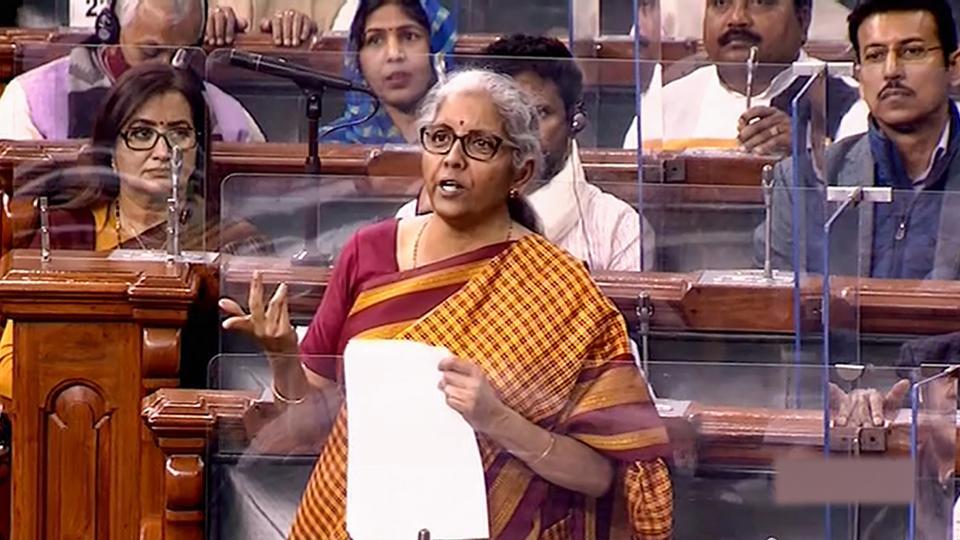
Starting her reply to the comments and questions raised during the Budget debate in the Lok Sabha, she said the Congress regime was the “andh kaal” [dark age] because of rampant corruption, scams, middlemen, double-digit inflation, and policy paralysis. Sitharaman was referring to the Opposition’s remarks at the beginning of the debate calling “Azadi ka Amrit Kaal” [the 25-year lead-up to India at 100] in her Budget speech as “andh kaal”.
Giving an account of the Modi government’s financial inclusion programmes, schemes for basic amenities, and direct cash transfers to the farmers and the poor, the minister said this was certainly “amrit kaal”.
She said the financial crisis because of the Covid-19 pandemic that hit India in March 2020 was a global phenomenon, and compared it with the financial crisis of 2008 that also hit the Indian economy adversely during UPA rule. While that crisis led to a sharp fall in gross domestic product (GDP) to the tune of ₹2.21 lakh crore in 2008-09, the growth rate did not slip into negative territory.
“But, what we saw because of the pandemic in 2020-21, which led to a contraction of 6.2%, was one of the worst ever that we could face and we were not alone in it… I just like to do a comparison between what was the economy then [2008 global financial crisis]… and what is the economy now… Compared to that, lost GDP now is ₹9.57 lakh crore, so that is the extent we had lost in this pandemic compared to recently, mean a decade ago global financial crisis,” Sitharaman said.
“Despite significant supply-side disruptions, India’s CPI inflation was 6.2% in 2020-21 as compared to 9.1% in 2008-09,” she said, adding that the government has contained consumer price inflation (CPI) well within the prescribed limit. She said the government is still making efforts to calm prices of essential commodities through various measures, including imports of items such as edible oil. The official prescribed limit for CPI inflation is 4% (plus/minus 2%).
Attacking the erstwhile Congress government for the Bali agreement at the World Trade Organization (WTO), Sitharaman said “They [had] sold away the right of procurement and MSP [minimum support price” in 2013 that could have a detrimental impact on food security of the country. The Narendra Modi government in 2015-16 reversed it so that the government’s food procurement programmes continue and it would be able to supply subsidised grains to the poor, she said.
Also Read | Cong, DMK & IUML walk out during Nirmala Sitharaman's reply in Lok Sabha
She blamed the Congress government for the sickness of state-run telecom firms BSNL and MTNL. “Revival of BSNL is thanks to Prime Minister Modi, and I will tell how,” she told the Lok Sabha. BSNL was formed in 2000 and there was an agreement at that time that the annual licence fee will be reimbursed till 2010, but in 2006, the UPA government stopped paying the reimbursement. “I’m telling gradually, why BSNL came to the verge of ICU [intensive care unit]… reason Congress,” she said.
“Second, …in 2010 MTNL was told suddenly, to pay as per the price determined through auction for broadband wireless access. Till then the MTNL, which was a cash-rich company, had to suddenly pay ₹11,000 crore, due to that overnight MTNL became a loss-making company,” she said. “Kill BSNL slowly, kill MTNL, it happened in 2010,” she added in Hindi.
She also accused the then government of postponing the February 2014 decision to give annual financial support. She said BSNL was harmed by delaying the tendering process for its 93 million line expansion plan in 2006, 2008, and 2010. She said the market share of BSNL shrank from 19% in 2005 to 7.96% “due to their non-cooperative measures”.
On the criticism that the government is overemphasising capital expenditure in the Budget at a time when it should boost consumption, Sitharaman said the return on ₹1 spent on revenue expenditure waas 45 paise, while ₹1 spent on infrastructure gets a return of ₹2.45 in the first year and ₹3.14 subsequently for two more years.
Justifying raising customs duty on umbrellas from 10% to 20%, she said it was done to protect domestic small and medium enterprises as India was flooded by “25 million umbrellas from one country”. While she did not mention the name of the country, according to officials, the said country is China which is dumping umbrellas in India.
During the Budget reply, Congress leader Adhir Chowdhury and other MPs made frequent protests and comments. Union minister Narendra Singh Tomar intervened and claimed that Chowdhury was getting instructions from outside and acting accordingly. “He is looking into his phone and then tries to speak every time,” Tomar said.
Earlier, during the debate, Chowdhury said the Air India sale will create a duopoly between the Tata Group and IndiGo. He also dubbed the target of 400 Vande Bharat trains as unrealistic and citing reports, said that while the Modi government had promised two crore jobs annually more than 12 crore people lost jobs since the pandemic began. Chowdhury hit out at high fuel prices and said the government has no road map as there is no road.