E-Paper



MP govt spends Rs 1.5 lakh to capture, relocate one Nilgai
The Madhya Pradesh government spent ₹1.5 lakh on an average to catch and relocate one Nilgai in December, 2016.

 Prefer HTon Google


The Madhya Pradesh government spent ₹1.5 lakh on an average to catch and relocate one Nilgai in December, 2016.
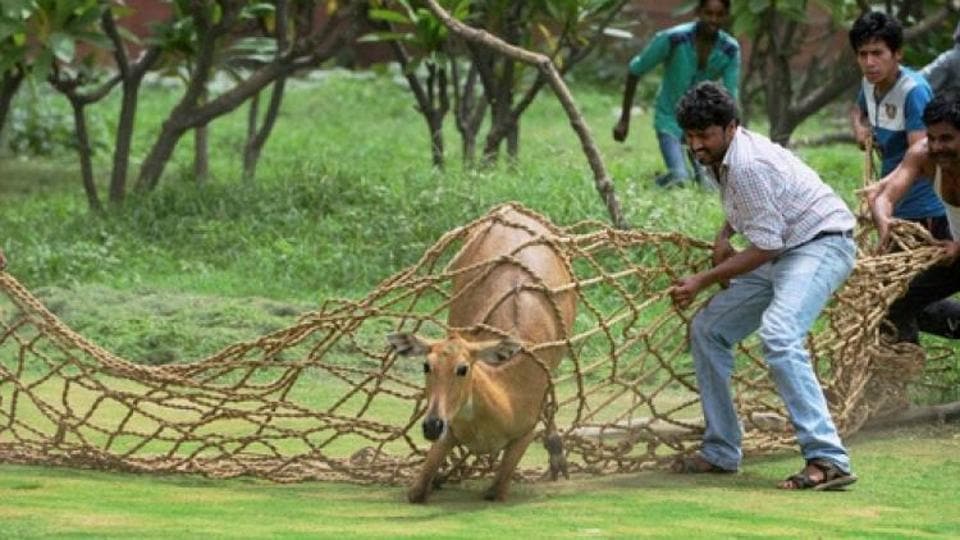
That month, the state’s forest department for the first time used Boma technique and a private helicopter to capture 27 Nilgais (blue bull) in Mandsaur district. They were later relocated to the forests of Gandhi Sagar Sanctuary in the same district.
Over 150 forest officers, 70 villagers, 30 horses and a helicopter were used in the entire exercise and ₹41.6 lakh was spent.
State forest minister Gaurishankar Shejwar gave the details of the cost incurred by the government in relocating Nilgais in a written reply to the assembly.
Shejwar stated ₹41,61,393 were spent in capturing the antelopes, adding that the helicopter was provided by a private party for ₹5,000 for the two-hour flight.
UK Sharma, divisional forest officer (DFO) Mandsaur told HT that they had to resort to a costly capturing method like the Boma technique (luring wild animals into an enclosure by chasing them through a funnel-like fencing) as the Nilgai dashes away the moment officials attempt to tranquillise and capture it.
“Nilgai is a very sturdy, heavy and fast antelope. When we try to capture it, it runs away and many a times breaks its leg. Also, there have been incidents when a running Nilgai has killed a person here and also damaged the vehicle of a politician,” he said.
Sharma said Boma technique reduced the chance of the animal or forest officer getting injured.
“Many states have tried to capture Nilgai to check crop damage, but they were not successful. Some states opted for culling, But we decided against it,” he said.
According to wildlife experts, Nilgai is endemic to the Indian subcontinent and has been categorised as Least Concern by the International Union for Conservation of Nature (IUCN).
In June last year, HT had reported that the MP government would attempt to capture Nilgai through a ‘trial and error method’, instead of culling them. Blue bulls have been damaging crops in the state . In 2015, farmers from Neemuch went on a hunger strike, demanding compensation for the damage caused to their crops by Nilgais.
WildLife (Protection) Act, 1972, has certain provisions which allow the Centre to move wild animals from Schedule II, III and IV category to the Schedule V category of the Act (vermin) for a certain period. Those animals that damage crops, kill livestock or are a threat to people by spreading diseases can be declared vermin, paving the way for their culling for a limited period.