
 E-Paper



PM Oli convenes special sitting to clear new map; India to cold-shoulder him
PM Oli has carried out a cartographic expansion to whip up ultra-nationalistic sentiments in Nepal.


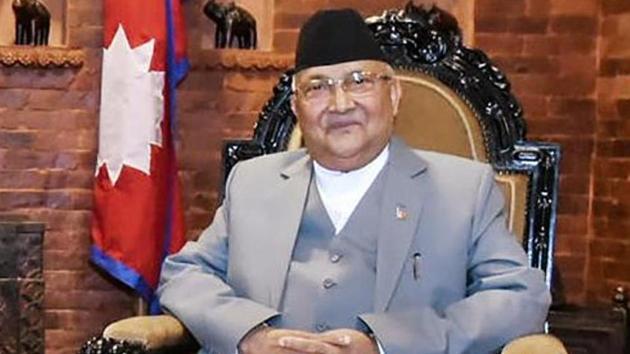
Nepal’s parliament will hold a special meeting on Saturday to complete voting on a new political map that redraws its border with India. Prime Minister KP Sharma Oli’s push to get parliament to hold a special sitting on a public holiday - Saturday is the weekly public holiday in Nepal - is seen as an effort to signal his determination to escalate the boundary row with India.
The new map shows Limpiyadhura, Lipulekh and Kalapani - a sliver of land counted as part of India’s Uttarakhand in the older maps - to be in northwestern Nepal.
Nepal’s lower house had backed the constitution amendment bill that formalises the new map on Tuesday this week. But before lawmakers can vote on the bill, parliamentary procedures require the legislature to give 72 hours to allow any MP to move an amendment. No amendments have been proposed so far, people familiar with the development in Kathmandu told Hindustan Times.
The 72-hour period ends on Friday evening.
An India official said the fact that PM Oli did not wait for parliament’s next working day to take up the legislation on the new map speaks volumes about his intentions.
Also read | In Nepal’s map tactics, a reflection of China’s growing footprint in Kathmandu
PM Oli, who has been facing pressure from his rivals within the ruling party, came up with the surprise move last month within 10 days of India formally opening a road to Lipulekh Pass for Kailash Mansarovar pilgrims.
In Delhi and Kathmandu, the new map has been seen as an attempt by the Communist Party of Nepal leader to consolidate public support behind him and whip up ultra-nationalistic sentiments.
The announcement, which came around the same time that a standoff between India and China was at its peak, is also seen to have the blessings of Beijing’s communist party.
In April this year when PM Oli had issued two ordinances to amend the anti-defection law to blunt a political offensive launched by his detractors, China got him to scrap the changes within five days. Chinese president Xi Jinping’s emissaries told PM Oli that he should not allow the communist party to be split over their differences.
India has described PM Oli’s map as a “unilateral act” that was not based on historical facts or evidence and asked Kathmandu to “refrain from such unjustified cartographic assertion” for an “artificial enlargement of territorial claims”.
To be sure, Prime Minister Oli told lawmakers on Wednesday that he had sought talks to resolve the dispute with India.
“We have told (them) that we want to resolve this through diplomatic talks ... And the solution is that our land should be returned to us,” Oli said in parliament on Wednesday. He also deplored Uttar Pradesh Chief Minister Yogi Adityanath’s comment that asked Nepal to think through the long-term consequences of its decision and asked Kathmandu to remember what happened to Tibet.
Indian officials have also told Hindustan Times that New Delhi had taken note of the developments around the map and stressed that parliamentary approval would seal any possibility of dialogue between the two sides on the “dispute manufactured by Kathmandu”.
But do not expect many harsh statements from the government, one of them said, suggesting that New Delhi was more likely to go for the silent treatment as far as the Nepal leadership is concerned but keep its focus on cementing ties with the people of Nepal.
That approach was on display in New Delhi on Thursday when external affairs ministry spokesperson Anurag Srivastava was asked about the developments around the map. Srivastava spoke about friendly relations between the two countries and India’s cooperation via-a-vis Covid-19. But on the map, he refused to say much except to stress that New Delhi had already made its position clear.


