E-Paper



New equations, change of guard in BTC 17 years after its formation
The UPPL and the BJP, which have joined hands, ended the domination of the Bodoland Peoples’ Party and its president Hagrama Mohilary, who was in power in Bodoland Territorial Council for 17 years since its inception in 2003.

 Prefer HTon Google


Student leader-turned-politician Pramod Boro took charge as the chief executive member of Bodoland Territorial Council (BTC) in Assam on Tuesday, three days after the declaration of results of election to the council that administers four districts in the state.
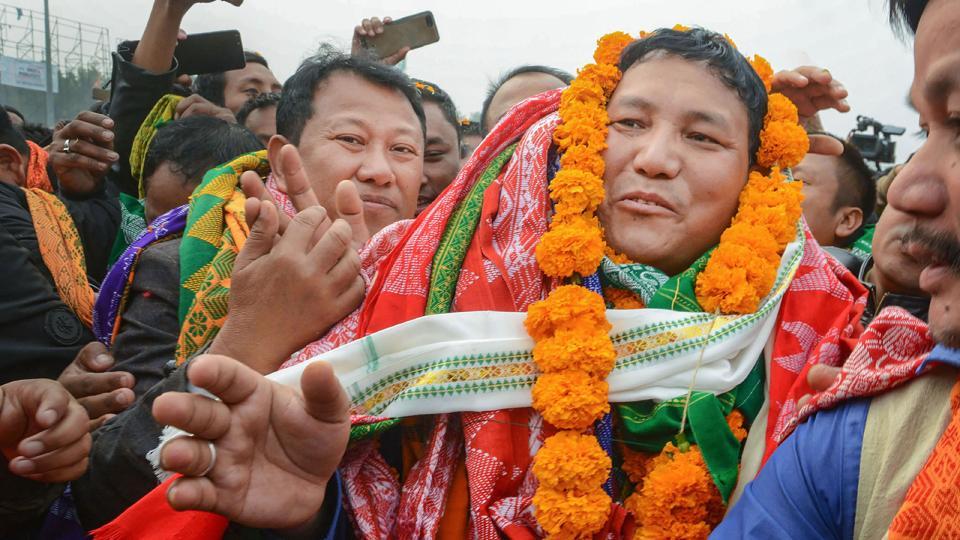
The 45-year- old leader of the United People’s Party Liberal (UPPL), who was heading All Bodo Students Union (ABSU) till few months back, was administered oath of office and secrecy by Assam chief secretary Jishnu Barua in the presence of chief minister Sarbananda Sonowal and other dignitaries in Kokrajhar.
“Our government is here not for power, but to solve all issues pertaining to Bodoland Territorial Region (BTR). Let’s forget the past and look ahead to a peaceful and developed BTR where everyone has equal rights,” Boro said in his inaugural address after swearing in.
It has been a sharp rise to power for Boro, who quit the ABSU and joined the UPPL in February this year. He was made the party’s president soon after. He steered the party to secure win in 12 of the total 40 seats and joined hands with the Bharatiya Janata Party (10) and the Gana Surakha Party (1) to assume power in BTC.
On Tuesday, along with Boro, four other executive members of the council -- one from UPPL, two from the BJP and one from GSP -- took oath.
The UPPL and the BJP’s rise has come at the cost of Bodoland Peoples’ Party (BPF) and its president Hagrama Mohilary, who was in power in BTC for 17 years since its inception in 2003.
The BPF secured 17 seats in the BTC polls, but it failed to cobble together a majority due to souring of relations with the BJP., though the two parties are partners in the state government.
Mohilary, a rebel-turned-politician, had come to power in BTC after the second Bodo Accord, signed by Bodo Liberation Tigers (which Mohilary headed) with the Centre and state government in 2003.
The accord had paved way for creation of the BTC, after the first one signed in 1993 with the aim of ending the movement for a separate Bodoland state had failed.
And now, Boro came to power after the third Bodo Accord in January this year, which he had signed as president of ABSU along with leaders of four factions of the National Democratic Front of Bodoland and the United Bodo Peoples’ Organisation (UBPO).
Unlike Mohilary, Boro had been not been associated with any rebel outfit. But his deputy Govinda Chandra Basumatary, the vice president of UPPL, has a violent past. The former head of NDFB (Progressive) was also a signatory to the third Bodo Accord.
With assembly election in the state due in March-April next year, the BJP aims to further consolidate and increase its hold in BTC administered areas.
In his address, CM Sonowal congratulated BJP workers for the win in BTC and indicated that the new tie-up with UPPL and GSP will continue in the assembly polls as well. Education and finance minister Himanta Biswa Saram announced setting up of 40 new colleges, 40 stadiums and a medical college in the area soon.