
 E-Paper



New satellite imagery suggests China developing missile bases to cover Doklam, Naku La
The Indian side has been “noted running regular intelligence and reconnaissance missions in this sector” during the current standoff with various platforms such as the Boeing P-8 Poseidon surveillance aircraft, @detresfa added.

 Prefer HTon Google


Open source satellite imagery suggests China is developing two new air defence positions that cover sensitive stretches of the disputed border in the Doklam and Sikkim sectors, including an area where Indian and Chinese troops had clashed in May.
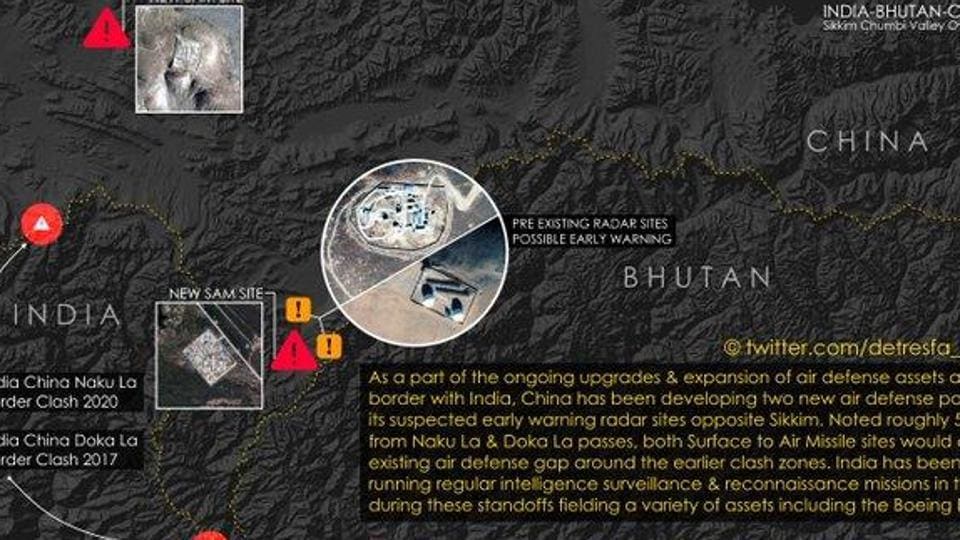
The satellite imagery, shared by the open source intelligence analyst who uses the name @detresfa on Twitter, show what appear to be two sites at which the People’s Liberation Army (PLA) is developing surface-to-air missile facilities. Both these sites are near what have been described as “suspected early warning radar sites” opposite Sikkim state.
Experts said the location of missile air defence facilities close to radar installations would help the Chinese side to pick out possible targets with greater accuracy.
ALSO READ | New satellite imagery suggests China is building military infrastructure opposite Lipulekh
In a graphic posted on Twitter, @detresfa said the new missile facilities were apparently part of China’s “ongoing upgrades and expansion of air defence assets along its border with India”.
The new missile facilities are located roughly 50 km away from Doka La (Doka pass), close to the Doklam plateau that was the scene of a 73-day military standoff between India and China in 2017, and Naku La (Naku pass), where troops from the two countries had clashed on May 9. Four Indian and seven Chinese soldiers were injured in this clash, the second such reported incident since the current standoff began in early May.
The two surface-to-air missile sites would “close the existing air defence gap around the earlier clash zones” for the Chinese, @detresfa said.
The Indian side has been “noted running regular intelligence and reconnaissance missions in this sector” during the current standoff with various platforms such as the Boeing P-8 Poseidon surveillance aircraft, @detresfa added.
According to the graphic posted on Twitter, one missile site is located at the tri-junction of the borders of India, Bhutan and China, while the other is located in Chinese territory opposite Sikkim.
There was no immediate reaction from Indian officials to the reported development of missile sites by the Chinese.
Even after the end of the Doklam standoff in 2017 after several rounds of negotiations, there were reports that the Chinese side had not fully pulled back its troops in the area. There have also been several reports of Chinese troops building trenches, fortified positions and infrastructure to support operation by helicopters and aircraft in the area.
Last month, Hindustan Times had first reported that China had officially stated for the first time that it has a boundary dispute with Bhutan in the eastern sector, a development with significant implications for India as the region borders Arunachal Pradesh state, which is also claimed by Beijing.
Since this year’s standoff emerged in the open, there have been several reports of PLA beefing up its deployment all along the LAC, including in areas opposite India’s northeastern states.
Earlier this month, @detresfa had used open source satellite imagery to report that China had stepped up work on military infrastructure opposite Lipulekh region in Uttarakhand. The infrastructure included a surface-to-air missile site on the banks of Mansarovar Lake in Tibet.
The imagery showed what appeared to be two sites at which PLA is creating new infrastructure and accommodation. Both are not far from the Kalapani-Lipulekh region that is at the heart of a new border row between India and Nepal.
The mobilisation of a battalion by PLA near Lipulekh Pass, one of the locations outside of the Ladakh sector that have witnessed movement of Chinese troops in recent weeks, was first reported by Hindustan Times on August 2.
India has emphasised the need to speedily resolve “outstanding issues” related to the standoff after being unable to bridge differences with China on the disengagement and de-escalation process along the LAC in several round of diplomatic and military talks.


