
 E-Paper



No big income tax move, markets in red, spotlight on reforms: Key takeaways from Budget 2026
While the Budget 2026 presented by finance minister Nirmala Sitharaman saw no major income tax change, tax reforms were proposed for various sectors.

 Prefer HTon Google


An 81-minute long Budget speech of finance minister Nirmala Sitharaman saw no change in tax slabs but included major announcements that focused on three “kartavyas” or duties of the central government - accelerating and sustaining economic growth; fulfilling aspirations of the people; and the vision of ‘Sabka Sath, Sabka Vikas’.
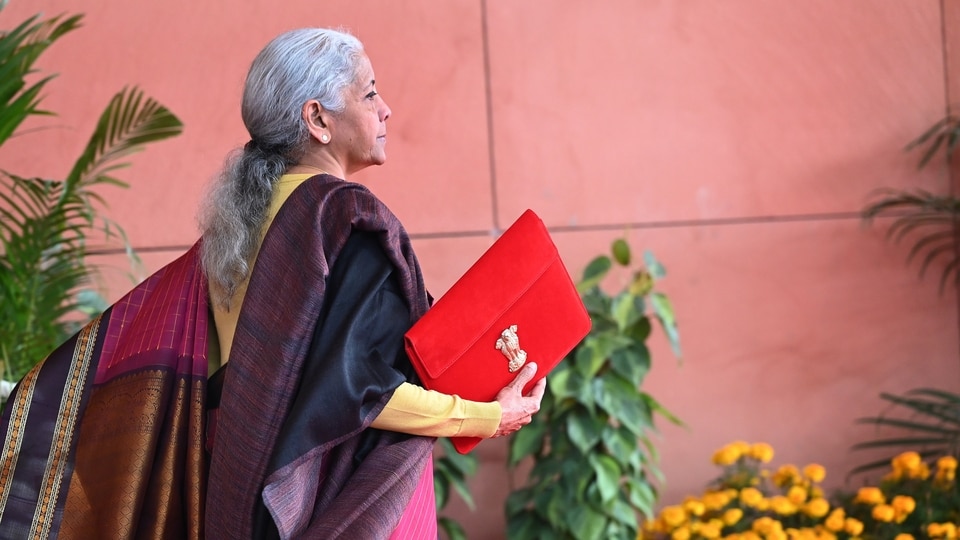
Among the major announcements was a move that made stock derivatives trading costlier - a call that crashed the stock market - a proposal allowing Individual Persons Resident Outside India (PROIs) to invest in equity instruments of listed Indian companies through the Portfolio Investment Scheme (PIS) and a massive spike in defence budget allocation.
10 takeaways from Budget 2026
-Budget speech duration: Finance minister's Budget speech - her ninth consecutive one - this year was around 81 minutes long. She laid out proposals reflecting “action over ambivalence, reform over rhetoric and people over populism” with the aim to transform aspiration into achievement and potential into performance. Check out all Budget highlights here
-Budget's ‘kartavya’: Sitharaman started the speech by saying that it is a “yuva shakti-driven Budget [youth power-driven] to focus on poor, underprivileged and disadvantaged. Government’s ‘sankalp’ or resolution through three "kartavyas” (duties) she said is to accelerate and sustain economic growth, fulfil aspirations of the people and intensify the vision of sabka sath, sabka vikas.
-A massive Defence allocation: In the Budget 2026, the first Union Budget after Operation Sindoor and India's military conflict with Pakistan last year, ₹2.19 lakh crore to the defence forces has been allocated for modernisation, an increase of about 22 per cent, with the defence ministry being given ₹7.8 lakh crore for the year 2026-27.
-Budget income tax 2026: While there was no change in income tax slabs, several proposals were laid out to boost tax reforms for manufacturing sector, service sector, financial sector, for increasing farmer’s income by enhancing productivity in agricultural and allied sector, and for ease of doing business and ease of living.
-Key proposals to boost tax reforms: Some of the many proposals for the above-mentioned tax reform boosts include - Permission for Individual Persons Resident Outside India (PROIs) to invest in equity instruments of listed Indian companies through the Portfolio Investment Scheme (PIS); exemption from income tax for five years to nonresidents providing capital goods, equipment or tooling, to any toll manufacturer in a bonded zone; exemption to global income of non-resident expert for a stay period of five years under notified schemes.
-Deadline for ITR revisions extended: Time available for revising income tax returns has also been extended from December 31 to up to March 31 with the payment of a nominal fee. Individuals with ITR 1 and ITR 2 returns will continue to file till July 31 and non-audit business cases or trusts are proposed to be allowed time till August 31.
-STT on Futures, Options trading hiked: Another major announcement among tax proposals for financial sector by Sitharaman was the raising of STT (Securities Transaction Tax) on Futures from 0.02 per cent to 0.05 per cent and the same on Options premium and exercise of options raised to 0.15 per cent from rate of 0.1 per cent and 0.125 per cent, respectively. This move, in simple terms, is set to make futures and options trades slightly more expensive. Market experts, cited in a PTI news agency report, believe that the move could help discourage excessive speculative activity and promote a more balanced market structure. However, some caution that it may weigh on foreign portfolio investor (FPI) participation in the near term.
-Stock market crash: Following the STTT hike announcement, the stock market crashed with Sensex plunged 2,370.36 points, or 2.88 per cent, to slip below the 80,000-mark to 79,899.42 during the afternoon trade. The 50-share NSE Nifty tanked 748.9 points, or 2.95 per cent, to 24,571.75. The market bounced back shortly after.
-High-speed rail corridors: Another major announcement was of seven high-speed rail corridors that will be developed to promote environmentally sustainable passenger transport and act as growth connectors. These corridors will be - Mumbai–Pune, Pune–Hyderabad, Hyderabad–Bengaluru, Hyderabad–Chennai, Chennai–Bengaluru, Delhi–Varanasi and Varanasi–Siliguri.
-Proposals announced for rationalisation of custom duties: In Marine, Leather, and Textiled products, the limit for duty-free imports of specified inputs used for processing seafood products for export, is to be increased from the current 1 per cent to 3 per cent of the FOB value. The duty-free imports of specified inputs, which is currently available for exports of leather or synthetic footwear will be allowed. To enhance the ease of living, the Sitharaman said that the tariff rate on all dutiable goods imported for personal use will be reduced from 20 per cent to 10 per cent. To provide relief to patients, particularly those suffering from cancer, the basic customs duty on 17 drugs or medicines will be exempted, she said.


