
 E-Paper



No immunity in bribery cases to MPs, MLAs: SC
Supreme Court reverses 1998 ruling, MPs and MLAs can't escape punishment for accepting bribes to vote or speak in House. PM Modi hails clean politics.

 Prefer HTon Google


A seven-judge bench of the Supreme Court on Monday reversed the court’s 1998 ruling that let lawmakers escape punishment for accepting bribes in exchange for voting or giving speeches on the floor of the House, holding that such actions cannot be shielded under the doctrine of parliamentary privilege.
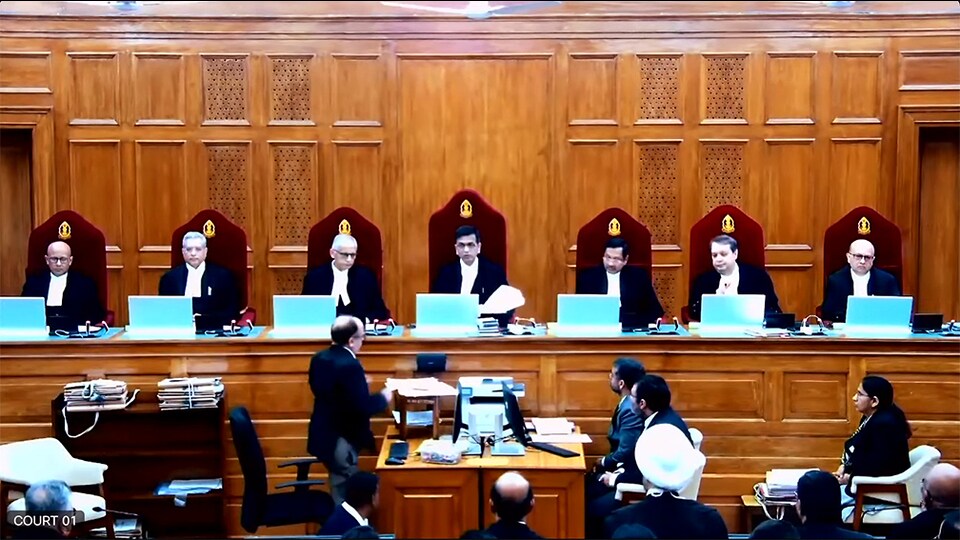
The bench, led by Chief Justice of India (CJI) Dhananjaya Y Chandrachud, declared that MPs and MLAs will not have immunity from prosecution for taking a bribe to make a speech or vote in Parliament and state legislatures, adding the rule will equally apply to elections to the Rajya Sabha and to the offices of President and Vice-President.
“The Houses of Parliament or legislatures, and the committees are not islands which act as enclaves shielding those inside from the application of ordinary laws. The lawmakers are subject to the same law that the law-making body enacts for the people it governs and claims to represent,” said the court.
The unanimous verdict by the bench, which also comprised justices AS Bopanna, MM Sundresh, PS Narasimha, JB Pardiwala, Sanjay Kumar and Manoj Misra, said that bribery is not protected by parliamentary privilege because these privileges are essentially related to the House collectively, and are necessary for its functioning.
“Corruption and bribery of members of the legislature erode the foundation of Indian parliamentary democracy. It is destructive of the aspiration and deliberative ideals of the Constitution and creates a polity which deprives citizens of a responsible, responsive and representative democracy,” held the court, overturning a five-judge bench decision by the top court in the 1998 PV Narasimha Rao case. CJI Chandrachud authored the 135-page judgment on behalf of the bench.
Prime Minister Narendra Modi welcomed the ruling. “SWAGATAM! A great judgment by the Supreme Court which will ensure clean politics and deepen people’s faith in the system,” he said in a post on X, formerly Twitter.
The verdict was also welcomed by the Congress, which said it was desirable to set right the law and should have been done earlier.
“It is a salutary, desirable, welcome judgement. It is something which sets right the law and it should have been done earlier,” Congress spokesperson Abhishek Singhvi said, adding that there is no need to go into the facts of the case, because this is not a judgment about the merits of whether anybody did receive a bribe or not.
Outlining the contours of the scope of parliamentary privilege under Articles 105 and 194, the Constitution bench held that the privileges and immunities enshrined in the Constitutional with respect to members of the Houses of Parliament and state legislatures belong to the House collectively. Article 105(2) lays down that no member of Parliament shall be liable to any proceedings in any court “in respect of” anything said, or any vote given by him in Parliament or any committee thereof. A corresponding provision giving immunity to members of state legislatures is contained under Article 194(2).
“The exercise of the privileges individually by members must be tested on the envelope of whether it is tethered to the healthy and essential functioning of the House...To give any privilege unconnected to the functioning of the Parliament or legislature by necessity is to create a class of citizens which enjoys unchecked exemption. From ordinary application of the law. This was neither the intention of the Constitution nor the goal of vesting Parliament and legislatures with powers privileges immunities,” said the bench.
The court underlined that a claim to immunity by a lawmaker accused of taking a bribe fails to fulfil the two-fold test: “That, the claim is tethered to the collective functioning of the House and that it is necessary to the discharge of the essential duties of a legislator...corruption and bribery have wide ramifications on public interest, probity in public life and parliamentary democracy.”
The bench added that bribery is “not rendered immune under Articles 105(2) and the corresponding provision of Article 194(2) because a member engaging in bribery commits a crime which is not essential to the casting of the vote or the ability to decide on how the vote should be cast”. The same principles that apply to bribery in connection with the speech in the House or a committee, it said.
According to the court, the jurisdiction exercised by a competing court to prosecute a criminal offence and the authority of the House to take action for a breach of discipline in relation to the acceptance of a bribe by member of the legislature exist in distinct spheres.
The bench pointed out that the 1998 judgment had resulted in “a paradoxical outcome” where a legislator was conferred with immunity if they accepted a bribe and followed through by voting in the agreed direction. “On the other hand, the legislator who agrees to accept the bribe but eventually decides to vote independently will be prosecuted. Such an interpretation is contrary to the text and purposes of Articles 105 and 194,” said the bench, adding letting the 1998 ruling stay would pose a “grave danger of this court allowing an error to be perpetuated”.
By inserting the immunity provisions, the court said, the Constitution sought to create a fearless atmosphere in which debate, deliberations and exchange of ideas can take place within the Houses of Parliament and the state legislatures and lawmakers, who have a right to speak before the House or any committee, must remain free from fear or favour induced into them by a third party.
“This is exactly what is taken away when a member is induced to vote in a certain way, not because of their belief opposition on an issue, but because of a bribe taken by the member,” emphasised the bench.
It also held that the elections for the President, Vice-President and to Rajya Sabha are also integral parts of the powers and responsibilities of elected members of the parliament and the state legislative assemblies and therefore, such elections cannot be pushed outside of the protection and principles of parliamentary privilege, as enunciated in the judgment.
“Further, the purpose of parliamentary privilege is to provide legislators with a platform to speak and vote without fear, which is equally applicable to elections to the Rajya Sabha and elections for the President and the Vice-President as well,” it said. In ruling so, the court rejected the Centre’s argument that polling to the Rajya Sabha is not protected by Article 194(2) since such an election does not form part of the legislative proceedings of the House.
On September 20, the top court had decided to have a relook at the 1998 judgment in the PV Narasimha Rao vs State (CBI) case after this judgment was relied upon by a former member of the Jharkhand assembly, Sita Soren of the Jharkhand Mukti Morcha (JMM), who allegedly accepted a bribe from an independent candidate for voting in the Rajya Sabha elections of 2012.
The judgment on Monday is set to revive the criminal case against Soren, a serving MLA in Jharkhand, as the top court disposed of her plea. The verdict may also impact the fate of Trinamool Congress (TMC) lawmaker Mahua Moitra, a first-time member who rose to prominence with her combative speeches in the House and was disqualified from the Lok Sabha in December over her “direct involvement” in cash-for-query charges and “unethical” conduct. Moitra was accused of having received cash and gifts from industrialist Darshan Hiranandani in exchange for parliament login credentials and asking certain questions as a “quid pro quo”. She has denied any such quid pro quo existed.
The 1998 decision by a five-judge bench, by 3-2 majority, held that MPs and MLAs accepting bribes and voting or asking questions in the House would enjoy immunity under the Constitution. This judgment, curiously, protected those lawmakers who vote or ask questions after receiving bribes, but it did not protect those who received bribes but did not keep their end of the bargain. This judgment came in the backdrop of the JMM bribery scandal that rocked the Congress government, headed by PV Narasimha Rao in 1993. The Narasimha Rao government allegedly bribed several parliamentarians across parties to defeat a no-confidence motion.
The seven-judge bench on October 5 last year reserved its verdict on the correctness of the 1998 ruling even as the Union government implored the bench to nullify the precedential value of the 1998 judgment while emphasising that any act of bribery outside legislative Houses are prosecutable under the Prevention of Corruption (PC) Act.
While making the request to declare the 25-year-old judgment “per incuriam” (rendered in ignorance of a statute), the Centre, represented through attorney general R Venkataramani and solicitor general Tushar Mehta, also proposed that an in-house committee, to be coined as “speech and vote watch”, could be a worthwhile alternative to the judicially mandated guidelines that the seven-judge Constitution bench may consider.
However, the bench, in its judgment on Monday, refrained from commenting on the proposed committee, pointing out that the purpose, consequences, and effect of the jurisdictions of the House and criminal law are separate. “A criminal trial differs from contempt of the House as it is fully dressed with procedural safeguards, rules of evidence and the principles of natural justice,” it said.
When the case was being argued in October, the Centre had also emphasised that the bench should limit its ruling to stating that the 1998 judgment should not be regarded as precedent, adding there was no need to delve into the larger issue of immunity granted to the lawmakers under Articles 105(2) and 194(2) of the Constitution.
But the bench on Monday held that the issue of bribery is not one of exclusivity of jurisdiction by the House over its bribe-taking members. “The purpose of a House acting against contempt by a member for receiving a bribe serves a purpose distinct from a criminal prosecution,” it maintained.



