
 E-Paper



No phone call between Modi and Trump during military actions, EAM Jaishankar tells Parliament
In Parliament, Jaishankar said PM Modi and US President Trump had no phone call during those key weeks and denied any trade-related links.


New Delhi : India’s military response to the Pahalgam terror attack has created a “new normal” for fighting cross-border terrorism emanating from Pakistan that includes confining bilateral talks to terrorism and not giving in to nuclear blackmail, external affairs minister S Jaishankar said on Monday.
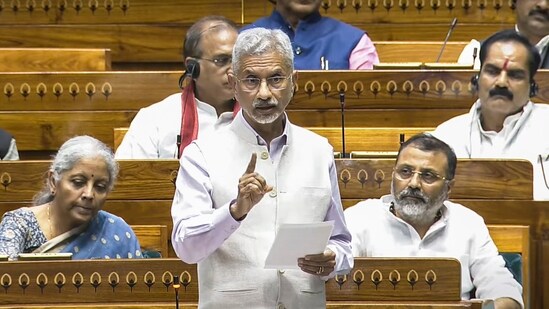
Participating in a special debate on Operation Sindoor in Parliament, Jaishankar said India’s new approach is based on a five-point approach, which makes it clear that “terror and good neighbourliness cannot co-exist [and] blood and water cannot flow together”. He said there was no phone call between Prime Minister Narendra Modi and US President Donald Trump during those crucial weeks and rejected any links to trade.
Also Read | ‘Outstanding’: PM Modi praises S Jaishankar's Operation Sindoor speech in Parliament
He also said other than Pakistan and three nations, most of the 193 United Nations members had backed India’s position and said the recent designation of the The Resistance Front –– which claimed responsibility for the April 22 Pahalgam attack –– as a global terrorist organisation came after the Centre’s efforts.
“The challenge of cross-border terrorism continues but Operation Sindoor marks a new phase. There is now a new normal. The new normal has five points. One, terrorists will not be treated as proxies. Two, cross-border terrorism will get an appropriate response. Three, terror and talks are not possible together. There will only be talks on terror,” Jaishankar said at the conclusion of his intervention in Lok Sabha. “Four, not yielding to nuclear blackmail. And finally, terror and good neighbourliness cannot coexist, blood and water cannot flow together. This is our position.”
Jaishankar, who spoke on the foreign policy dimension of India’s response to the Pahalgam attack, made it clear that the understanding to halt military actions on May 10 was reached by the Directors General of Military Operations of India and Pakistan – thereby implying that Trump had played no role in the matter. He said there was no contact between Modi and Trump between April 22, when the US leader called to condemn the Pahalgam attack, and June 17, when the two leaders spoke on phone after they were unable to meet on the margins of the G7 Summit in Canada. “I want to make two things very clear… One, at no stage in any conversation with the US was there any linkage with trade and what was going on. Secondly, there was no call between the Prime Minister and President Trump from April 22, when President Trump called up to convey his sympathy, and June 17, when he called up Prime Minister in Canada to explain why he could not meet [Modi], Jaishankar said.
Trump has claimed on more than 20 occasions that he brokered a “ceasefire” between India and Pakistan as they are nuclear-armed states.
While the military hostilities were on, a number of countries and leaders contacted the Indian side to ascertain the thinking in New Delhi. “To everybody, we gave a common message [that] India is exercising its right to defend itself against terrorism [and there] will be no mediation,” he said.
Though India announced a range of punitive measures against Pakistan a day after the Pahalgam attack, including keeping the Indus Waters Treaty of 1960 in abeyance and shutting down the only operational land border crossing at Attari, Jaishankar said India’s response could “not stop there”. He added, “Our red lines had been crossed and we had to make it very apparent that there would be serious consequences.”
Before launching Operation Sindoor, Jaishankar said, India began “shaping the global understanding” of the Pahalgam attack by highlighting to the world community Pakistan’s long-standing use of cross-border terror, and how the attack was “meant to target the economy of Jammu and Kashmir and to sow communal discord among the people of India”.
India faced a challenge in these efforts because Pakistan is currently a member of the UN Security Council. However, India worked to get an endorsement from the Security Council of the need for accountability and to bring to justice those who perpetrated the Pahalgam attack, he said. This came in the form of the council’s press statement of April 25, which condemned the attack and underlined the need to hold the perpetrators, organisers, financers and sponsors of the attack accountable.
The government’s efforts also led to the recent US designation of TRF as a global terrorist organisation, which came after the Pakistan government blocked any reference to the terror group at the UN Security Council.


