
Sign in

Not halting ops in Valley during Ramzan helps rein in militancy

Forces killed 23 militants during the period leading to a drop in terror attacks.

Updated on: Jun 2, 2019, 07:50:33 IST
Hindustan Times, New Delhi | By
Share
Share via
  • facebook
  • twitter
  • linkedin
  • whatsapp
Copy link
  • copy link

Ignoring the demand of Valley- based political parties to halt counterterror operations during Ramzan has reaped dividends. Security forces have neutralised 23 local and foreign militants in Kashmir during this period, taking the number killed in the counterterror drive to more than 100 in 2019. This also resulted in largely peaceful congregations in the Valley during Jamat-ul-Vida, the last Friday before Eid next week.
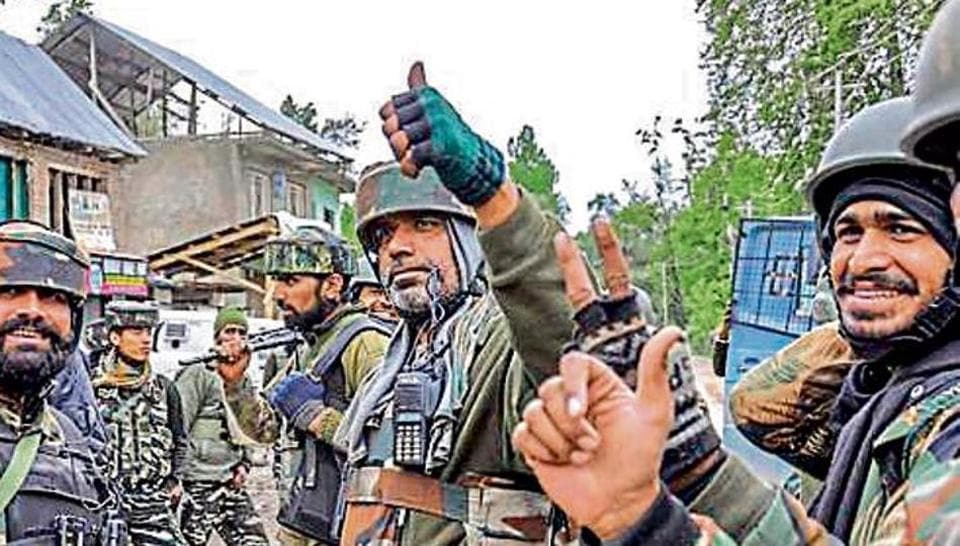
Army soldiers show the victory and thumb up sign near the house where Three top Hizb-ul-Mujahideen militant Commanders including Lateef Tiger (close associate of Burhan Wani) were hiding during an encounter, in which they were killed, at Adkhara Village in Imam Sahab area of South Kashmir’s Shopian district (PTI Photo)

Last year, due to the imposition of non-initiation of combat operations (NICO) in the Valley, only 11 militants were killed during the Ramzan month and that too on the Line of Control (LOC) in Kupwara and Handwara districts.

The Bharatiya Janata Party (BJP) pulled out of its coalition government with the People’s Democratic Party (PDP) on June 19, 2018, after the Eid-ul-Fitr festival, citing increased violence and radicalisation in the Valley.

Although PDP leader, Mehbooba Mufti, wanted the Centre to declare NICO during Ramzan this year, the Narendra Modi government ignored the call and turned up the heat on militants in the Kashmir Valley. Until Friday, 23 terrorists had been killed by the security forces in the Ramzan period, including Zakir Musa of Al Qaeda affiliate Ansar Ghazwat ul Hind. Others were gunned down in Shopian, Pulwama, Avantipora, Sopore, Kulgam and Anantnag areas of the Valley.

All the encounters were conducted on the basis of human intelligence that originated from the ground, according to senior home ministry officials.

While the security forces expect more encounters with local and foreign militants in June due to a rise in infiltration during summer months, the situation in the Valley has improved as militant numbers have gone down.

With no let-up in counterterror operations, security forces have ensured that foreign terrorists do not have a chance to regroup and plan during the Ramzan month.

Although Muslims largely keep the peace during the pious month, Pakistan-based terror groups use a different interpretation to launch attacks against India both in the state of Jammu and Kashmir and the hinterland.

The interpretation being that the crucial battle of Badr was fought by the Holy Prophet against the Quraish tribe of Mecca, which led to the rise of Islam in Saudi Arabia. Islamic radicalisers use this analogy to launch attacks against their enemies and hence some of the biggest terror attacks globally have taken place during the holy month.

  • Shishir Gupta
    ABOUT THE AUTHOR
    Shishir Gupta

    Shishir Gupta is Executive Editor at Hindustan Times and one of India's top journalists covering national security, strategic affairs, foreign policy and geopolitics. Over the past three decades, he has extensively reported on India's military, diplomatic and security landscape, covering every major conflict and national security challenge, from the 1999 Kargil War and the 2020 East Ladakh standoff to Operation Sindoor in 2025. He has also covered major terror attacks, including the IC-814 hijacking, the 26/11 Mumbai attacks and the 2025 Pahalgam terror strike, along with numerous Pakistan-backed terrorist incidents in the Kashmir Valley and across India. He has reported on national and state elections for more than three decades. A recognised authority on strategic affairs, Gupta has covered India's nuclear programme since the Pokhran-II (Shakti series) tests in May 1998 and has written extensively on global nuclear issues, Indian diplomacy and the country's expanding global outreach. He has also reported widely on international conflicts and terrorism, with a special focus on the Indian subcontinent. Gupta has interviewed Prime Minister Narendra Modi more than four times, including Modi's first interview with the print media after becoming Prime Minister in May 2014. His other interviews include three with the Dalai Lama, as well as conversations with Benjamin Netanyahu, Amit Shah, Yogi Adityanath, S. Jaishankar, Nirmala Sitharaman and Piyush Goyal. He is the author of Indian Mujahideen: The Enemy Within (Hachette, 2011) and Himalayan Face-off: Chinese Assertion and Indian Riposte (Hachette, 2014). He was awarded the Chevening-Wolfson Joint Scholarship at Wolfson College, University of Cambridge, UK, in 1998 and participated in the International Visitor Leadership Program (IVLP) of the US State Department in 2006. He received the Ben Gurion Prize from Israel in 2011 and the K. Subrahmanyam Prize for Strategic Studies in 2015 from the Manohar Parrikar Institute for Defence Studies and Analyses (MP-IDSA). Since 2024, he has hosted Point Blank, Hindustan Times' weekly YouTube show on global geopolitics.Read More

Get the latest India News, breaking headlines and real-time updates from across the country. Stay informed about politics, government policies, crime, weather and major national developments.