
 E-Paper



Vijayan, Stalin write to PM Modi objecting to proposed amendments in IAS rules
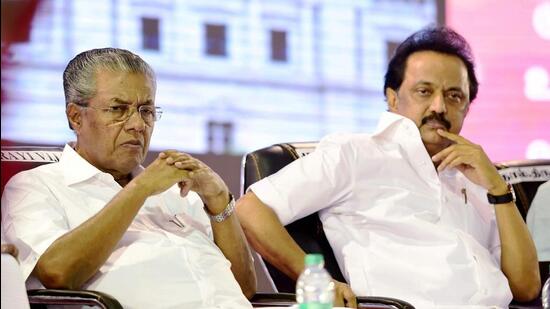
Tamil Nadu chief minister MK Stalin and his Kerala counterpart, Pinayari Vijayan, on Sunday urged Prime Minister Narendra Modi to drop the proposed amendments to IAS (Cadre) Rules,1954, saying the rules will “weaken the very root of co-operative federalism”.


Tamil Nadu chief minister MK Stalin and his Kerala counterpart, Pinayari Vijayan, on Sunday urged Prime Minister Narendra Modi to drop the proposed amendments to IAS (Cadre) Rules,1954, saying the rules will “weaken the very root of co-operative federalism”.
The chief ministers of Rajasthan, Maharashtra, Chhattisgarh, West Bengal and Jharkhand have in the past also opposed the proposed amendments which allows the Centre to summon any official (Indian Administrative Service, Indian Police Service and Indian Forest Service) for central deputation without the consent of the concerned state governments.
In his letter to Modi, Stalin said the amendments “strikes at the very root” of the nation’s federal polity and state autonomy,
“State governments are on the forefront of implementation of various programmes, including the schemes of the Union government at state level. The states also face frequent natural disasters which demand services of IAS officers in the state more than elsewhere,” he said.
“Under such circumstances, forcing the state governments to depute officers would surely aggravate the ‘governance deficit’ in various states due to shortage of officers and also it is an ‘affront’ to the administrative frame work of the states,” he added.
The Tamil Nadu chief minister also claimed that the proposed amendments “would cause irreparable damage to the spirit of cooperative federalism that exist between Union and the states and result in concentration of powers with the Union Government”.
Vijayan said the Centre’s move will create “fear psychosis” among civil service officials to implement the state government policies.
“The proposed amendments in the Deputation Rules of All India Services will definitely induce a fear psychosis and an attitude of hesitancy among All India Service Officers to implement policies of a state government, which are formed by party/parties politically opposed by the ruling party at the Centre,” he said in his letter to the Prime Minister.
“The present deputation rules are themselves heavily loaded in favour of the Union and bringing further stringency will weaken the very root of co-operative federalism. The government of Kerala is of the opinion that the proposed amendments may be dropped,” he added.
The Kerala chief minister said that in a federal setup, the state governments are on par with the central government because both are elected by the people, though the division of authority in the constitution gives the Centre jurisdiction over a wide range of subjects.
At least five states have written to the Union government against the proposed changes so far.
On Saturday, Jharkhand chief minister Hemant Soren had urged Modi to “bury” those proposals.
Likewise on January 21, Chhattisgarh chief minister Bhupesh Baghel wrote to Modi, saying the amendments were in “contrary to spirit of federalism enshrined in the Constitution of India”.
A day earlier, West Bengal chief minister Mamata Banerjee had told the Prime Minister that the amendment will “destroy” the federal polity and basic structure of the Constitution.
The chief ministers of the above states believe that amendments in the transfer rules would lead to shortage of staff even as Union government officials have claimed that the proposed changes would bridge the deficit gap between the central ministries and departments.
The present rules provide that an officer, after working with states for a certain period, be made available for central deputation with the consent of the state concerned.
If the Centre’s proposed amendments are implemented, the state’s consent will no longer be required in such matters.


