E-Paper



Number Theory: 3 variants of BJP’s 2024 alliance playbook
A careful analysis of the BJP’s 2024 tactics suggests a mix of absolute confidence, calculated risks, and extreme risk-aversion.
Published on: Mar 27, 2024, 09:02:21 IST


Share via


Copy link

The Bharatiya Janata Party (BJP) has thus far announced 405 candidates for the 2024 Lok Sabha elections. The party has also finalised almost all of its alliances by now. The BJP’s approach to the 2024 elections has many elements that are different from its 2019 playbook. It has tried getting new allies, broken ranks with some of its traditional partners, and patched up with some older allies. A careful analysis of the BJP’s 2024 tactics suggests a mix of absolute confidence, calculated risks, and extreme risk-aversion — all at the same time. This is best understood by looking at three states.
3 variants of the BJP's 2024 alliance playbook
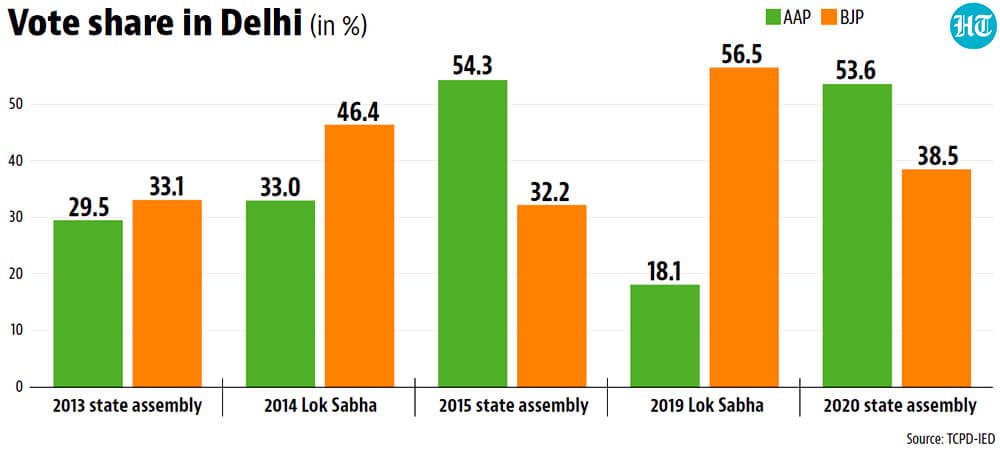
 BJP versus all in Delhi shows its extreme confidenceWhile the Aam Aadmi Party (AAP) and the Congress announced a seat-sharing deal in Delhi, the arrest of chief minister Arvind Kejriwal is a rare occasion that has united almost all constituents of the INDIA block against the BJP. While Kejriwal’s arrest, technically speaking, has been made by the Enforcement Directorate, there is good reason to believe that it is not a completely apolitical call. Does the BJP not fear a backlash against it after Kejriwal’s arrest in Delhi? One statistic that perhaps explains the BJP’s confidence is that a large part of AAP’s supporters have been voting for the BJP in national elections in any case. Also, the BJP’s vote share was comfortably above 50% in all seven parliamentary constituencies in Delhi in 2019. The BJP’s real test, as far as the backlash over Kejriwal’s arrest is concerned, will perhaps only come in the assembly elections in 2025. Of course, this tactic is based on the assumption that Kejriwal’s arrest will not antagonise the common voter base which has been moving between the BJP and AAP in national and state elections. A similar tactic has been deployed in Jharkhand, where chief minister Hemant Soren is in custody, as well.
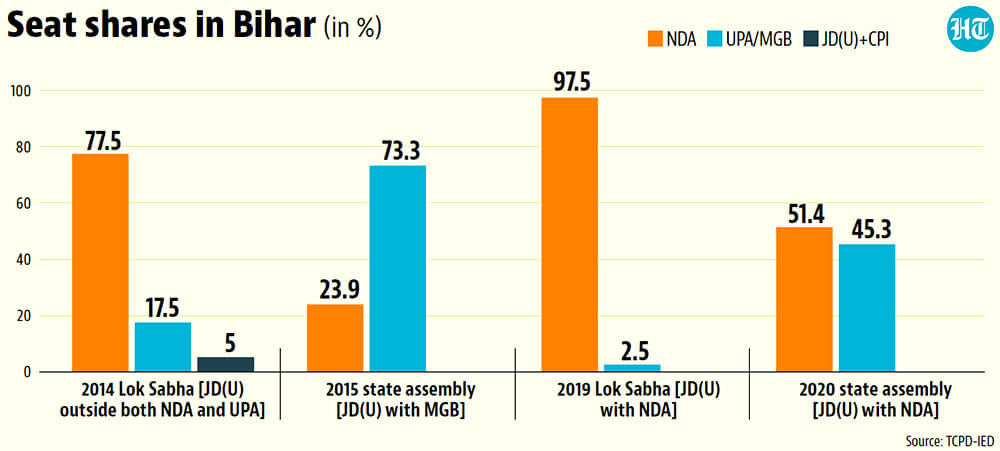
- Bihar shows the extremely risk-averse part of the BJP’s tacticsWhen Nitish Kumar’s Janata Dal (United), or JD (U), made its fourth somersault to rejoin the National Democratic Alliance (NDA) in Bihar in January 2024, the BJP’s rank and file in the state was not exactly thrilled. After all, the senior leadership of the BJP had gone on record many times after the JD(U) rejoined the Rashtriya Janata Dal (RJD) in 2022 to say that Kumar would not be reinducted into the NDA at any cost. With the BJP deciding to allocate 16 Lok Sabha seats to the JD (U) in Bihar, it is now clear that the JD(U)’s stature within the NDA remains unchanged despite it being a much smaller party in the assembly. Why is the BJP being so accommodative of the JD(U)? The answer perhaps lies in the 2015 assembly election results when the JD(U), RJD and the Congress pretty much decimated the BJP in the state. This was a very different result from when the BJP, RJD and the JD(U) fought in separate alliances in the 2014 Lok Sabha elections and the BJP swept the state. Had the BJP not accommodated the JD(U), the latter would have stayed with the RJD alliance rather than contest alone, risking a 2015 like loss for the BJP. While Bihar is an extreme case, elements of this strategy can also be seen in state such as Maharashtra (where the BJP has allies with factions of the Shiv Sena and Nationalist Congress Party) or even Uttar Pradesh (where it has accommodated a much smaller Rashtriya Lok Dal to contain any damage in the western part of the state) to prevent large consolidations behind the principal opposition party. It remains to be seen whether these ideology light alliances, especially in Bihar and Maharashtra, cause disunity and confusion within the NDA’s ranks.
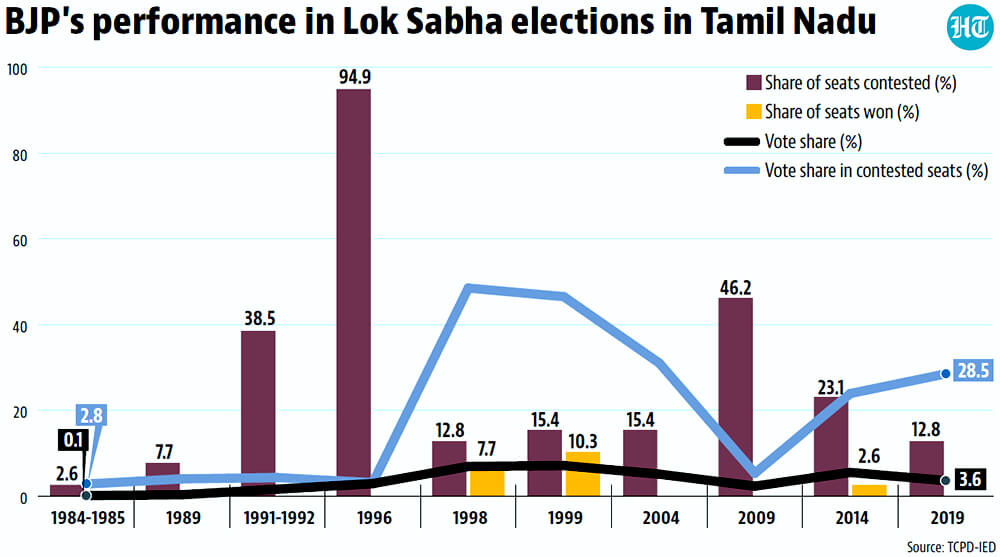
- Pursuing growth, not alliances, in low-reward statesTamil Nadu is the biggest example of this tactic. The BJP fought the 2019 and 2021 Lok Sabha and assembly elections in the state in an alliance with the All India Anna Dravida Munnetra Kazhagam (AIADMK), one of the two biggest Dravidian parties in the state. However, in both these elections, the Dravida Munnetra Kazhagam (DMK) alliance registered big victories. It is perhaps in this context that the BJP has decided to unleash a core and polarising ideological plank to increase its own vote share (even at the risk of low seat share) rather than preserve alliance with parties which are only willing to do business with the BJP if it does not assert its core agenda. The only factor which might have encouraged the BJP to take this gamble is that it expects its first and second tactical plans to work out very well to put it past the halfway mark in the Lok Sabha without states where the BJP still lacks a hegemonic status.