E-Paper



Number Theory: Tamil Nadu’s political landscape for 2024
.
Published on: Apr 3, 2024, 19:36:07 IST

 Prefer HTon Google
Share via


Copy link

With 39 MPs in the Lok Sabha, Tamil Nadu is the fifth-largest state in terms of number of parliamentary constituencies (PCs), after Uttar Pradesh, Maharashtra, West Bengal, and Bihar. In the 2019 elections, the Dravida Munnetra Kazhagam (DMK) led alliance won 38 out of the 39 PCs in the state. Will the 2024 elections see a similar result in Tamil Nadu? The political landscape in the state has changed significantly compared to what it was in 2019 and here are four charts that explain the nature of the contest in 2024.

Three-cornered contest in Tamil Nadu this time
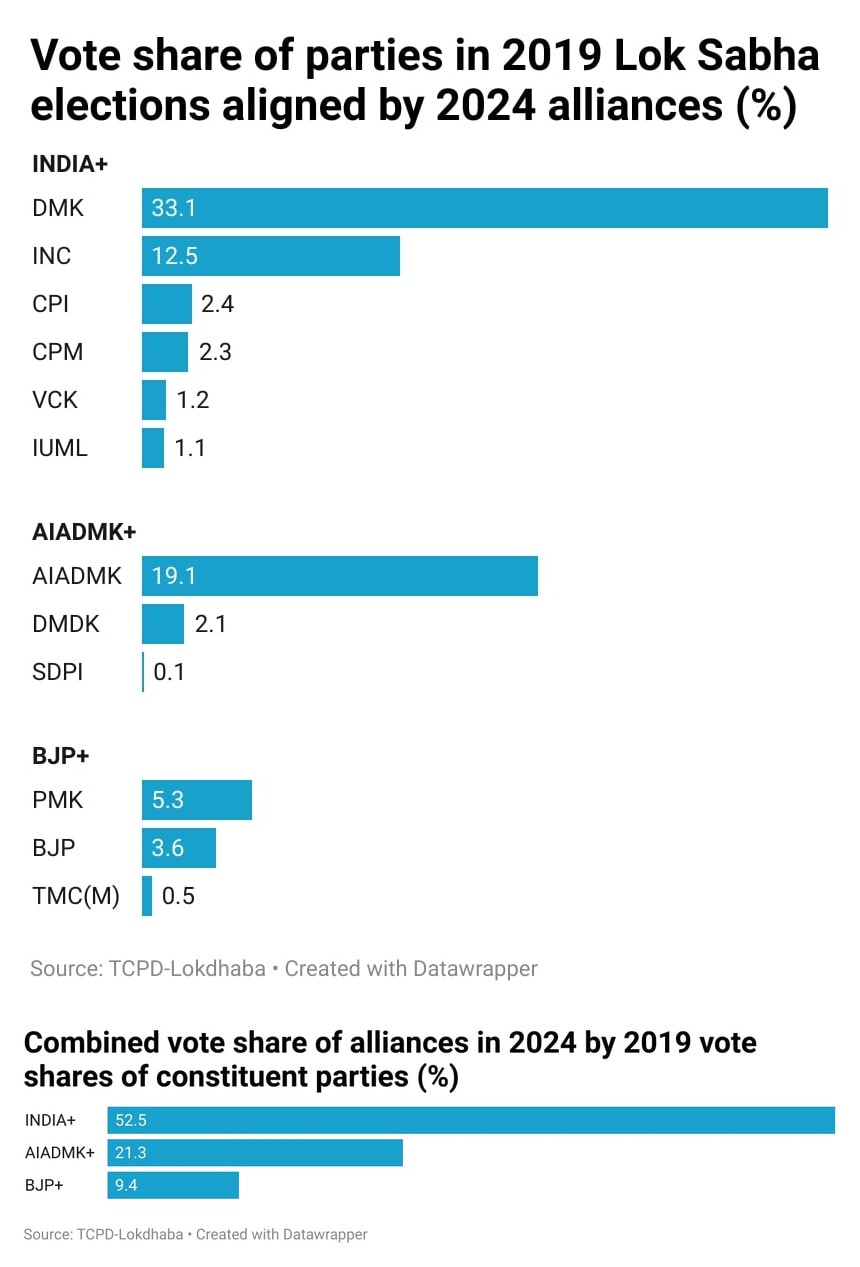
 Three-cornered contest in Tamil Nadu this timeThe Lok Sabha elections in Tamil Nadu have three main alliances this time. The DMK alliance comprises the Congress, the Communist Party of India (CPI), and the Communist Party of India (Marxist) known as CPI (M), Viduthalai Chiruthaikal Katchi (VCK), Marumalarchi Dravida Munnetra Kazhagam (MDMK), and Kongu Makkal Desiya Katchi (KMDK). The All India Anna Dravida Munnetra Kazhagam alliance includes the Desiya Murpokku Dravida Kazhagam (DMDK), Social Democratic Party of India (SDPI), and Puthiya Tamilagam Katchi (PTK). The third alliance, led by the Bharatiya Janata Party (BJP), includes Pattali Makkal Katchi (PMK), Tamil Manila Congress (M) (TMC(M)), and Amma Makkal Munnetra Kazhagam (AMMK). If one were to take the 2019 performance of these parties, the DMK-led alliance was clearly ahead in terms of vote share. Because the AIADMK and the BJP fought the 2019 polls together and are now contesting as separate blocks, the aggregate vote shares of different parties in the AIADMK and the BJP alliance should be read with caution.
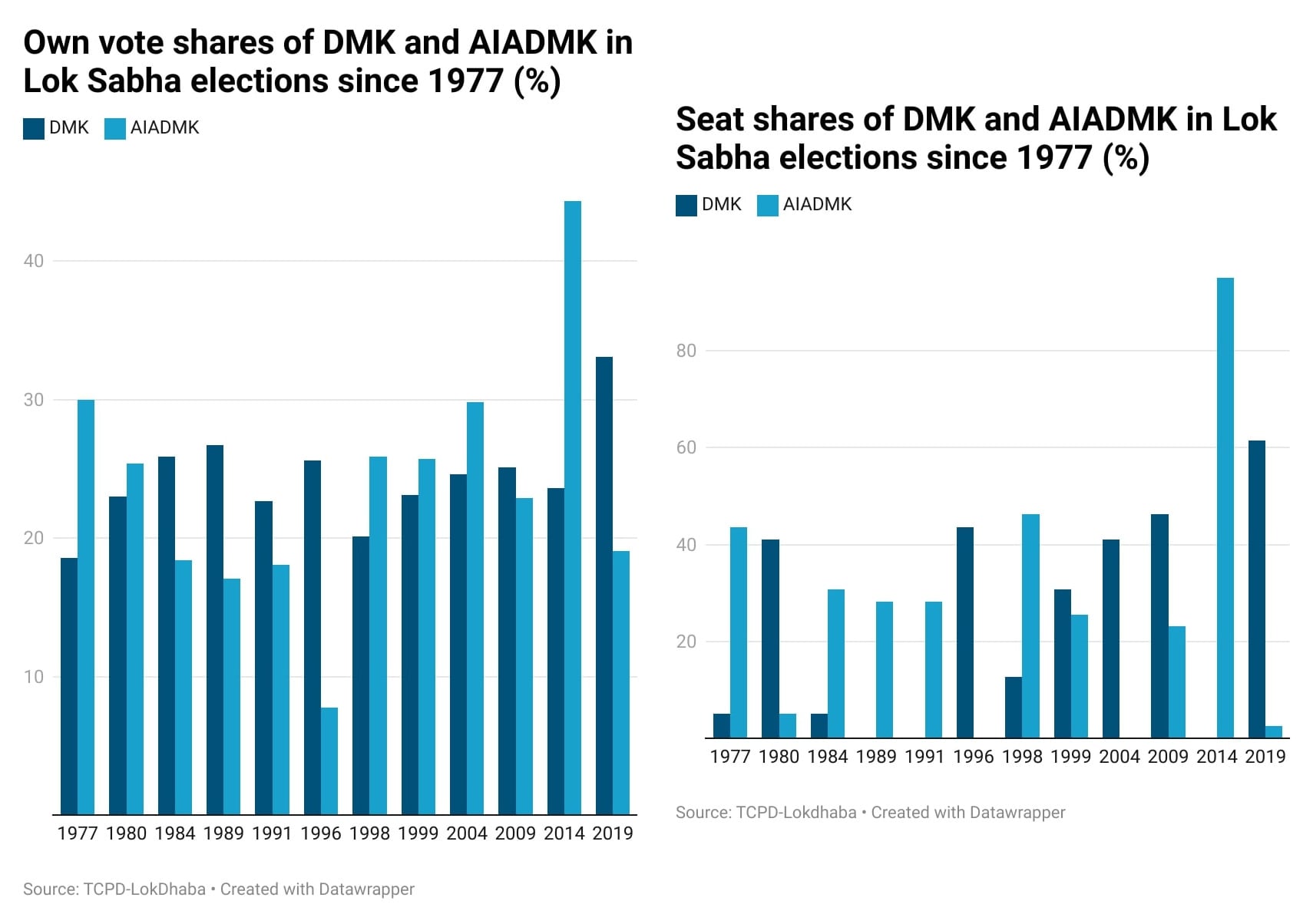
- So far, Tamil Nadu’s politics has essentially been a contest between the DMK and the AIADMKThe two Dravidian parties secured a combined seat share of above 40% in almost all Lok Sabha elections since 1996 and it is only an alliance led by either of them that has succeeded in the State. The AIADMK suffered a disruption after the death of its supremo Jayalalitha. It secured a vote share of 19% in the 2019 Lok Sabha elections, the lowest since 1996 when the party won just 7.8% of the votes. The DMK surged ahead, as its vote share crossed 30% for the first time in its history, touching 33% in 2019. The party also won all 20 seats it contested. The AIADMK won just 1 (of 20 contested), down from the 37 it won (of the 39 contested) in 2014. This means the upcoming election will be crucial for the AIADMK’s future, at least in terms of parliamentary elections.
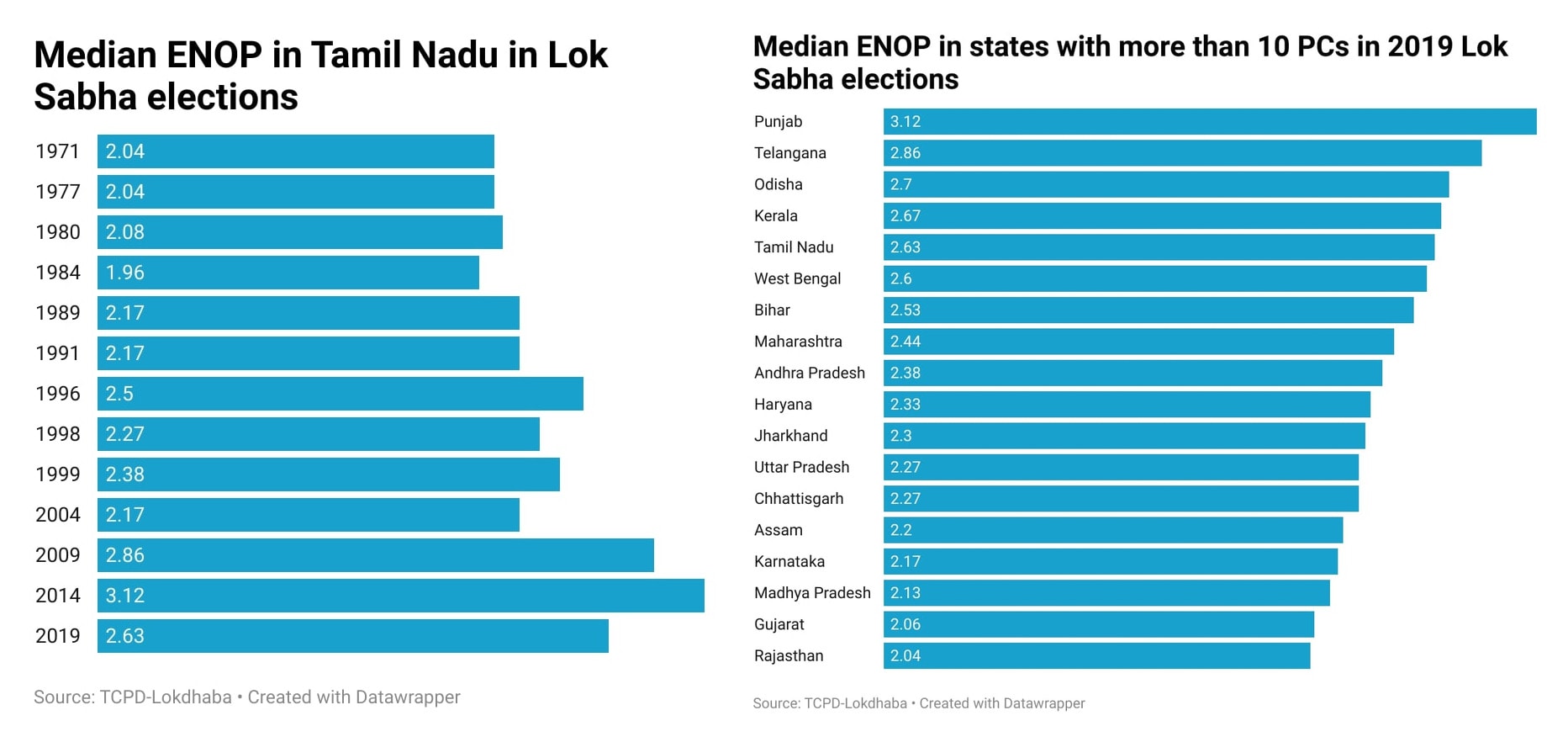
- To be sure, two-party dominance did not mean elections were bipolar in Tamil NaduElectoral politics in Tamil Nadu has become more competitive since the 1970s. This can be gathered from the increasing median Effective Number of Parties across the constituencies in the state, particularly since the 2009 Lok Sabha election. The Effective Number of Parties measures the adjusted number of parties in a state or constituency. It is measured as the reciprocal of the sum of the squared vote shares of all parties contesting in an election. The median ENOP of Tamil Nadu was 2.63, higher than most states with more than 10 PCs. This number was just 2.04 for Tamil Nadu in the two Lok Sabha elections held in the 1970s. For the past three elections, the median ENOP has been on the higher side. The number was 2.86 in 2009 and 3.12 in 2014. This shows that a two-party domination does not necessarily mean a bi-polar election; indeed, Tamil Nadu ranks fifth in the list of states with more than 10 PCs in terms of median ENOP in 2019.
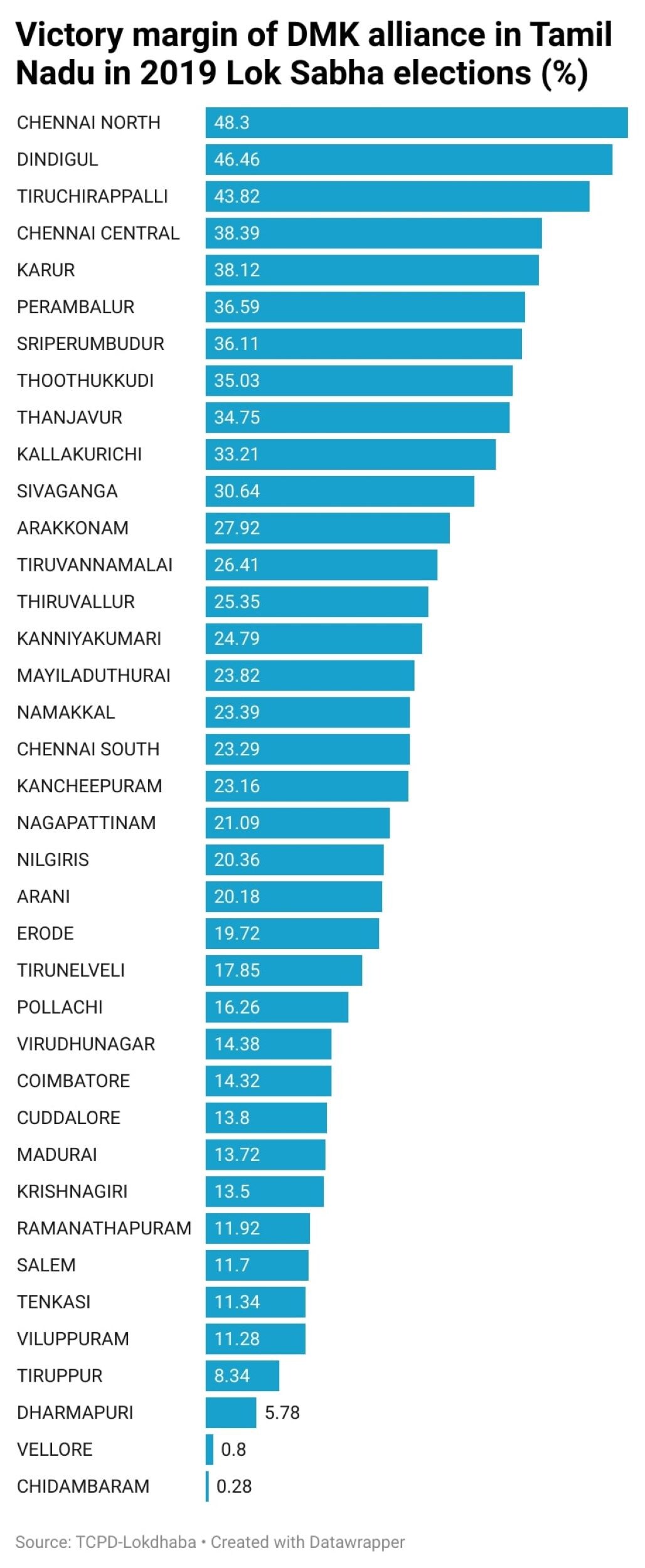
- What will it take to defeat the DMK?The fact that the AIADMK and the BJP are fighting the elections separately rather than in an alliance could mean that the DMK-led alliance could gain by a fragmentation of votes. Still, it is useful to look at the margin of the DMK alliance’s victories in the 2019 elections. An analysis of the 2019 results shows that of the 38 PCs that the DMK alliance won in 2019, its victory margin was more than 20% of the votes polled in 22 PCs. In another 12 PCs, its victory margin was between 10% and 20%. These numbers suggest that unless there is a major shift of voters away from the DMK alliance, it will be difficult to defeat it in most PCs in Tamil Nadu.