E-Paper



Number Theory: Textiles, an under-utilised engine of India’s manufacturing push
The Annual Survey of Industries (ASI) data is the official source of statistics on India’s registered manufacturing units
Updated on: Mar 12, 2024, 09:01:15 IST

 Prefer HTon Google
Share via


Copy link

The Consortium of Textile Export Promotion Councils (EPCs) recently organised Bharat Tex, one of the largest ever expo on textiles held in India. The event, organised with the aim of promoting India’s textiles prowess and fostering collaborations in the sector, comes against the backdrop of the sector becoming relatively stagnant in India’s manufacturing universe. Understanding the reasons for this decline and correcting it is key in making manufacturing an engine of India’s employment growth. Here are five charts which explain this in detail.
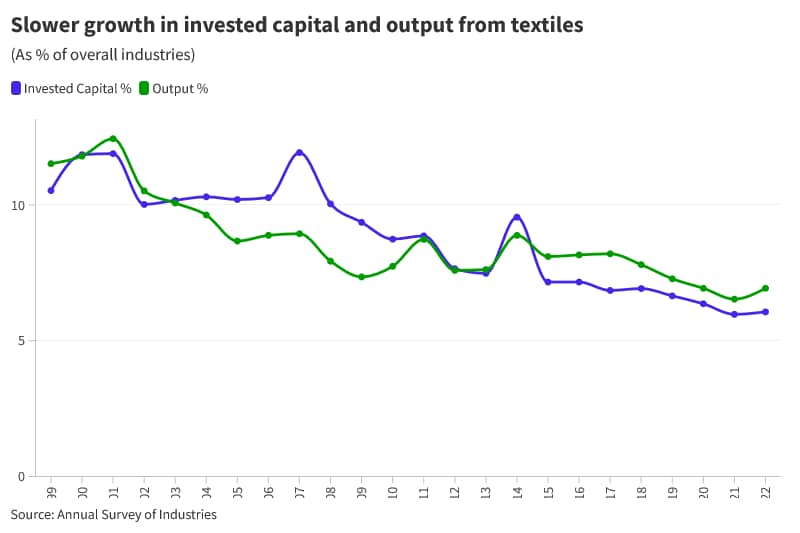
 Textiles have lost their importance in manufacturingThe Annual Survey of Industries (ASI) data – it is the official source of statistics on India’s registered manufacturing units – shows this clearly. The share of total invested capital, i.e. the sum of fixed and physical working capital, in the textiles sector had a share of 11.8 percent in the ASI dataset in 2000-01. This has gone down to just 6.06 percent as of 2021-22, the latest year for which data is available. Textiles here includes all textile and apparel industries, and cotton preprocessing. Along with the fall in share of capital invested, there has also been stagnation in the share of textiles in total industrial output. The sector accounted for 12.44 percent of the total output recorded by ASI in 2000-01. However, by 2021-22, its share in output had fallen to just 6.93 percent.
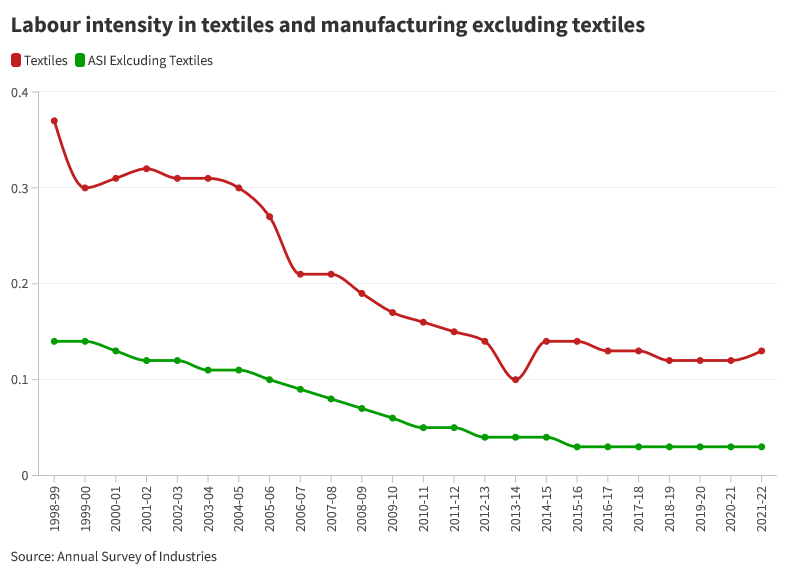
- Why is the textiles sector important?The key problem with manufacturing as a source of employment generation is that parts of it are increasingly becoming very capital intensive and employ very few people. However, the sector can still generate a lot of employment. Labour intensity – as measured by number of workers employed per lakh rupees of fixed capital stock – in the textiles sector was 0.13 in 2021-22. This number was 0.03 for the ASI universe after excluding textiles. To be sure, textiles have become less labour intensive over time, but they are still better creators of employment per unit capital than most other manufacturing.
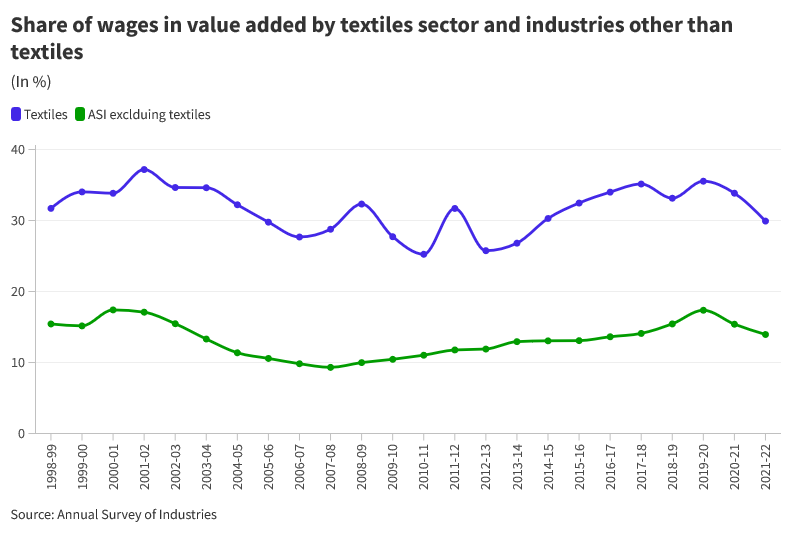
- A lower capital intensity also means higher rewards for workersThe share of wages to workers in the total net value added by the sector has also been higher for textiles than overall industries. In 2021-22, wages as a share of net value added stood nominally at 29.92% for textiles, while for industries excluding textiles, it was only at 13.95%.
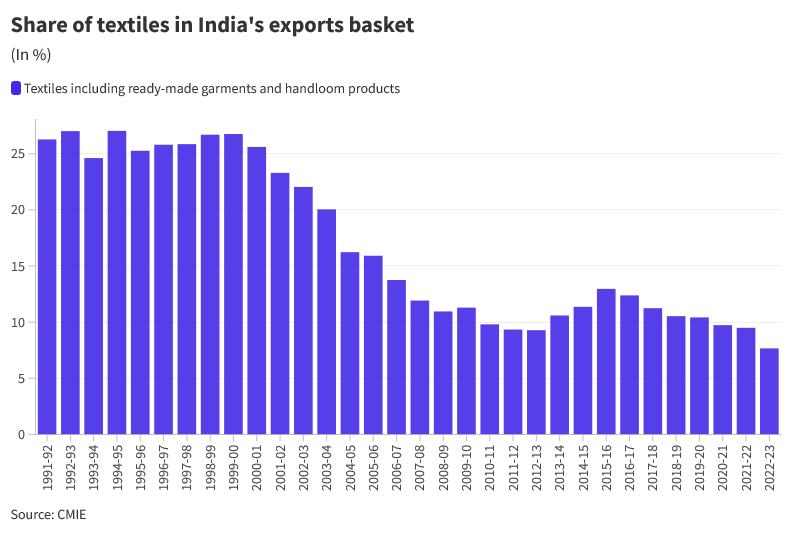
- Why did textiles lose its sheen?If textiles are so good for the economy, why has the sector lost momentum ? The reason is to be found in both domestic and international markets. The 2020-21 Economic Survey discussed a part of the problem when it highlighted that most of India’s manufacturing exports were capital rather than labour-intensive in nature, unlike countries such as Bangladesh, which had gained a much bigger advantage in labour-intensive exports such as textiles. Data shows this clearly. The share of textiles including ready-made garments in India’s exports basket has seen a decline in the last two decades from 25.6% in 2000-01 to just 7.66% in 2022-23.
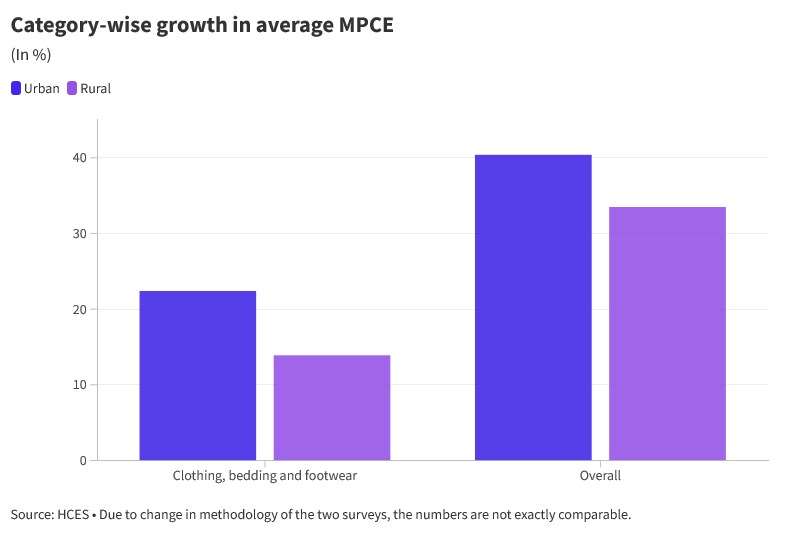
- Slow growth in domestic demandTo be sure, exports are only a part of the story behind the loss of momentum in India’s textiles story. An argument can be made that part of the reason for slow growth in India’s textiles sector is also the slow growth in incomes of those at the bottom of the pyramid in the Indian economy. A comparison of average monthly per capita expenditure (MPCE) from the 2011-12 and the 2022-23 Consumption Expenditure Surveys (HCES) shows that spending on the clothing segment has seen among the slowest growths during this period.