E-Paper



Number Theory: The voter turnout story so far
.
Published on: May 8, 2024, 18:54:46 IST


Share via


Copy link

The Election Commission of India (ECI), on May 7, published the number of registered voters for the parliamentary constituencies (PCs) which have already voted. While the number of electors for phase three was published on the day of the polling, the number of registered voters for the first and second phases was published with a significant delay. These numbers allow us to answer all questions on voter turnout in the 2024 Lok Sabha elections with much more clarity than was possible earlier. Here is what we know about voter turnout in the 2024 elections.

Is the overall turnout so far lower than what it was in 2019?
 Is the overall turnout so far lower than what it was in 2019?The short answer is yes. Elections are over for 283 parliamentary constituencies (PCs) so far. In Gujarat’s Surat, there was no polling because the BJP candidate was elected unopposed. The turnout figures in two PCs in Jammu and Kashmir cannot be compared with 2019 because delimitation has led to a change in constituency boundaries. While Assam has also undergone delimitation rendering PC-wise comparisons impossible, it is possible to compare the state-level turnout for 2019 and 2024 as elections are over in the state. In the 280 PCs for which comparisons can be made with 2019, the voter turnout in the 2024 elections is 65.75% which is around three percentage points less than the 68.84% number for 2019. At the PC level, voter turnout has fallen in 213 out of the 266 constituencies (all 14 PCs in Assam have to be excluded here) for which comparisons can be made; 174 of these 213 PCs have registered a decline of more than two percentage points; 78 of more than five percentage points; and seven of more than 10 percentage points. The phase 3 turnout data was taken from ECI’s Voter Turnout App at 11:30am on May 8 and can increase by a few percentage points as is usually the case.
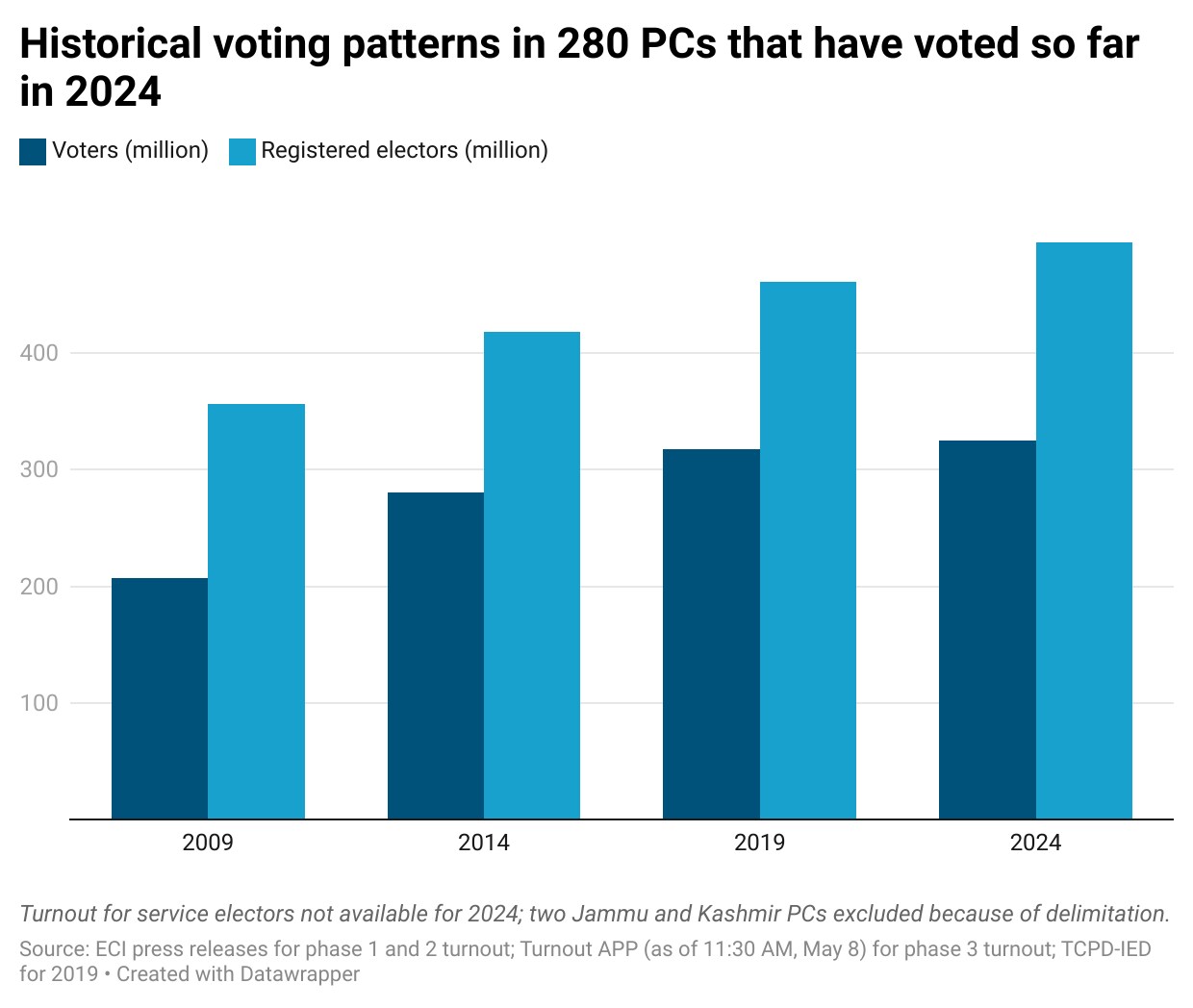
- Does a lower voter turnout mean the total number of voters fell in absolute terms?This is the question which could not be answered earlier because of no data on the number of registered voters at the constituency level. Now that ECI has published this data there is no such constraint: 324.8 million of 494 million registered electors have voted in the 280 PCs for which comparison can be made with 2019. The absolute turnout in these PCs is 2.4% more than the 317.1 million turnout figure in 2019. To be sure, the growth in absolute number of voters in these elections is among the slowest ever.
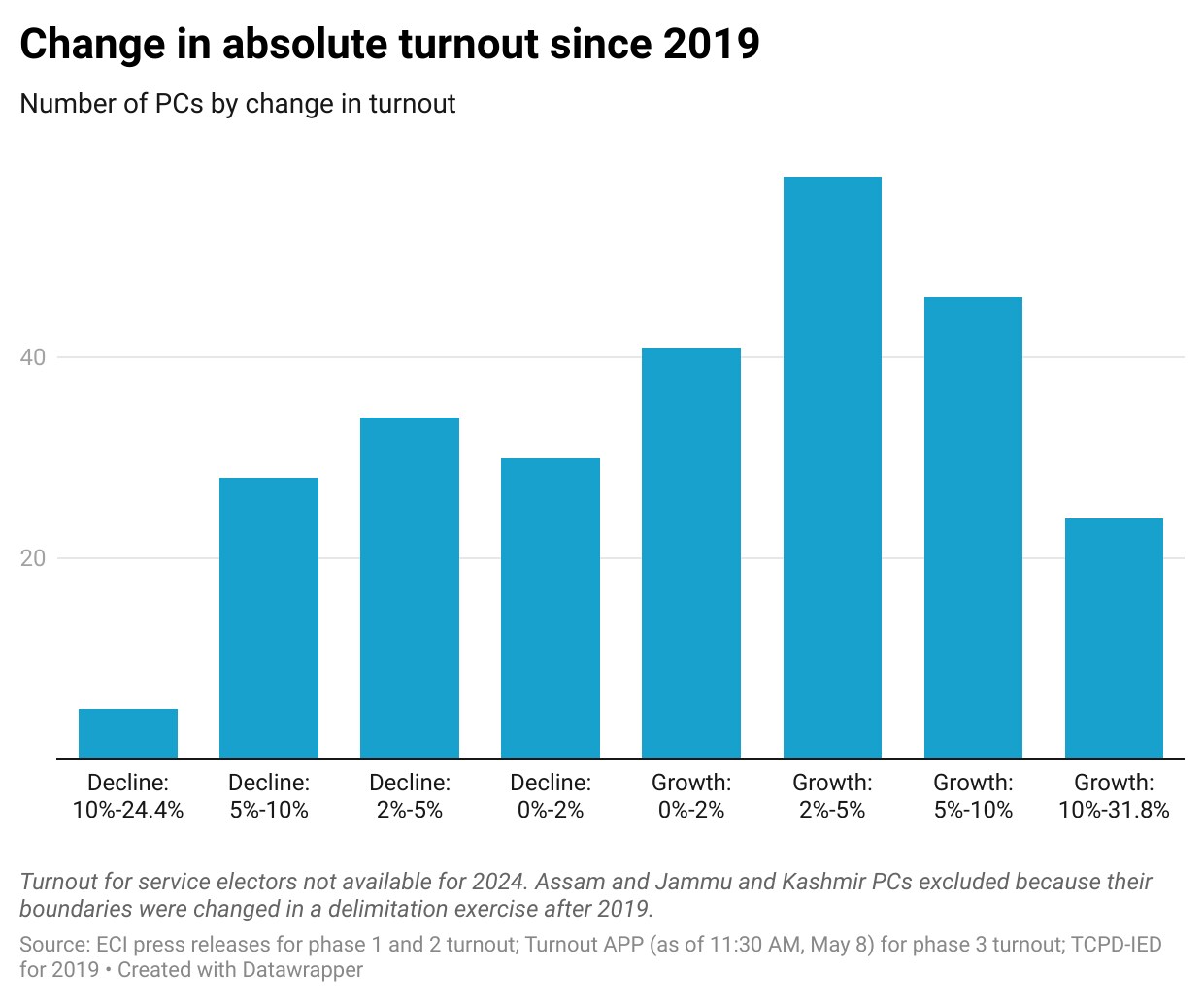
- But the absolute turnout has fallen in one-third of the PCs which have gone to polls so farOf the 266 PCs for which this comparison is possible with 2019 (14 PCs in Assam have to be excluded here), 97 have registered a decline in absolute turnout compared to 2019; 67 out of these 97 have registered a decline of over 2%. Absolute turnout has decreased by over 5% in 33 PCs and over 10% in five. These five PCs with the biggest drop in absolute turnout are: Nagaland (24.4%), Mathura in Uttar Pradesh (13.5%), Pathanamthitta in Kerala (11.7%), Baghpat in Uttar Pradesh (11.1%), and Sidhi in Madhya Pradesh (10.7%).
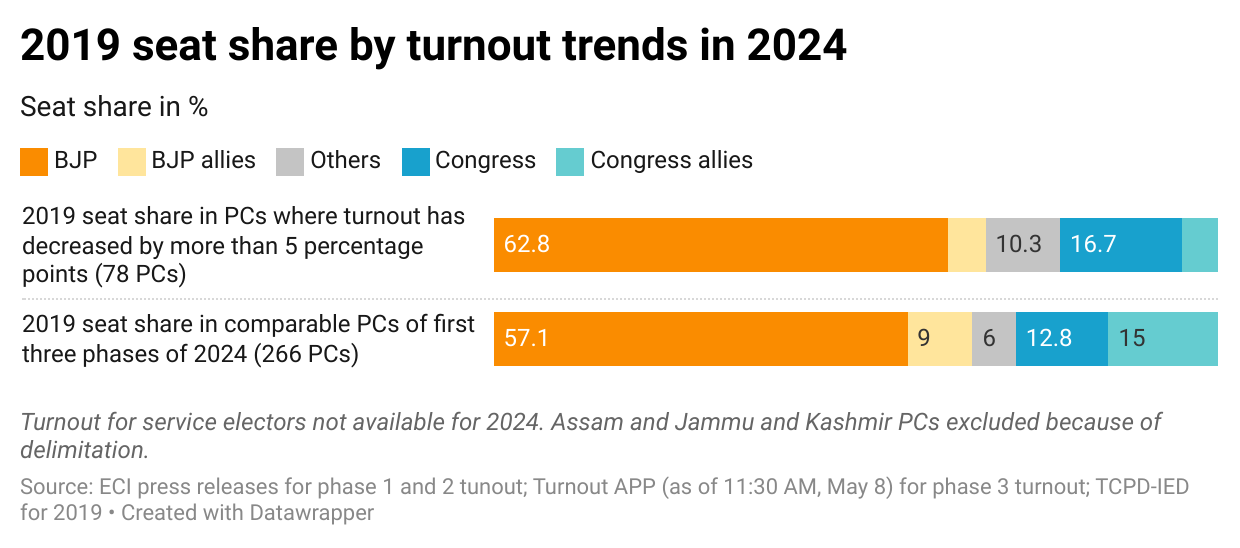
- Is there a relationship between the drop in turnout and the incumbent in a PC?Among the 78 PCs where the turnout has dropped by more than 5 percentage points, 49 were won by the BJP in 2019, four by BJP’s allies, 13 by the Congress, four by Congress allies, and eight by others. However, this must not be taken to mean that the BJP and its allies are at a disadvantage. This is because the distribution of PCs where turnout has dropped – 68% won by BJP and allies in 2019 and 22% by Congress and allies – largely reflects the overall outcome of the 2019 elections in these 266 PCs. The BJP and its allies won 176 of the 266 PCs (66%) and Congress and allies 28%. These trends also hold largely true if one is looking at PCs where turnout has decreased in absolute terms: 19 of 33 PCs where the absolute turnout has decreased by more than 5% were won by BJP and allies in 2019, 10 by Congress and allies, and four by others.