
 E-Paper



Lok Sabha Election 2024: 283 seats locked as Phase 3 concludes
111 million voters in 93 constituencies across 11 states and Union territories cast their votes in the high-stakes third phase of India's general elections.

 Prefer HTon Google


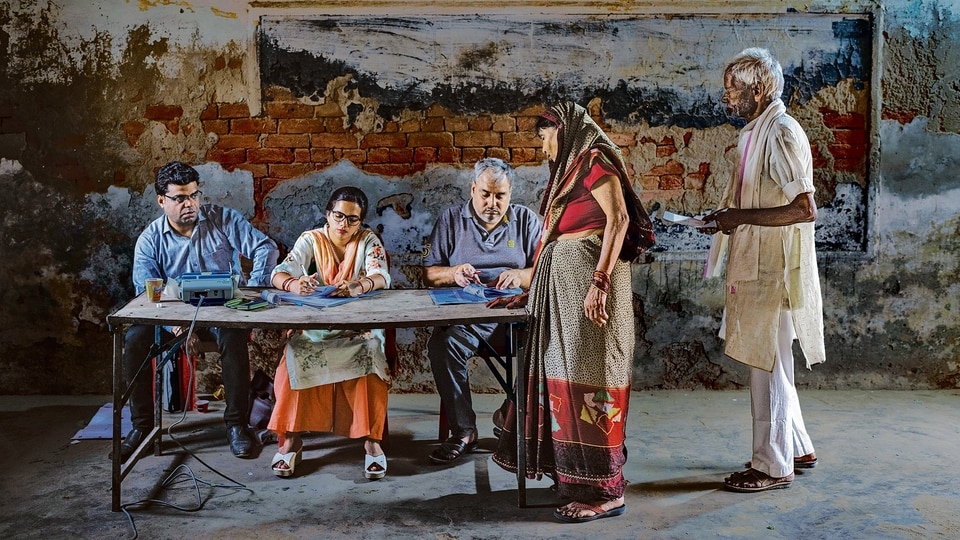
New Delhi: Roughly 111 million people on Tuesday voted to elect their Lok Sabha representatives in 93 constituencies across 11 states and Union territories, marking the end of the high-stakes third phase of polling that saw citizens from Assam to Gujarat and Karnataka to western Uttar Pradesh exercise their franchise.
Full coverage of Lok Sabha Election 2024
With this, 283 seats — or more than half of the Lok Sabha’s strength of 543 — have gone to the polls since the general elections began last month.
The provisional turnout stood at 64.37% at 11pm, said the Election Commission of India (ECI), adding that it was expected to rise once the final numbers are tallied by the poll watchdog.
In 2019, the turnout in these seats (excluding the four in Assam, which are not comparable to 2019 because of delimitation) stood at 65.9%.
“Though polling was till 6pm, voters were seen in the queue at many polling stations. Voters from across 11 states/UTs participated enthusiastically to cast their vote at their polling stations, braving hot weather conditions in some areas,” ECI said in a statement.
Prime Minister Narendra Modi was among the voters who exercised their franchise in Gujarat, where all Lok Sabha seats went to the polls. “Today is the day of celebrations of democracy. I will congratulate the Election Commission, security forces and officials involved in conducting the first two phases of polls almost violence-free. In the past, violence during elections was very common,” he said.
Voting is now complete in 20 states and Union territories. On April 19, 102 seats went to polls in the first phase and on April 26, 88 constituencies exercised their franchise.
The turnout was in sharp focus because the first phase voting percentage of 66.14% and the second phase figure of 66.71% were both lower than the 2019 numbers of about 69.4% and 69.6%, respectively. Of particular concern were rising temperatures across vast swathes of the heartland and eastern India, which are gripped by heatwaves.
A total of 1,331 candidates — including six Union ministers and four former chief ministers — were in the fray. This included Union home minister Amit Shah and Union civil aviation minister Jyotiraditya Scindia.
“The polling was held smoothly and peacefully in all states/UTs… stringent security measures were in place creating a conducive environment for voters to cast their vote without fear or intimidation,” ECI said.
The highest turnout was recorded from Dhubri in Assam at 86.8% as of 11pm, where the contest is between Zabed Islam of the Asom Gana Parishad (part of the NDA alliance), Rakibul Hassan of the Congress, and Badruddin Ajmal of the AIUDF. The lowest turnout was reported from Amreli in Gujarat at 49.22% as of 11pm. The BJP’s Bharatbhai Manubhai Sutariya and Congress’s Jenny Thummar are in battle in the segment.
Overall, across the 93 seats going to the polls on Tuesday, the 2019 outcome is not possible to be calculated for the four seats in Assam that underwent delimitation. Of the remaining 89 seats, 70 were won by the BJP and three by the Congress in 2019. The Janata Dal (United) — which is part of the National Democratic Alliance — won three seats; while Trinamool Congress and Samajwadi Party — part of the Indian National Developmental Inclusive Alliance — won two each. The Shiv Sena, the Nationalist Congress Party, and the Lok Janshakti Party won four, three, and one seat respectively. All three parties have undergone a split since 2019. One seat in Dadra and Nagar Haveli and Daman and Diu UT was won by an independent candidate.
The next four phases will take place over the next month, with the results on June 4. Modi is seeking a historic third consecutive term, hoping to become only the second PM after Jawaharlal Nehru to achieve this feat. The Opposition is aiming to use a mix of economic agenda and social redistribution promise to damage the BJP’s electoral coalition.
“The Congress and INDIA alliance is dedicated to protecting the Constitution and democracy. Vote for Congress for a bright future for all and together let us build a strong and united India,” former Congress chief Sonia Gandhi said in a message.
The third phase of the polling saw fierce campaigning by both sides. Modi led the charge for the BJP, alleging that Pakistan wanted the Congress to win and for its prince — a reference to Congress leader Rahul Gandhi — to become prime minister. He also blamed the Congress of blocking the development of scheduled castes and scheduled tribes, saying that the party wanted to give SC/ST reservations to Muslims.
The Opposition rebuffed the charges and accused the BJP of running a communal campaign to divide the electorate. It focussed on the allegation that the BJP wanted to change the Constitution if it won 400 seats and cast itself as the protector of the Constitution and reservation.
Of the 26 seats in Gujarat, voting took place for 25 as BJP candidate Mukesh Dalal won unopposed from Surat. The state recorded a turnout of 58.9%, compared to 64.4% in 2019.
In Maharashtra, all eyes were on the high-profile contest in Baramati, where two factions of the NCP were in direct contest. The Ajit Pawar faction nominated the deputy CM’s wife Sunetra Pawar, who was taking on sitting MP, Supriya Sule, also the daughter of party patriarch Sharad Pawar. Baramati recorded a low turnout of 56.07% till 11pm, compared to 61.7% in 2019.
The state recorded a turnout of 61.44%, compared to 63.8% in 2019.
A prestige battle also ensued in Uttar Pradesh, where the Yadav family bastion of Mainpuri was among the 10 seats in the fray. In this seat, once held by five-time UP CM Mulayam Singh Yadav, his daughter-in-law and party chief Akhilesh Yadav’s wife Dimple Yadav was aiming to consolidate the party’s hold over its pocket borough.
The state recorded a turnout of 57.34%, compared to 68.6% in 2019.
Voting also took place for remaining 14 Lok Sabha seats in Karnataka, coming just days after rape and mass sexual assault allegations surfaced against Janata Dal (Secular) Hassan MP Prajwal Revanna, also the grandson of former prime minister HD Deve Gowda.
The state recorded a turnout of 70.41%, compared to 70.41% in 2019.
Among other constituencies voting were four in Assam, five in Bihar, seven in Chhattisgarh, eight in Madhya Pradesh, and four in West Bengal.
In Bengal, the Congress’s Lok Sabha floor leader Adhir Ranjan Chowdhury will hope to defend his seat of Murshidabad for a sixth time. The state recorded a turnout of 75.83%, compared to 81.7% in 2019.


