E-Paper



Number Theory: Why the political contest remains BJP vs Congress
There is something in BJP’s or Narendra Modi’s politics which is making people think that the BJP is a better party to rule at the national level than Congress

 Prefer HTon Google


The political crisis facing the Congress in Himachal Pradesh after the shock defeat of its candidate in the Rajya Sabha elections in the state comes soon after its losses in the Rajasthan-Madhya Pradesh-Chhattisgarh state elections held in late 2023. The second weakened the Congress’s standing within the INDIA bloc, and the first has increased the chances of the Congress not being in power in any north Indian state, something that has not happened before or since June 1991. Irrespective of the nature of outcome of the crisis, it still highlights an important aspect about the nature of India’s political contest -- contrary to what many commentators believe, it is still a BJP versus Congress battle. Here are four charts which explain this in detail.
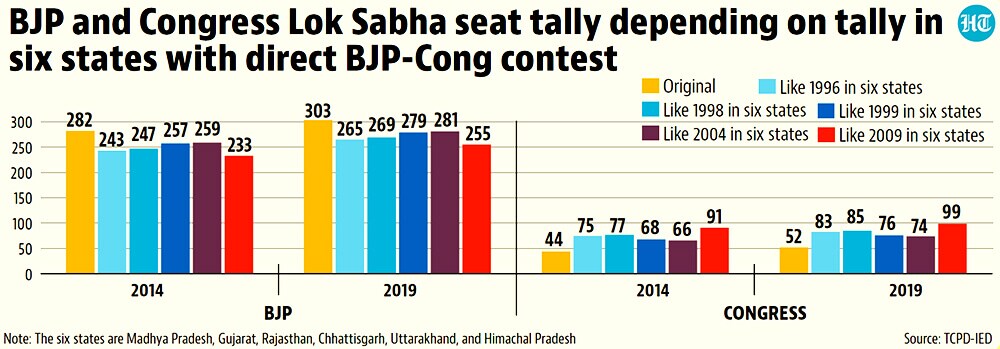
 States with direct BJP-Congress contests will be decisive in the BJP crossing the majority markThere are six states in India which saw a direct contest between the BJP and the Congress in both 2014 and 2019 with both parties contesting at least 99 of the total 100 parliamentary constituencies (PCs) in these states and finishing either first or second in at least 95. They are, in decreasing order of number of Lok Sabha MPs, Madhya Pradesh (29), Gujarat (26), Rajasthan (25), Chhattisgarh (11), Uttarakhand (5), and Himachal Pradesh (4). States such as Haryana and Assam, which are also primarily a contest between the Congress and the BJP, have been excluded from this analysis because the BJP is in alliance with some regional parties in these states at the moment. Together, these six states have 100 PCs, 18% of the seats in Lok Sabha. While the number itself might not appear very big, 2014 and 2019 results show that these states played a key role in the government formation arithmetic. The BJP won 97 and 96 out of the 100 PCs in these states in 2014 and 2019, and the Congress could win just three PCs in both these elections. Even if the BJP managed to repeat its 1996, 1998 and 1999 performance in these states – it ended up ahead of the Congress in these elections too – it would have fallen short of the majority mark in 2014 elections. The BJP would also fall short of the majority mark in 2019 elections if its performance in these six states was similar to that in the 1996 and 1998 elections in these six states, but manage a majority if its performance in the six states was similar to that in the 1999 or 2004 elections. However, the Congress’s tally in 2014 and 2019, had it managed to repeat its 2004 and 2009 performances in these states, would reach 99, lower than its pre-2014 tally, but higher than its tally in 2014 and 2019.
- Ironical as it may sound, Congress’s biggest support base is still in these statesThe numbers speak for themselves. Both in the 2014 and 2019 Lok Sabha elections, these six states were generally among the top nine in terms of the Congress’s state-wise vote share if states and UTs with one or two Lok Sabha seats are excluded. The only exception to this was Congress’ vote share in Himachal Pradesh in 2019, which was ranked 13th among 22 big states where it contested. These six states contributed 32% and 35% of the total votes the Congress received in the 2014 and 2019 elections when these states had just 18% and 20% share in total votes cast in those elections. This clearly shows that the Congress is far from a spent force in these states. In fact, the Congress has won at least one election in each of these six states except Gujarat after the 2009 Lok Sabha elections. It won Rajasthan, Madhya Pradesh, and Chhattisgarh elections in 2018; Himachal Pradesh elections in both 2012 and 2022; and Uttarakhand in 2012.
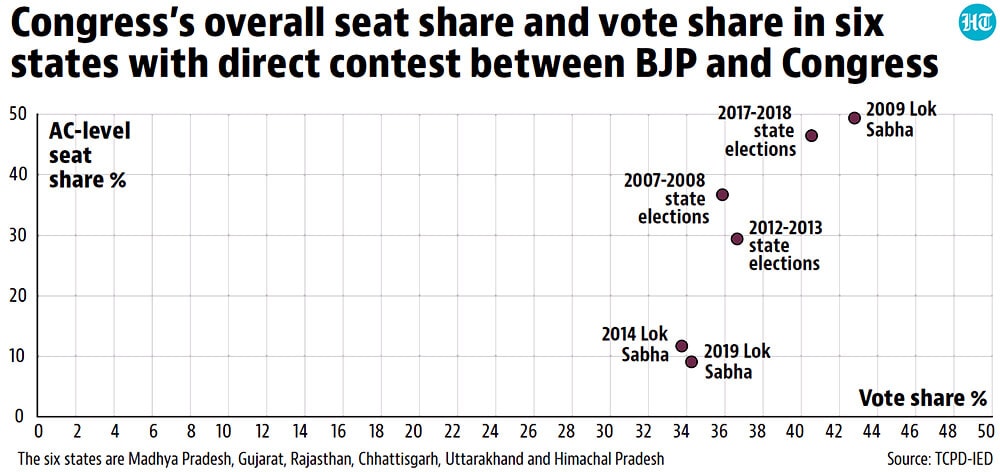
- So why does it do so badly in national elections?The best way to answer this question is to look at the Congress’s seat share and vote share in assembly and national elections in these states from the 2009 Lok Sabha elections. The Congress’s seat share shows a massive fall in 2014 and 2019 national elections, even though its vote share largely remained unchanged between assembly and national elections.
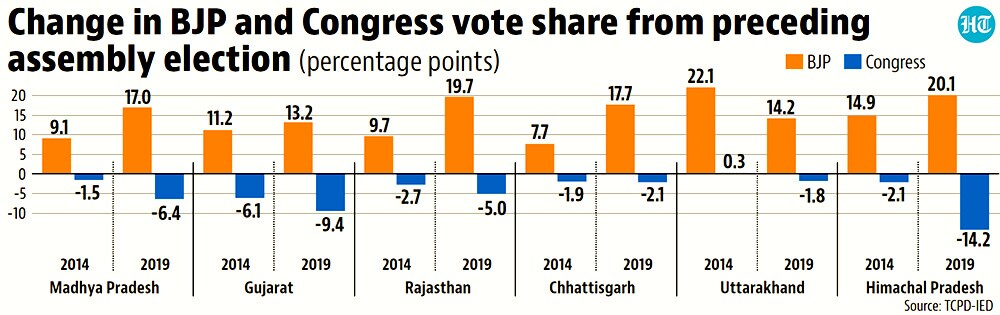
- What does the Congress need to do to overcome this disadvantage?The easiest, although, provocative answer to this question is that it needs to start behaving like a national party. The reason the BJP has swept these states in both 2014 and 2019 is that it has also attracted a large part of the non-Congress non-BJP voters in these states – if one compares Lok Sabha elections with the previous assembly elections – along with winning a part of the Congress voter. Clearly, there is something in the BJP’s or Narendra Modi’s politics which is making people think that the BJP is a better party to rule at the national level than the Congress or local political players. HT has previously equated this to a conglomerate premium that conglomerates enjoy in stock markets and pointed out that, at the moment, the Congress only seems to have a conglomerate discount. Unless the Congress can change this, it will continue to have an entrenched disadvantage at the level of national political contest.