E-Paper



Number Theory: Will Telangana elect BRS for the third time?
An HT analysis of past results shows that any opposition party will have to really outperform its previous best
Updated on: Nov 30, 2023, 07:53:44 IST


Share via


Copy link

All 119 assembly constituencies (ACs) in Telangana will vote today, November 30. Will the Bharat Rashtra Samiti (BRS), formerly the Telangana Rashtra Samiti (TRS), retain power for the third time? An HT analysis of past results shows that any opposition party will have to really outperform its previous best to stage an upset. Here are some charts which explain this in detail.

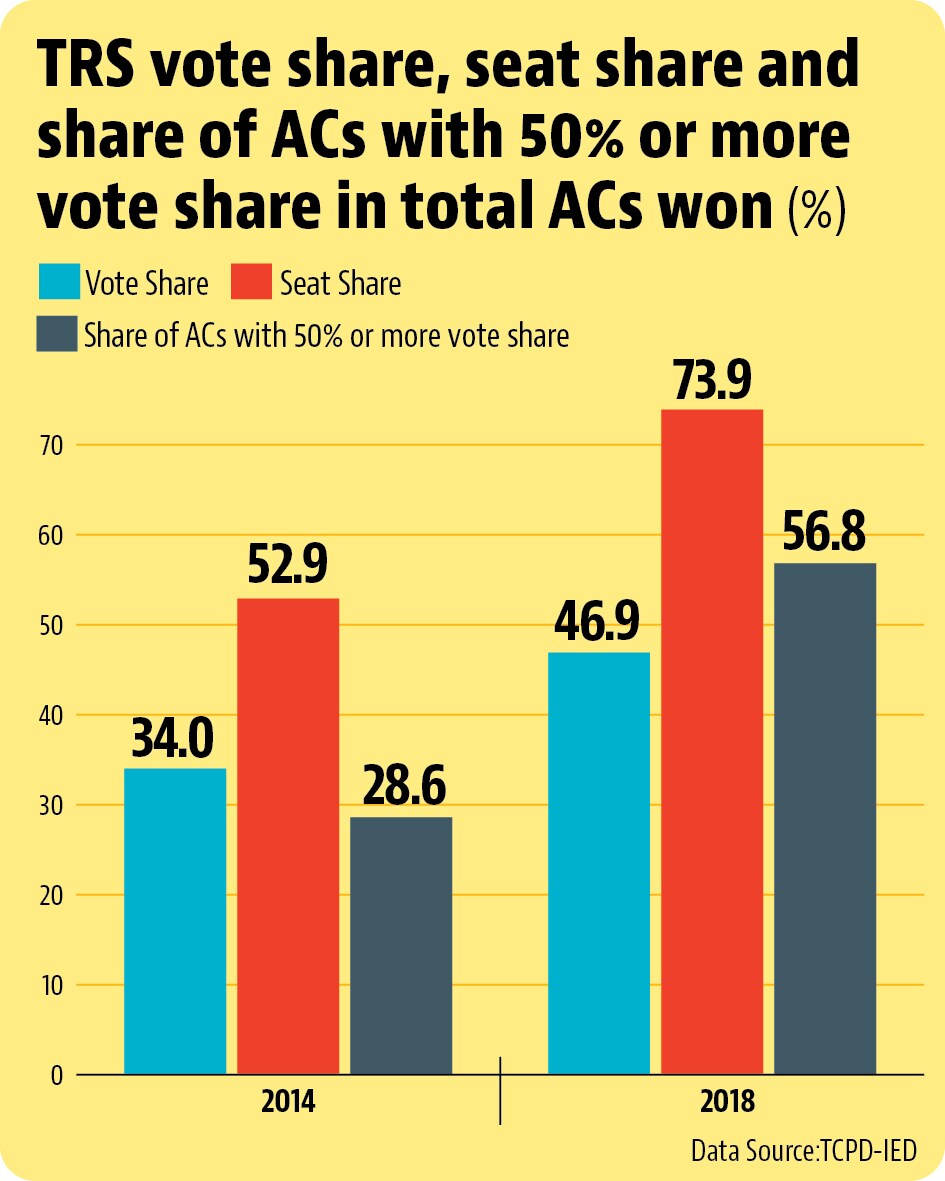
 TRS’s 2018 victory was massive no matter which way one looks at itThe TRS won 88 out of the 119 ACs in the 2018 elections with a vote share of 46.87%. In 50 out of these 88 ACs, TRS had a vote share of 50% or more. TRS’s 2018 performance was a significant improvement over its 2014 performance when it won 63 ACs with a vote share of 34.04%. The 2018 performance of the TRS suggests that it will take more than a consolidation of opposition votes to unseat it from power.
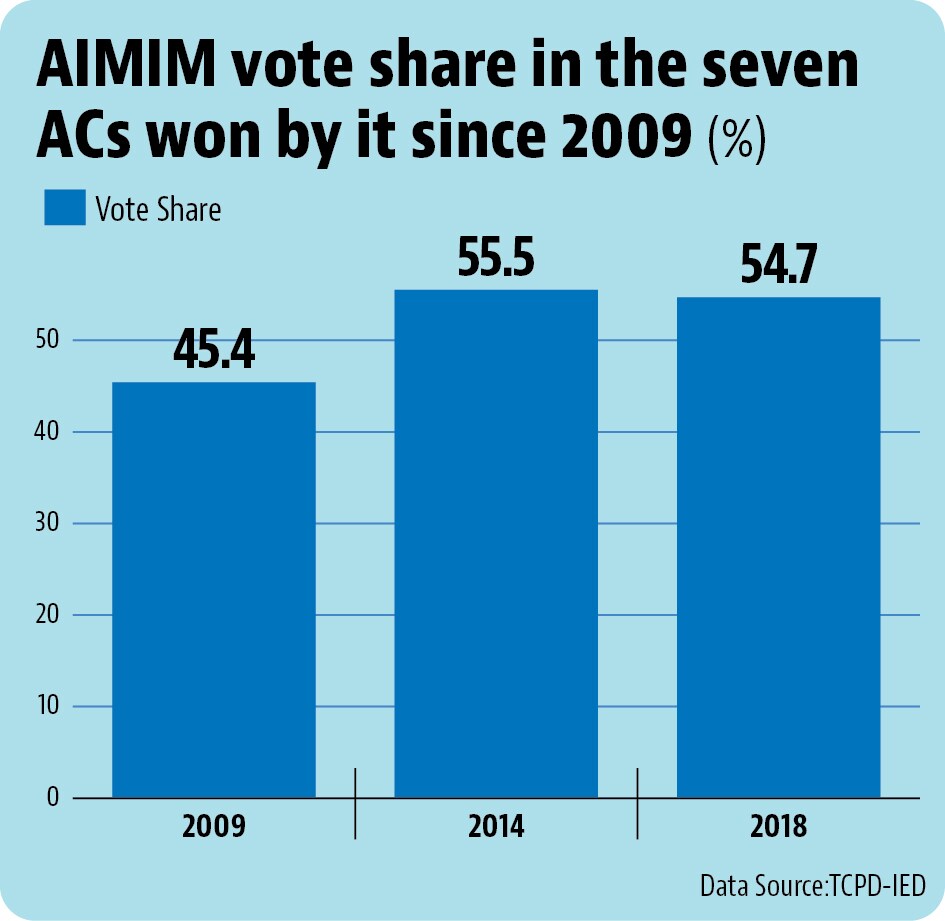
- AIMIM’s pro-BRS tilt makes it even more difficult for a party looking to unseat BRSThis is perhaps the most important factor which needs to kept in mind for the formation of a non-BRS government. The All India Majlis-e-Ittehad-ul-Muslimeen (AIMIM) won the same seven ACs in the 2018 and 2014 assembly elections in Telangana. Even in 2009, when Telangana had not been formed, the AIMIM won all of these ACs. While the AIMIM’s overall vote share in the state was just 3.74% and 2.71% in 2014 and 2018, its vote share in these seven ACs is 54.65% in 2018 and 55.34% in 2014, which shows how formidable it is in its pocket of strength. The AIMIM supported the TRS in after the latter failed to secure a majority in the Greater Hyderabad Municipal Corporation elections held in 2020, and a similar tie-up cannot be ruled out this time. Also, the AIMIM is known to be politically hostile to the Congress, which by all anecdotal accounts, seems to be the main party challenging the BRS’s bid for third time in power. This effectively means that for the BRS, the halfway mark is a little lower than it is for the Congress.
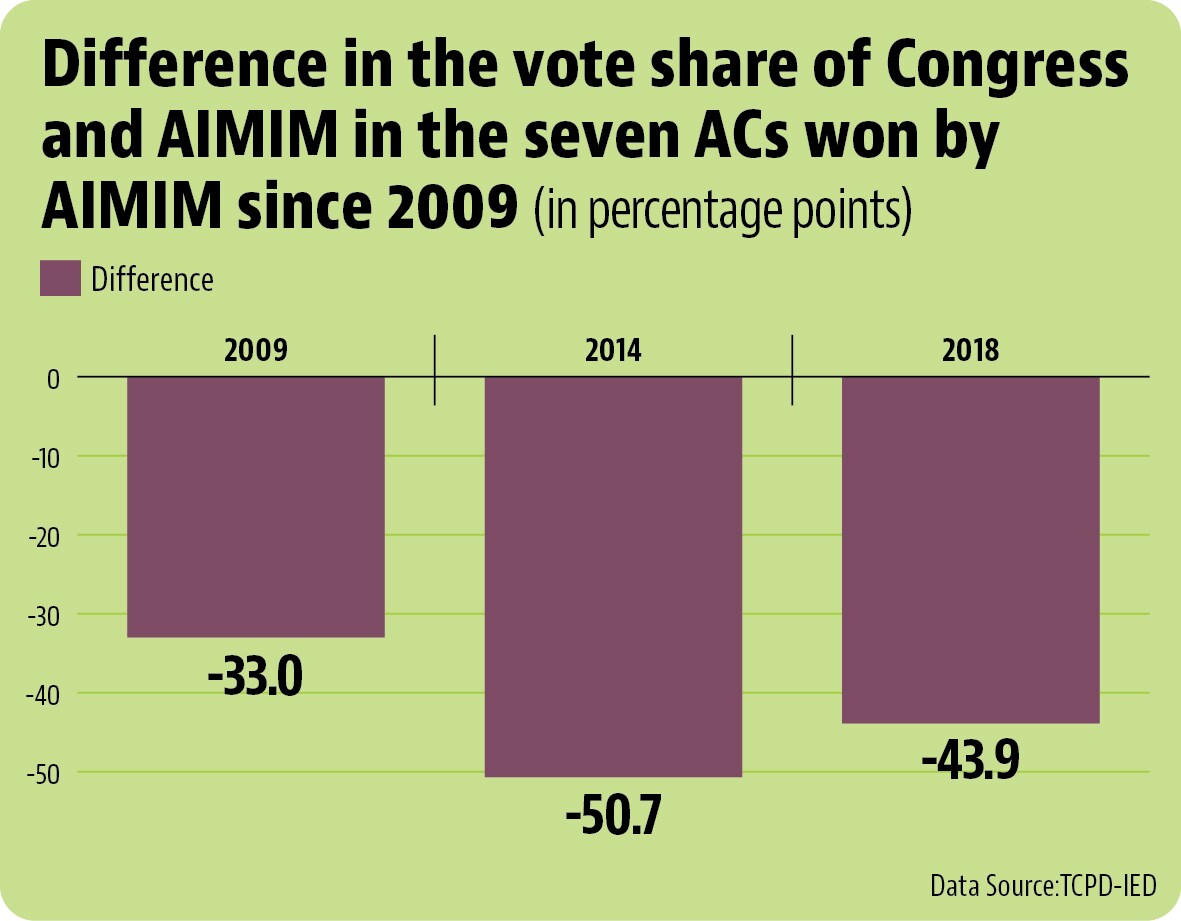
- The Congress’s gap vis-a-vis the AIMIM is massive in its pockets of influenceIs there a possibility of the Congress unseating the AIMIM in its strongholds in these elections? An analysis of 2009, 2014 and 2018 results show that this would take a completely upset of past trends in these ACs. The Congress’s average vote share deficit vis-à-vis the AIMIM in 2018 elections was a massive 43.9 percentage points and the former did not even finish second in six out of these seven ACs. The 2009 and 2014 results were not very different.
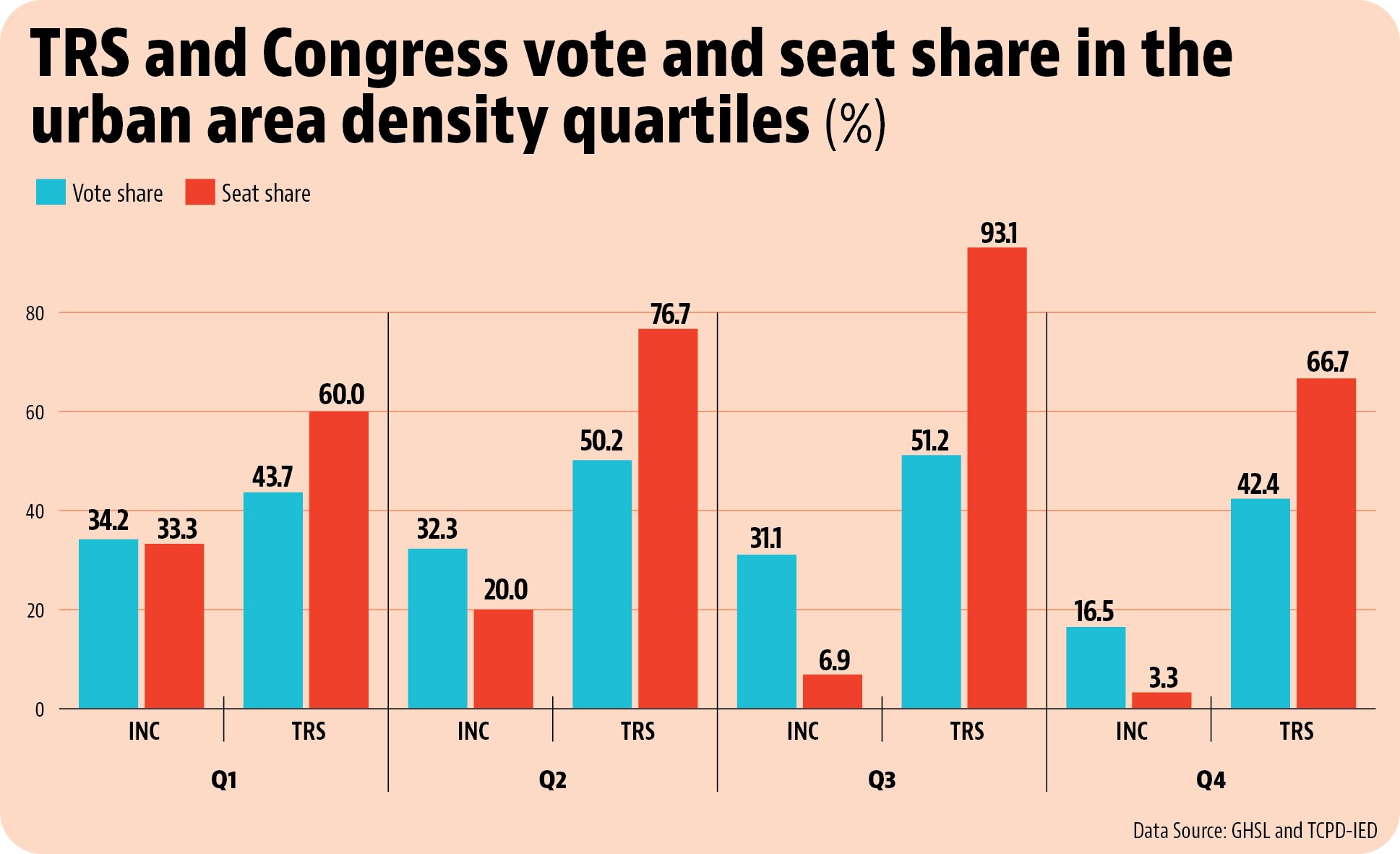
- Can the Congress pin its hopes on a rural-urban polarisation in these elections?According to the 2011 census, 38.9% of Telangana’s population is urban, which is higher than the national average of 31.15%. Because the 2011 census numbers are now dated and the government has not conducted a fresh census so far, HT has used Global Human Settlement Layer (GHSL), a data product of the European Space Agency, which provides degrees of urbanisation estimates using built-up and population information. This dataset was processed to derive AC-level urbanisation estimates by Shamindra Nath Roy from the Centre for Policy Research. The analysis shows that TRS won a majority of seats in each of the quartiles (ACs divided into four parts starting from most rural to most urban) in the 2018 elections. To be sure, its performance was significantly better in the second and third quartile of these ACs. It has a vote share of 50.23 and 51.17 per cent in the second and third quartiles. The vote share of TRS was lowest in the fourth quartile, 42.36%. The highest seat share for the TRS falls in the third quartile where it had a seat share of 93.1% — winning 27 out of 29 ACs in the third quartile. As far as the Congress performance is concerned, it had a vote share of 34.17% in the most rural ACs and just 16.48% in the most urban ACs in the state. All of AIMIM’s seven ACs are among the most urban ACs in the state. Given the Congress’s massive deficit against the AIMIM, this analysis shows that the Congress cannot unseat the BRS unless it manages a landslide in the rural half of the state.