
 E-Paper



On US trade deal, Jaishankar draws Delhi’s ‘red lines’ amid Trump tariff aggression
"There are things you can negotiate and [those] you can't... We have to find landing ground; that's the conversation since March,” says India's foreign minister

 Prefer HTon Google


Many of the issues currently affecting India-US relations are linked to the inability to reach an understanding on trade, but any deal that is finalised has to respect New Delhi’s red lines, external affairs minister S Jaishankar said on Sunday.
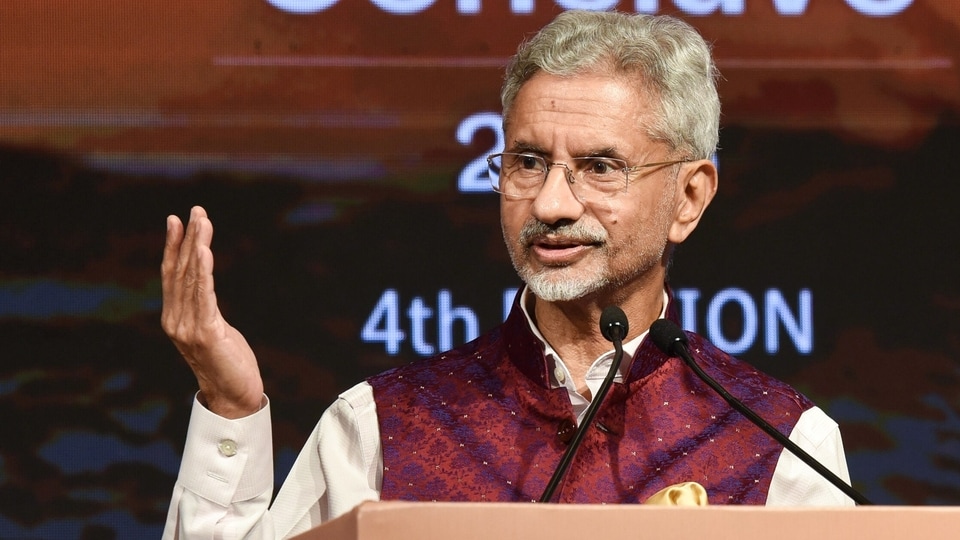
An understanding on trade is necessary because the US is the world's largest market but differences between the two countries have to be seen in proportion as some aspects of the bilateral relationship are continuing as “business as usual”, Jaishankar said during a discussion with the theme of ‘Shaping Foreign Policy in Turbulent Times’ at the Kautilya Economic Enclave in New Delhi.
Also read | Jaishankar's ‘red lines’ versus US commerce secy's condition for ‘open markets’
Jaishankar’s address largely focused on the strategic consequences of unprecedented changes on the global stage, including the leveraging of production, supply chains, trade, data and connectivity, and India’s approach towards coping with these shifts by developing manufacturing and national power.
On India-US relations, Jaishankar's straight talk
Against the backdrop of strains in the India-US ties not witnessed in close to two decades, Jaishankar said most of the issues in the relationship are linked to the inability to conclude a trade deal. He made the remarks while responding to questions from the moderator, former revenue secretary NK Singh, and members of the audience.
Also read | India to make a case for IT workers after H-1B visa row
“We have today issues with the United States. A big part of it is the fact that we have not arrived at a landing ground for our trade discussions, and the inability so far to reach there has led to a certain tariff being levied on India,” Jaishankar said, referring to the 25% reciprocal tariff levied by the Trump administration.
“In addition, there is a second tariff which we have publicly said we regard as very unfair, which has picked on us for sourcing energy from Russia,” he said in the context of a 25% punitive levy imposed by the US administration.
On Russia, oil, and bottom lines
Jaishankar noted that countries with a “far more antagonistic relationship with Russia” that are also buying Russian energy had not faced similar punitive levies from the US.
“Whatever happens at the end of the day, there has got to be a trade understanding with the US…because it is the world's largest market but also because much of the world has reached those understandings,” he said.
Also read | 'Losses by India...': Putin's trade balance plan, big praise for ‘very wise’ Modi amid Trump tariffs
“But it has to be an understanding where our bottom lines, our red lines are respected. In any agreement, there are things you can negotiate and there are things you can't. I think we are pretty clear about that. We have to find that landing ground and that's been the conversation which has been going on since March,” he said, referring to negotiations with the US on a bilateral trade agreement.
Talks on a trade deal resumed recently following a thaw in the relationship after a phone conversation between Prime Minister Narendra Modi and President Donald Trump though there is no clarity on whether the two sides will be able to reach the first tranche of a trade deal by the fall, as was envisaged when the two leaders met in February.
Also read | Quad meet unlikely this year amid trade tensions between India, US
Jaishankar said the current strains should not be seen as percolating to “every dimension of the relationship”, and things should be seen “in proportion”. He added: “There are problems, there are issues, nobody is in denial of it. Those issues need to be negotiated and discussed and resolved, which is exactly what we are trying to do.
“But I would really…hesitate to read very much more into it than the issues themselves. I think I also want to say a large part of the relationship is actually continuing either as business as usual or in fact in some cases even doing more than it was doing before.”
Jaishankar said the world is “going through an extraordinary and intense period of change” by every metric of measuring the global economy or of assessing the state of the world.
“Now, the strategic consequences of this are quite obvious. We have seen a weakening, sometimes even discarding, of international regimes and rules. We have seen, economically, that cost may not any longer be the definitive criteria or that ownership or security or reliability, resilience is equally important,” he said.
On China, and the balance of power
Political alliances and understandings are being revisited and the belief of major powers in the balance of power is much less. “They seem to think they may not need the rest of the world as much as they did before,” he said.
Without directly naming China, Jaishankar said the shifting of one-third of global manufacturing to one country has had significant consequences for the international economy and supply chains. He also pointed to significant shifts in the realm of energy, with the US becoming both self-sufficient and a significant exporter of energy and championing fossil fuels, while China has established itself as a leader in renewables.
Also read | It's Trump vs ‘swadeshi’ now: US tariffs spark new pledge with old fears unlocked
In the case of data, Jaishankar highlighted the role of big tech in driving the global economy and the “influence of a few companies”. At the same time, worries have grown about the concentration, narrowness and fragility of supply chains, he said.
“When it comes to finance, what we have seen in the last few years is a completely different level of application of sanctions. We have even seen the seizure of sovereign assets,” he said, adding that the race for critical minerals has “become a very major factor in competition between nations”.
The nature of weaponry war too has fundamentally changed and the Azerbaijan-Armenia, Ukraine-Russia and Israel-Iran conflicts have demonstrated that “contactless war” is possible with stand-off weapons and can have a “decisive outcome”.
The US, which underwrote the contemporary international system, has become the harbinger of change as it is more assertive and has allowed its national interest goals to drive its approach towards partnerships and cooperation. China, which had “mastered the old system”, has been caught in these changes at a time “when many of the new concepts, mechanisms, institutions which they were pushing are not yet in place”, Jaishankar said.
Europe was in a sweet spot in terms of security provided by the US, energy supplied by Russia and trade with China, but has seen all those aspects “become a challenge”, while Russia’s current goals and future opportunities “are not aligned on the same plane”, he said.
The challenge for India lies in not only defending the country’s interests but also rising in these turbulent times, Jaishankar said. “Because for us, just defending what we have is simply not good enough. This has caught us at a time… where we had to not only internalise and absorb these risks, but find a way of going beyond and continuing with our rise,” he added.
This will require both deepening advanced manufacturing in areas such as semiconductors, electric vehicles, drones or space, and enhancing comprehensive national power to deal with the turbulent times, he said.
“The answer for a more difficult world is not just outside, a large part of that answer is inside,” he said, calling for the development of human resources, infrastructure, manufacturing, trade flows, energy security, food security, and health security.


