
 E-Paper



‘Our future is bleak’: Kerala flood fury leaves behind trail of despair
According to Indian Meteorological Department (IMD), Kerala received 567 mm rain against normal fall of 290 mm between October 1 and 28 and half of this came in just two days -- October 15 and 16, which caused massive landslides in Kottayam and Idukki districts.


Sitting alone at a relative’s house in Kottayam’s Koottickal, 12-year-old S Jebin, a class 7 student of St George School here, says he is sure that if his father would have got a few more seconds he would have been alive today. On October 16, when Jebin’s father heard a deafening sound, he asked his son to run. As Jebin ran out of the house, a few seconds later, a big boulder crushed his house and his father was swept away in gushing water.
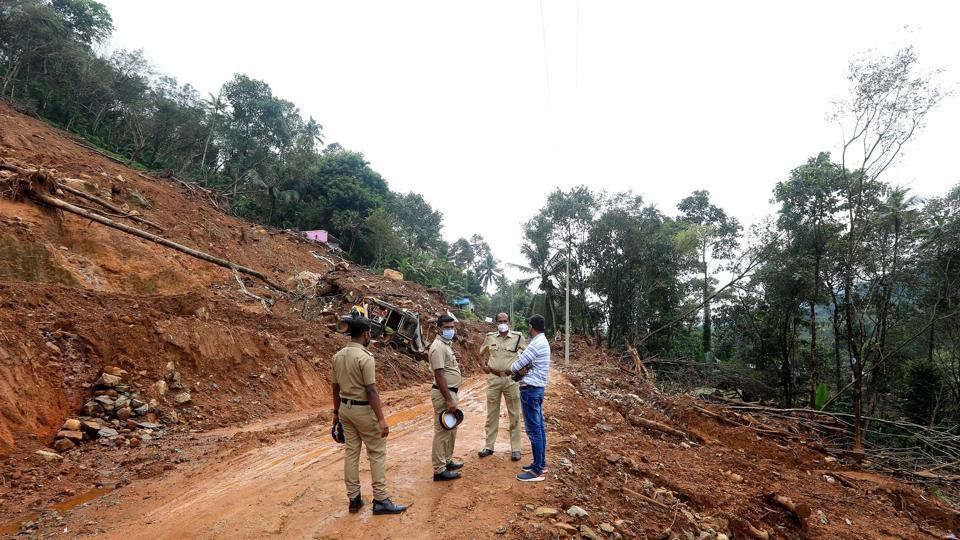
“Our house was decimated in seconds and I was also swept away. I got hold of a tree branch and fell into a stream and later I managed to swim across,” said the 12 -year-old boy. Jebin, who now lives in a makeshift camp.
“My father was keen to save me and in the process he got into swirl of water and rocks,” he said. His body was retrieved two days later. Fortunately, Jebin’s mother and two brothers had gone to a function in Kochi and were saved from the tragedy.
According to Indian Meteorological Department (IMD), Kerala received 567 mm rain against normal fall of 290 mm between October 1 and 28 and half of this came in just two days -- October 15 and 16, which caused massive landslides in Kottayam and Idukki districts. Heavy rain triggered two major landslides in Idukki and Kottayam districts claiming 18 lives with Koottickal in Kottayam and Kokkayar in Idukki being the worst-hit.
In all, 42 persons died in October rain-related incidents this year in Kerala and close to 3,000 people were left houseless, according to the official data.
In Kavali, 4 kms from Koottickal, a family of six -- 65-year-old Claramma Joseph, her48 year-old son M. Saji, daughter-in-law and her three granddaughters -- all aged between 9 and 13 years-- was wiped out by floods.
“After every year nature is getting more hostile. It seems we have to redraw our strategies to avoid such tragedies,” said Father P K Sebastian, priest of St Luke’s CSI church in Koottickal , founded in 1852.
“After landslides, river Manimalayar (in Koottickal) breached its banks in seconds. I was planning to close my shop but before that water gushed in. I ran atop a hilly terrain to save my life,” said Sainalabuddin, a shop keeper in Koottickal. He lost goods worth ₹3 lakh. “I saw a child struggling in gushing water but couldn’t do anything,” he said.
A trip through affected areas, telltale marks of nature’s fury are visible. Chiseled hills, broken roads and culverts, uprooted trees, muddy water bodies, big boulders and mangled concrete structures stand testimony. Even two weeks after the tragedy many are still stranded in relief camps because landslides and flash floods have taken their life’s savings including land.
On October 16, six people died in Idukki’s Kokkayar village due to landslides. In Idukki’s Kokkayar, 38-year-old Sabeena M is taking an afternoon nap on a barren bench in a school which doubles up as her bed at night. She visited the spot two days after the tragedywhere her house once situated but couldn’t trace any of her belongings except the mangled remains of her husband’s mangled auto-rickshaw found 2 kms away from where it was parked.
On October 16, Sabeena ran out of her house with her two children after the local mosque blared a final warning. But her neighbours weren’t as lucky. Her husband, an autodriver survived. “Why tragedy always strikes the poor,” she asks wiping tears.
58-year-oldP Francis, a coffin box maker in Kokkayar, rebuilt his house recently after taking a loan from the co-operative bank and his house was among 150 washed out in floods and landslides. “Future is bleak,” he said, as numbness gripped him recalling what happened on that fateful day.
Rampant development, loss of local ecology and blocking of natural water streams by construction is said to be reasons for Kerala seeing four big rain related disasters in the past three years.
Many boards saying “damaged household things will be repaired free” can be seen in Koottickal and Kokkayar, the two worst-affected areas, as volunteers are extending help in whatever way they can and relief materials are also pouring in. Many volunteers working in the area complain that NGOs, religious bodies and good Samaritans chip in fast but as usual the tardy government agencies steal credit.
“I have visited most of the landslide affected areas. Many landslips took place in uninhabited areas also. I find government agencies are more into public relations exercise. Poor land use pattern and lopsided development for such tragedies are behind such tragedies,” said K M Naafih, a research scholar from Pondicherry University, who is collecting data for aid agencies.
But state revenue minister K Rajan denied the charge. “Government agencies were first to reach disaster spots. We have announced ₹5 lakh to kin of those who died and 10 lakh people who lost their homes. We will do more,” he said. But some of the survivors said they can’t buy land home with his amount.
After landslides carcasses of four elephants have found giving credence to wildlife loss also. “We fear heavy loss of wildlife also,” admitted a senior forest official of Idukki, on request on anonymity adding big animals usually suffer during such calamities.
In September, the Kerala Disaster Management Authority (KDMA) identified 30 landslide-prone areas in Kottayam and Idukki districts in Kerala but these figures remained only on papers. Torrential rains triggered more than 100 big and minor landslides during mid-October.
Some areas like Peerumedu in Idukki and Koottickal in Kottayam received more than 200 mm rain between October 15 and 16.
The state saw three devastating floods in last four years that together killed at least 600 people and wiped out entire habitations.
After 2018 floods that claimed 480 lives, chief minister Pinarayi Vijayan launched a new initiative called ‘Rebuild Kerala’ and said that developmental initiatives will get a new impetus in the changed scenario but many experts say the government is going ahead with many big budget projects like K Rail (high speed rail corridor) and hill highways ignoring the nature’s warnings.
Experts say the state is yet to learn a lesson from recurring tragedies. “In the age of climate change such disasters will recur frequently. The state will have to give top priority to environmental impact studies when it takes up developmental projects. It will have to pay a heavy price if it goes ahead ignoring such signals,” said Dr M G Manoj of the Advanced Centre for Atmospheric Radar Research with the Cochin University of Science and Technology.
After recurring calamities social workers like Naafih said many are now talking about two expert committee reports --Madhav Gadgil and Kasturirangan -- to save fragile ecology of Western Ghats.
“After tragedy many people call me but all forget it easily till the next”, said Dr Madhav Gadgil whose report to save fragile Western Ghats mountain ranges is gathering dust in government cupboards.
“Look, nature never requires human beings to survive whereas the latter needs nature for its survival. There has to be a healthy co-existence between two. But of late this balance has been tilted heavily,” said bio-diversity expert and member of the Madhav Gadgil panel, Dr V S Vijayan. Thanks to rapid urbanisation and naked exploitation of nature, Kerala is a sitting duck, he said.
“Besides mountains most of the rivers were also encroached and huge concrete structures were built on their banks. When natural flows were blocked rivers take their own course,” said green activist John Peruvanthanam criticising the government’s move to reduce norms on distance between quarries and nearest residential area from 100m to 50 m. “Illegal quarrying and sand mining have affected most of the mountains and rivers of the state,” he said. The state is endowed with 44 rivers, except three all originate from Western Ghats.
“Shift in rain pattern is quite visible in Kerala these days. The state will have to readjust and redraw its strategies and end crass commercialization of porous areas. Otherwise, it will have to deal with many such tragedies,” Dr M G Manoj said.


