
 E-Paper





Follow the latest breaking news, major developments and agenda-setting stories from India and around the world with the newsdesk at Hindustan Times. Operating round the clock, the desk brings together experienced editors, reporters and correspondents to deliver fast, accurate and contextual reporting across subjects that influence public policy, governance, business, society and international affairs. The HT News Desk covers politics, elections, government policies, the economy, business and markets, science and technology, the environment, law and order, infrastructure, education, climate issues and geopolitics, while closely tracking developments across states, institutions and global capitals. The team also leads coverage of major breaking news events, policy announcements, court proceedings, natural disasters, public emergencies and significant international developments. Reports published by the newsdesk are based on information gathered from reporters on the ground, official statements, government agencies, court records, regulatory filings, recognised institutions and other authoritative sources. Stories undergo editorial scrutiny and verification processes to ensure accuracy, fairness and relevance, and are updated as events evolve and additional information becomes available. Whether covering a key political decision in New Delhi, an economic policy shift affecting millions, a landmark court ruling or a major global event, the HT News Desk aims to provide readers with reliable, fact-based journalism that delivers not only the latest developments but also the context and analysis needed to understand their wider implications.
Over 300 migrant workers in Kandhamal dig canal through hills to bring water to their land
The first phase of bringing water to the village was completed early this month. Now the villagers are building smaller canals to get the water to individual fields.


Amid the distress of pandemic-triggered lockdown, more than 300 migrant workers in two Maoist-affected blocks in Odisha’s Kandhamal district have brought cheer to hundreds of farmers, digging nearly 8-kilometre-long canal through hilly terrain to bring water to the parched farmlands.
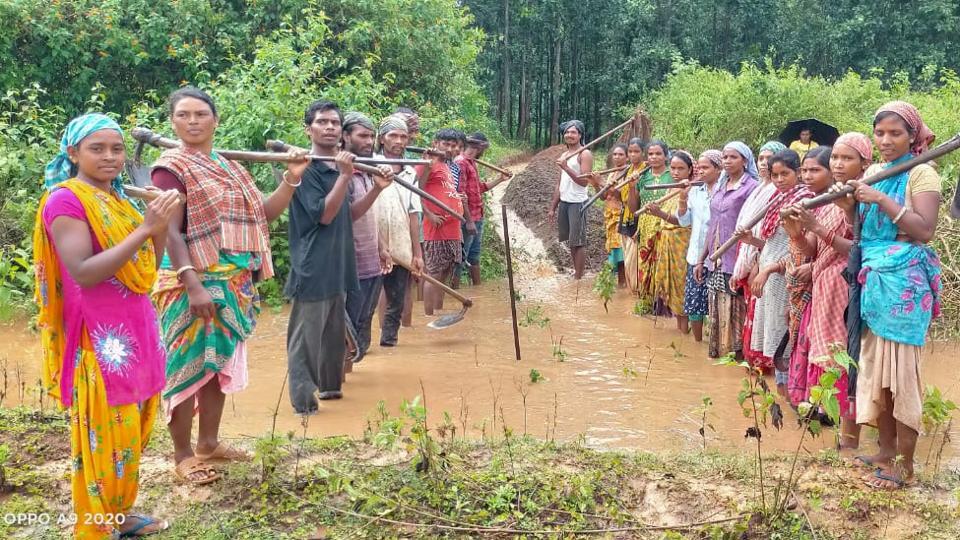
As the hilly terrain of Kotgarh and Daringibadi blocks in Kandhamal district have little irrigation in comparison with other district due to high hills and dense forests, there have been mass migrations to southern states like Kerala, Tamil Nadu, Karnataka and Andhra Pradesh for jobs. More than 15,000 migrant workers of the district who have returned were troubled with the thought of an uncertain future, but a local NGO Kandhamal Zilla Sabuja Baidya Sangathan exhorted them to think about ways to irrigate their farmland.
One of the workers Tusharkant Pradhan of Guhibadi village in Daringibadi block was sitting idle when local NGO Kandhamal Zilla Sabuju Baidya Sangathan called a meeting to do something for the village during lockdown. “The primary reason we all migrated out was lack of work during non-monsoon days. After monsoon, there was no water in our farmlands. Though there was a stream flowing at the nearby hill, the water was of no use to us due to lack of canal. We were sitting idle during lockdown. So when the NGO proposed digging up a 750-metre long canal from Patangi hill in lieu of clothes and food. We decided to give it a try,” said Pradhan.
Like him, several migrant workers as well as other non-migrant people in Ranipanga village of neighbouring Kotgarh block too followed suit by digging canals from the nearby stream. Armed with crowbars, hoes and shovels, people from 77 tribal families in the village led by sarpanch Johan Pradhan would gather in the morning and work till evening.
“As there was no explosive to smash the huge boulders, we would heat up the boulders for the entire night by lighting fires then let it cool in the morning by dew. The stress caused in the rocks by the expansion and contraction made it easy for us to break them with shovels,” said Pradhan. It took about a month before the one-kilometre-long canal with depth of about four feet to Ranipanga from the nearby stream could be completed.
The first phase of bringing water to the village was completed early this month. Now the villagers are building smaller canals to get the water to individual fields.
Like Guhibadi and Ranipanga, people in Kangadaka, Jidingmala, Ladangi, Lambabanda, Gadapakali and Gududi too have dug up around one-kilometre-long canal each in their villages that would irrigate over 1,000 acres of farmlands which otherwise remained parched.
Dinabandhu Maharana, secretary of the NGO Kandhamal Zilla Sabuju Baidya Sangathan, which provided food and clothes to the tribals working on the project, said the whole work was done without expenditure of a single government rupee. “No NREGA money was spent. People saw that they stand to gain if they slog hard for a canal. We just motivated them through some food and clothes. The people deserve all the credit,” said Maharana.
Now that the villagers have built rudimentary canals, the district administration plans to pitch in. Daringbadi block development officer Abhimanyu Behera said the administration would try to use the government resources to turn the canal into a concrete, permanent structures. “The villagers have shown exemplary spirit,” he said.


