
 E-Paper



Pakistan claims Chinese weapons did ‘exceptionally well’ against India: ‘Never tried to play with facts’
General Ahmed Sharif Chaudhary said Pakistan had recently raised its tally of Indian aircraft shot down to seven, up from a previous count of six.

 Prefer HTon Google


Pakistan again floated the idea of downing Indian jets while hailing the Chinese weapon system as performing “exceptionally well” during the May clashes with India in the aftermath of New Delhi's Operation Sindoor.
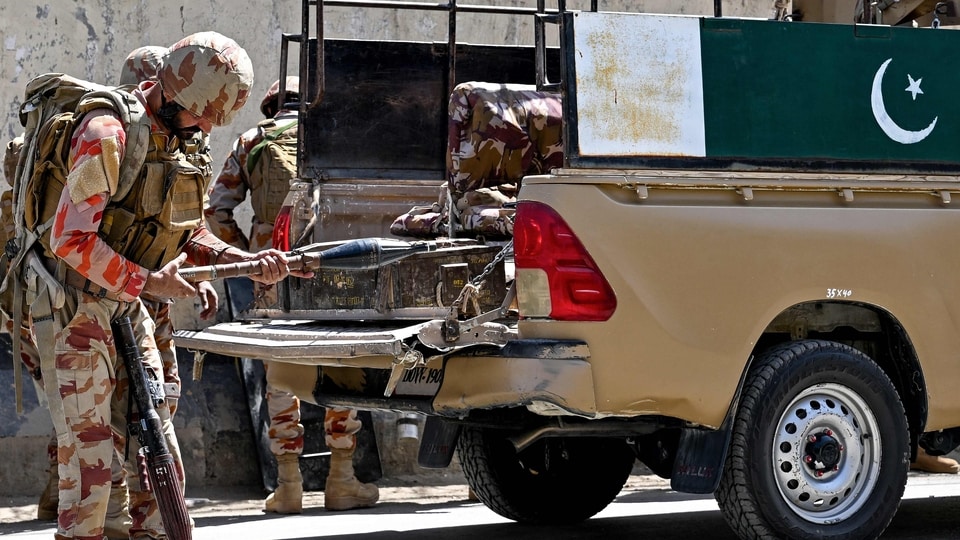
This is the latest endorsement of the Beijing-made arms that comprise the bulk of Pakistan’s recent purchases.
“We are open to all sorts of technology. Of course, recent Chinese platforms they’ve demonstrated exceptionally well,” General Ahmed Sharif Chaudhry told Bloomberg in an interview.
The May clash saw Pakistan’s first major use of modern Chinese-made systems, including J-10C fighters that Islamabad claims downed multiple Indian aircraft, a statement repeatedly denied by India.
General Chaudhary, who is Pakistan’s military spokesman, said Pakistan had recently raised its tally of Indian aircraft shot down to seven, up from a previous count of six. The claims have been inconsistent, to say the least.
India acknowledged in May that an unspecified number were downed. The Indian Air Force (IAF) chief Air Marshal AP Singh said on Friday that the country destroyed about a dozen Pakistani aircraft during Operation Sindoor. Chaudhry said in his interview that Pakistan didn’t lose any planes.
“Pakistan has never tried to play with figures and facts,” Chaudhry said.
The Chinese weapons for the Pakistan military
The conflict in May between India and Pakistan marked the largest battlefield deployment of Chinese weaponry in recent history, with the J-10C as well as the PL-15 air-to-air missile seeing live documented fighting for the first time.
Along with Chinese-made fighters, Pakistan used Chinese satellite and radar support during the conflict, an Indian Ministry of Defence group said in May.
China has been Pakistan's longtime ally and has invested billions of dollars in the country through its Belt and Road Initiative (BRI) and voiced support during the May clash.
According to the Stockholm International Peace Research Institute, or SIPRI, 81 percent of Pakistan’s arms imports from 2020 to 2024 came from China. Pakistan was China’s largest arms customer, accounting for nearly two-thirds of its exports. The Pakistani military also operates US-made weapons, including F-16 fighters.
Pakistan announced in August the addition to its arsenal of the Z-10ME attack helicopter — a model similar to the one China uses to patrol its border with India.
Pakistani President Asif Ali Zardari visited the defence company that makes the J-10 fighter jet in Chengdu last month.
General Chaudhry declined to say whether Pakistan would keep favouring Chinese arms, noting the country buys equipment from both China and Western nations.
“Our development strategy has always been to induct the most effective, efficient, as well as economic platforms and technology,” he said.
Pakistan “is not in a military catch-up or an arms race” with India, he said, adding that it has a military budget “a fraction” the size of its neighbour’s.
“We don’t have the luxury of unlimited money at our disposal,” he said.
According to SIPRI, Pakistan allocated $10.2 billion to defence spending last year, compared with $86.1 billion for India. However, as a share of each country’s GDP, defence spending was roughly equal — 2.7 percent for Pakistan and 2.3 percent for India, Bloomberg reported.


