
 E-Paper



Bihar electoral roll revision: 6.5 million names may be junked as Phase 1 ends
The ECI didn’t release final figures on Saturday but its bulletin on Friday showed 6.5 million names might be excluded from the draft electoral roll

 Prefer HTon Google


Nearly 6.5 million names or potentially 9% of Bihar’s current electorate might be removed from the state’s electoral rolls after the conclusion of the first phase of a controversial month-long verification drive that has triggered nationwide protests and a Supreme Court challenge.
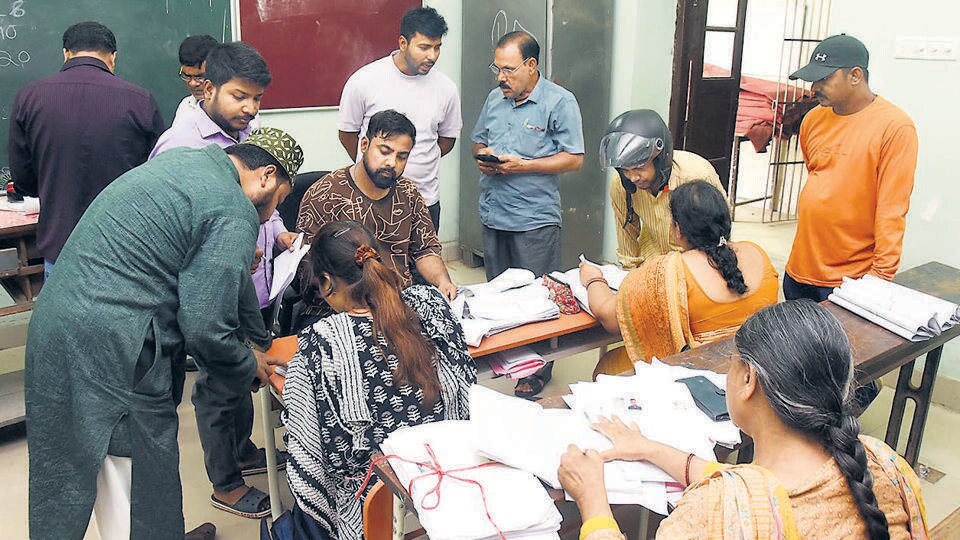
The first phase of the Special Intensive Revision (SIR) ended on Saturday. The new draft electoral roll is set to be published on August 1, which is also when the month-long claims and verification process will begin. The final electoral roll will be published on September 30 for the assembly polls, scheduled later this year.
The Election Commission of India (ECI) didn’t release final figures on Saturday but its bulletin on Friday showed 6.5 million names might be excluded from the draft electoral roll due to death, duplication, permanent migration, or non-submission of forms.
Bihar’s electorate stood at 78.9 million people, as per the rolls published in January by ECI after a special summary revision.
EC officials did not respond to HT’s queries.
The potential exclusions include 2.2 million deceased voters, 700,000 voters registered at multiple locations, and 3.5 million who have either migrated permanently or could not be traced during the house-to-house verification. An additional 120,000 enumeration forms remained pending as the deadline passed.
If all of them are excluded from the final rolls, it might represent the largest single potential exclusion of voters from any state’s electoral rolls in recent memory, a move the poll panel has defended as being necessary in the Supreme Court to maintain the sanctity of elections.
The commission has not released updated figures, with officials citing technical issues in data compilation. A “full and final update” is expected Sunday or Monday, according to a senior official who said “the process is still being collated.”
Election officials said that the state machinery including district election officers, electoral registration officers and 98,498 booth level officers, around 150,000 booth level agents ( BLAs) appointed by recognised political parties along with ground level workers and around 400,000 volunteers conducted the month-long exercise.
“The SIR has been one of the biggest poll exercises in recent years where state officials worked tirelessly to distribute, collect and also help voters in filling enumeration forms,” said an election official, requesting anonymity.
The commission said it received and digitised forms from 72.3 million voters but did not disclose how many submitted the required supporting documents to prove citizenship and residency.
“We are now just uploading any documents we get—Aadhaar card, ration card, property papers, anything we get our hands on,” said a booth-level officer, from Araria district. “Now it is up to the commission to take a call on whether these documents will be accepted as proof or not.”
The exercise began on July 1.
Those who have their name in the 2003 voter roll can just cite that extract. For others, there are three buckets (those born before 1987 can just give their own identity proof, those born between 1987 and 2004 have to provide their own proof plus documents of either parent, and those born after 2004 will have to provide documents for themselves as well as both parents. Voters can submit one of 11 listed documents, which doesn’t include Aadhaar, voter ID or ration card.
Opposition MPs have demonstrated against the exercise in Parliament, alleging it is an affront to electoral democracy. But ECI has said that the drive is aimed at weeding out ineligible names, citing rapid urbanisation, frequent migration and inclusion of the names of foreign illegal immigrants. The Bharatiya Janata Party has backed the exercise and said that it is needed to ensure the legitimacy of electoral rolls.
The protests come as the verification drive faces a critical Supreme Court hearing scheduled for Monday, July 28. The court had earlier refused to stay the exercise but asked the commission to consider accepting Aadhaar cards, ration cards, and voter IDs as supporting documents.
The commission filed a counter-affidavit July 21 stating these documents do not constitute proof of citizenship, setting up a potential confrontation when the court reconvenes.
The commission said it shared lists of deceased, migrated, or non-responsive voters with 12 political parties July 20 for verification, but many discrepancies remain unresolved. Senior commission officials said the verification identified suspected Bangladeshi, Nepalese, and Myanmar nationals on voter rolls in border districts including Araria, Kishanganj, Purnia, and Champaran. “All such cases will be referred to the competent authorities under the Citizenship Act,” one official said.
The commission will publish the draft electoral roll August 1, triggering what is expected to be an intense political battle over the exclusions. Voters and political parties can file claims and objections from August 1 to September 1, with electoral registration officers tasked with resolving disputes.
The final electoral roll is scheduled for publication September 30, ahead of assembly elections expected later this year. The timeline could leave little room for extensive appeals processes, raising concerns about permanent disenfranchisement of legitimate voters.
The exercise represents the first phase of a planned nationwide electoral roll revision, with five other states—Assam, Kerala, Puducherry, Tamil Nadu, and West Bengal—scheduled for similar drives before 2026 elections. A nationwide rollout schedule is expected once the Supreme Court hearing concludes.


