
 E-Paper



PLA force accretion on Finger 4 belies Beijing’s Ladakh disengagement offer
External Affairs Minister S Jaishankar is meeting his Chinese counterpart Wang Yi in Moscow on Thursday to discuss the situation along the Line of Actual Control or LAC.

 Prefer HTon Google


At a time when Chinese Foreign Ministry is expressing hopes of troops going back to camping areas from present confrontation in Ladakh, the People’s Liberation Army (PLA) is showing no such signs on ground and has undertaken force accretion on contested Finger four relief feature of Pangong Tso.
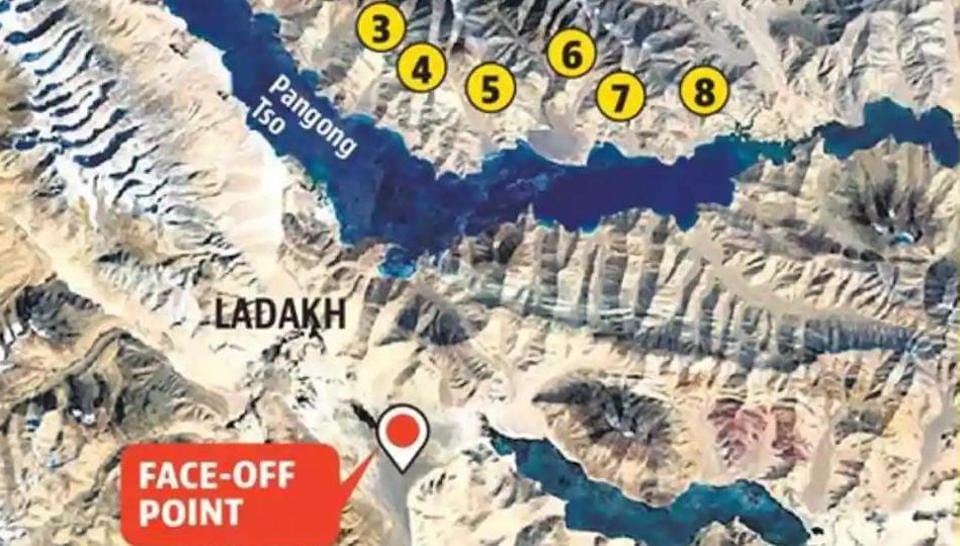
The doubling of PLA troop strength on Finger four on north bank of the lake has sowed distrust in the Indian Army’s mind about the sincerity of Beijing offer even as it holds dominant positions south of the saltwater lake. The only other explanation is that the Chinese Foreign Ministry is not on the same page as the Western Theatre Commander of the PLA.
External Affairs Minister S Jaishankar is meeting his Chinese counterpart Wang Yi in Moscow on Thursday to discuss the border situation and remind Beijing about the bilateral commitment to peace and tranquility accords signed since 1993 which pertain to minimum troop deployment along the Line of Actual Control (LAC).
Also Watch | Explained: Behind China’s LAC dares, a nefarious plot to destabilize India
The fundamental problem facing the Indian Army in proposed disengagement and de-escalation is lack of any Chinese guarantee that the PLA will not occupy those positions vacated by the Indian troops south of Pangong Tso. Just as PLA has taken dominant positions upto Finger 4 on the north bank, the Indian Army is now holding the Rezang La-Rechin La ridgeline right upto its perception of the LAC. The PLA troops are virtually contesting these Indian positions through large scale deployments south of the lake.
Although the Chinese spokesperson on Tuesday talked about harsh weather conditions in the area, fact is that Indian Army has been used to such conditions since Operation Meghdoot in Siachen in 1984. “ The Indian soldier is prepared for mountain and snow from the very beginning with virtually all of them serving either on the Line of Control with Pakistan, Siachen Glacier or the LAC,” said a military commander. The PLA on the other hand last bled in Vietnam in 1979.
The basic problem facing disengagement is that Chinese have road infrastructure right upto the LAC in Ladakh, while the Indian Army troops have to traverse mountain passes, nullahs and ridges to reach their current posts and positions. “If China is serious about disengagement and de-escalation, then both sides have to bilaterally commit that the other side will not occupy the heights once vacated by the present occupant. Only then will the disengagement be successful,” said a military commander.
In the past 27 years, the PLA have nibbled into the LAC with the Indian Army troops with their defensive mindset sticking only to the patrolling points (defined by the China Study Group), which fall well short of Indian perception line. However, the Indian Army’s posture has changed since the initial PLA transgressions in May. And this time, the Indian troops are not even willing to given an inch within their side of the LAC.


