
 E-Paper



Plea in SC challenges J&K delimitation
The plea filed by Haji Abdul Gani Khan and Mohammad Ayub Mattoo, both residents of Srinagar, said the last delimitation exercise in Jammu and Kashmir was carried out in 1995 and it based on the 1981 census as there was no census carried out in the erstwhile state in 1991.


A petition has been filed in the Supreme Court by two Kashmir residents challenging the Centre decision on the delimitation exercise for redrawing the assembly and Lok Sabha constituencies in the Union territory of Jammu and Kashmir.
The plea filed by Haji Abdul Gani Khan and Mohammad Ayub Mattoo, both residents of Srinagar, said the last delimitation exercise in Jammu and Kashmir was carried out in 1995 and it based on the 1981 census as there was no census carried out in the erstwhile state in 1991.
Questioning the delimitation order by which the number of assembly seats was sought to be increased from 107 to 114, the petition said, “The census operation was completed in 2001, but the delimitation was done in 1995. Even on this count, the entire process adopted is unconstitutional as there is no population census operation during 2011 at all for Jammu and Kashmir.”
“After the census of 2001, the Jammu and Kashmir Assembly amended ‘Section 47’ of the Jammu and Kashmir Constitution, vide the Jammu and Kashmir (Twenty-nine amendment) Act, 2002, to put on hold on delimitation exercise till after 2026, identical to and in tune with Article 170 of the Indian Constitution,” the petition filed through advocate Sriram Parakatt stated.
“If August 5, 2019 was to unite the Jammu and Kashmir state with India, then delimitation process defeats “new order” of One Nation One Constitution in the country,” the petition said, adding that the Centre has no power, authority, or jurisdiction to establish a delimitation commission, which is a task entrusted to the Election Commission of India.
Until 2019, according to the petition, when the state was bifurcated into two Union territories, the delimitation of J&K’s Lok Sabha seats was governed by the Constitution of India and that of assembly seats by the J&K Constitution and J&K Representation of People Act, 1957.
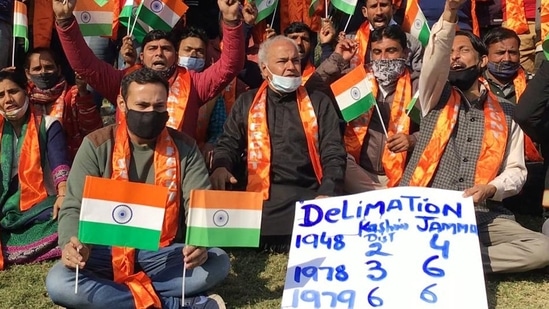
The present delimitation exercise in J&K is being done on the basis of the 2011 census, according to which, the population of Kashmir and Jammu are 6.8 million and 5.3 million, respectively. “Out of total 87 seats, (later increased to 90), 46 are in Kashmir and 37 in Jammu. It has been proposed that Jammu will get six new seats and Kashmir will get only one new seat, disproportionately with the respective population in these parts of the UT,” the petition stated, adding that the move was “unconstitutional and also violative of the provision of Section 39 of the UT Act”.
The Union ministry of law and justice (Legislative Department) on March 6, 2020, issued a notification in exercise of power under Section 3 of the Delimitation Act, 2002, constituting a delimitation commission, with former Supreme Court judge (Retd) Ranjana Prakash Desai as chairperson, for the purpose of delimitation of assembly and Lok Sabha constituencies in the UT of Jammu and Kashmir and the state of Assam, Arunachal Pradesh, Manipur and Nagaland, for a period of one year.
The petition also questioned why J&K was singled out for delimitation when Article 170 of the Constitution provides that the next delimitation in the country will be taken up after 2026. “Conducting delimitation only for UT of Jammu and Kashmir is unconstitutional as it amounts to further classification as held in the Subramanian Swamy case of 2014 that said there should be a nexus between the basis of classification and object of the law under consideration,” it added. The petition claimed that for J&K alone, 2011 census was the basis while for other states it was 2001 census.


