E-Paper



PM launches projects in Assam, invokes heritage
Indian Prime Minister Narendra Modi has said the Bharatiya Janata Party (BJP) has focused on both development and heritage over the past 10 years. Speaking at a public meeting in Guwahati, Modi criticised previous governments for failing to ensure simultaneous development and revival of the country's heritage. He cited examples of increased tourism and religious pilgrimage to demonstrate the impact of the BJP's policies. Modi also highlighted the increased number of higher education institutions and investment in the northeast region of India. During his two-day visit to Assam, projects worth INR116bn ($1.6bn) were rolled out.


The government under the Bharatiya Janata Party (BJP) has made vikas and virasat (development and heritage) its policy over the last 10 years, Prime Minister Narendra Modi said on Sunday, as he reiterated his pitch for a double-engine government.
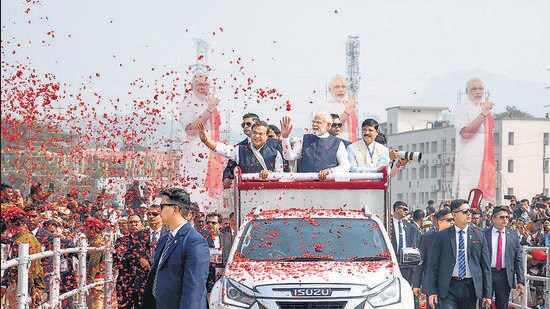
Addressing his first public meeting in Guwahati, Assam, ahead of the Lok Sabha polls in the summer, the PM hit out at previous governments for failing to ensure simultaneous development and revival of the country’s heritage after Independence. During his two-day visit to the state, the PM rolled out projects worth ₹11,600 crore.
“I am satisfied that in the past 10 years that situation has changed in India. The double-engine government of BJP has made both development and heritage (vikas and virasat) part of its policy,” the PM said. The BJP has often used the term “double-engine” for its governments at the Centre and state levels.
The outcome of this policy can be seen in rural areas of Assam where places of faith and history have witnessed a boost with modern facilities, he said, adding that this revival happened concurrently with development.
“The youth of the country has got the direct benefit of our focus on development and heritage. There’s enthusiasm in the tourism and religious pilgrimage sectors these days,” the PM said.
He cited the examples of over 85 million devotees visiting the Kashi Vishwanath Corridor in Varanasi over the past year, over 50 million visiting Ujjain to witness Mahakal-Mahalaok, over 1.9 million going to Kedarnath Temple and 2.4 million visiting Ayodhya within 12 days of consecration of the Ram Temple.
“The same will happen after the Divyalok Pariyojana is implemented at Kamakhya Temple in Guwahati,” he said.
A country cannot develop by erasing or forgetting its past, the PM said.
“No country can become developed by erasing, forgetting its past and by cutting its own roots… Unfortunately, those who ruled the country for long after Independence failed to recognise the importance of religious places. For political gains, they created a trend of feeling ashamed of one’s own culture and past,” he said.
The PM said that in the past 10 years, the number of higher education institutions has increased manifold. Earlier, educational institutes of repute used to be based only in few select cities, but there is a network of such institutes across the country, he said.
“Earlier Assam used to have just six medical colleges. Now, under the BJP government, it has increased to 12. The state is now on way to becoming the biggest centre of cancer care in the northeast,” said Modi.
The PM also highlighted the special emphasis the BJP has laid on the northeast over the last decade, and said that the budget outlay for the region has increased fourfold since the BJP formed a government at the Centre in 2014.
“We launched a campaign to provide electricity to all households. Now we are on the way to ensuring zero electricity bills (for consumers). In this year’s budget, we have announced a big project for roof-top solar (electricity),” said Modi.
“All these development works that are underway and have been done in past 10 years has been done with the aim of making India the third biggest economic power in the world and to transform the country to a developed one by 2047. There’s a big role of Assam and northeast in fulfilling this goal,” he said.
Earlier in the day, the PM unveiled various infrastructure and development projects in the state.
Some of the major projects for which foundation stones were laid were the Kamakhya temple corridor ( ₹498 crore), the six-lane road from the new airport terminal in Guwahati ( ₹358 crore), the upgradation of Nehru Stadium to FIFA standards ( ₹831 crore) and a new sports complex in Chandrapur ( ₹300 crore).
The second edition of ‘Asom Mala’ roads was also kick-started by the PM. This phase will comprise upgrading and constructing 43 new roads with 38 concrete bridges, entailing a total investment of ₹3,444 crore.
Besides, Modi laid the foundation stone for an integrated new building of the Gauhati Medical College and Hospital, to be constructed at a cost of ₹3,250 crore.
He also laid the foundation stones for the proposed Karimganj Medical College and Hospital, which will be constructed at a cost of ₹578 crore, and the ₹297-crore Unity Mall in Guwahati.
“All of these projects will increase connectivity of Assam and the rest of northeast with countries of Southeast Asia. They will create employment opportunities in the tourism sector, boost sporting talents and improve medical education and healthcare in the region,” the PM said.
Lauding PM Modi’s efforts in pushing infrastructure in the Northeast, Assam chief minister Himanta Biswa Sarma said, “Today marks a golden day for Assam. Under PM Modi, Assam has seen unprecedented peace and prosperity. Thousands of youths left extremism and returned to the mainstream. We got nine bridges made over the Brahmaputra. It could only happen in the Modi regime.”
“This is the first time in the state’s history that infrastructure projects worth ₹11,600 crore have been announced in one day,” he said.