
 E-Paper



PM Modi checks on Xi Jinping mid speech at BRICS Summit, asks, ‘Is it okay?’
Chinese President Xi Jinping attended the BRICS Summit in Delhi. It was his first visit to India in seven years.

 Prefer HTon Google


Prime Minister Narendra Modi briefly paused his BRICS Summit address on Day 1 to check on Chinese President Xi Jinping after appearing to notice that something was wrong. Click here for LIVE updates on Day 2 of the Summit
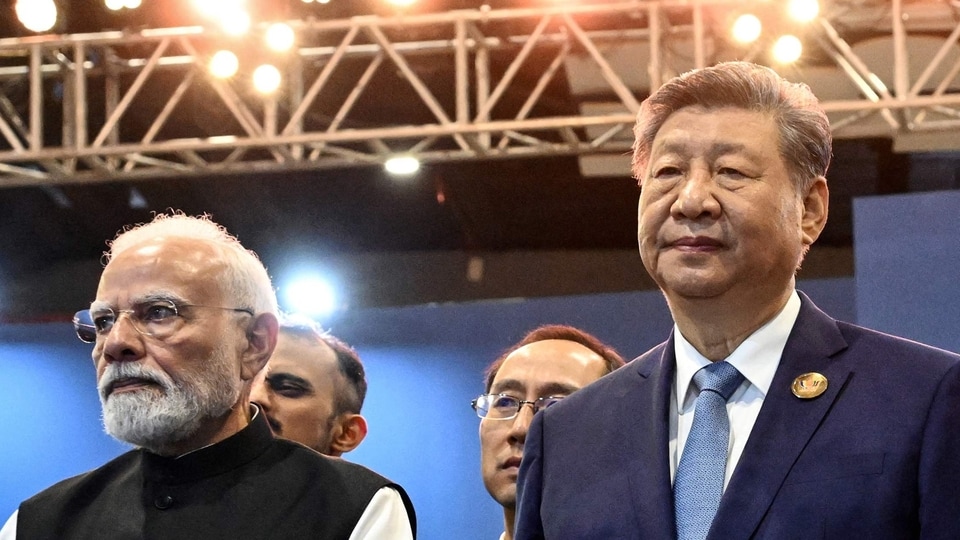
Modi, in the middle of his speech on Saturday, stopped and turned towards Xi, who was in India for the first time in seven years to attend the summit.
“Is it okay,” PM Modi asked the translator accompanying the Chinese president. He repeated the question moments later. It was not immediately clear what had caused Xi’s apparent discomfort.
Deep Dive

After a few seconds, Xi nodded in response, following which Modi resumed his address.
Modi-Xi bilateral meet
PM Modi and Xi Jinping held bilateral talks in New Delhi on September 12, on the sidelines of the BRICS Summit. The meeting lasted more than 50 minutes.
The talks focused on India-China relations, border peace, trade, market access and people-to-people exchanges. A key message from Modi was that peace and stability along the India-China border were essential for the broader relationship, HT earlier reported.
ALSO READ | 'Here, voices are heard’: PM Modi's BRICS message, with Xi, Putin by his side
Modi spoke of the principles of “mutual respect, mutual sensitivity and mutual interest” while discussing bilateral ties. Both sides agreed that differences should not turn into disputes and reiterated the need to work towards a fair and mutually acceptable resolution of the boundary question.
Xi has described India and China as partners rather than rivals and called for a long-term approach to bilateral relations and cooperation.
Xi skips Modi-hosted gala dinner
Xi did not attend the gala dinner hosted by Modi for BRICS leaders on Saturday. The Chinese president was reported to have returned to his hotel to rest.
ALSO READ | BRICS at a turning point: India’s leadership and the road ahead
BRICS Summit 2026: Day 2
The second and final day of the BRICS Summit began at Bharat Mandapam in New Delhi. Modi received visiting leaders, who then posed for the customary family photo with PM Modi at the centre.
Opening the second day, Modi said India’s BRICS presidency focused on four pillars: resilience, innovation, cooperation and sustainability.
He said India had worked with other BRICS members to turn the grouping’s shared vision into practical, “win-win” cooperation.
Modi also warned that rising global tensions were increasingly affecting ordinary people. He cited pandemics, climate-related disasters and supply-chain disruptions, stressing that in an interconnected world, crises do not remain limited to one region.
ALSO READ | A distress network for seafarers at sea: What Modi proposed at BRICS, and why India needs it
BRICS to develop infectious disease early-warning system
Modi announced that BRICS countries had reached a consensus on a BRICS Integrated Early Warning System aimed at improving preparedness and response to infectious diseases.
He also said the grouping had formulated Early Warning Data Integration Guidelines for disaster management.
The initiatives are aimed at improving coordination and ensuring that member countries can respond more quickly to emerging risks.


