
 E-Paper



PM Modi inaugurates Phase 2B of Mumbai Metro Line-3: Full guide to Aqua Line route, stations, fares, and timings
PM Narendra Modi inaugurated Phase 2B of the Mumbai Metro Line-3, stretching from Acharya Atre Chowk to Cuffe Parade, constructed at a cost of ₹12,200 crore.

 Prefer HTon Google


Prime Minister Narendra Modi inaugurated the final phase of Mumbai Metro Line-3, also called Aqua Line, during his two-day Maharashtra visit that began on Wednesday.
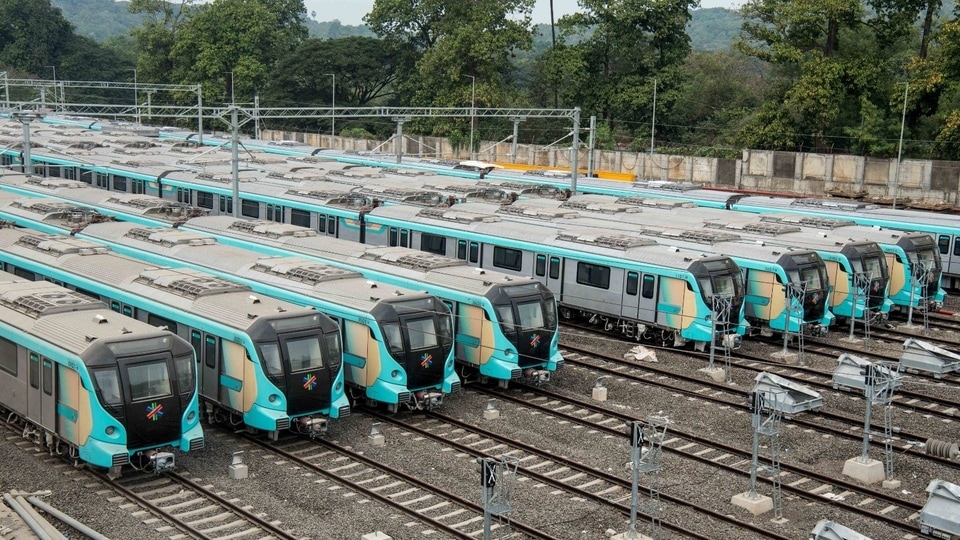
Mumbai’s first fully underground Metro corridor became fully operational on Thursday after the inauguration of the 10.99-km-long final stretch between Acharya Atre Chowk and Cuffe Parade stations.
After reaching Navi Mumbai on Wednesday, Modi undertook a walkthrough of the newly built Navi Mumbai International Airport. He inaugurated the airport and will also launch and dedicate various projects in Mumbai.
Also Read | Pvt buses to offer last-mile link to seven Metro 3 stations
About Phase 2B of Mumbai Metro Line-3:
- Modi inaugurated Phase 2B of the Mumbai Metro Line-3, stretching from Acharya Atre Chowk to Cuffe Parade, constructed at a cost of ₹12,200 crore.
- The prime minister dedicated the entire ₹37,270 crore Mumbai Metro Line 3 (Aqua Line) to the nation, marking a major milestone in the city’s urban transport transformation.
- The entire 33.5-km stretch of Mumbai Metro Line-3 between Cuffe Parade and Aarey JVLR became operational on Thursday morning.
- The full-length operation of the corridor, known as Aqua Line, started with the departure of the first trains from both the terminals at 5.55am, an official from the Mumbai Metro Rail Corporation (MMRC) told PTI.
Also Read | Mumbai metropolitan region to finally get one ticket booking app for all public transport
List of all 27 stations (south to north)
- Cuffe Parade
- Vidhan Bhavan
- Churchgate
- Hutatma Chowk (Fort)
- CSMT (Chhatrapati Shivaji Maharaj Terminus)
- Kalbadevi
- Girgaon
- Grant Road
- Mumbai Central
- Mahalaxmi
- Science Museum (Worli)
- Worli
- Siddhivinayak
- Dadar
- Shitaladevi Temple
- Dharavi
- Bandra Kurla Complex (BKC)
- Vidyanagari
- Santacruz
- CSIA Domestic Airport (T1)
- CSIA International Airport (T2)
- Marol Naka
- MIDC
- SEEPZ
- Marol
- Aarey Colony
- Aarey Depot (JVLR terminus)
10 things to know about Mumbai Metro Line-3 (Aqua Line)
- Phase details: The first phase (Aarey JVLR–BKC) was inaugurated on October 7, 2024, and the second phase (BKC–Acharya Atre Chowk) opened on May 10, 2025. The newly opened Phase 2B completes the corridor.
- Fully underground line: Metro Line-3 is Mumbai’s first and only fully underground Metro line, featuring 27 stations and spanning major residential, commercial, and heritage areas.
- Project cost: The final stretch cost ₹12,195 crore, while the total project cost stands at approximately ₹37,270 crore.
- Construction timeline: Work began in 2017 under the Mumbai Metro Rail Corporation Ltd (MMRCL), with over 15,000 workers involved at peak construction.
- Record-breaking engineering: For the first time in India, 17 Tunnel Boring Machines (TBMs) were deployed simultaneously, a national record in underground construction.
- Rail integration: The Aqua Line will connect seamlessly with Central Railway at CSMT and Western Railway at Mumbai Central and Churchgate, improving intermodal travel.
- Key connectivity hubs: The line enhances access to Nariman Point, Fort, Kalbadevi, RBI, BSE, and Mantralaya, easing travel for professionals working in the city’s core business and administrative zones.
- Airport link: The line will provide direct Metro access to Chhatrapati Shivaji Maharaj International Airport from south Mumbai, a major relief for air travellers.
- Commuter benefits: Once operational, the Aqua Line will serve around 13 lakh passengers daily, cutting travel time from Cuffe Parade to Aarey JVLR to just one hour, compared to the current 1–2 hours by road.
- Fares: Commuters travelling up to 3 km will have to pay ₹10, while those covering a distance between 3 km and 12 km will be charged ₹20. Those journeying between 12 km and 18 km will need to pay ₹30, and those travelling 18 to 24 km will be charged ₹40. For longer commutes, fares have been set at ₹50 for 24 km–30 km and ₹60 for 30 km–36 km.
Integrated Mobility - ‘Mumbai One’ App
Alongside the metro launch, Modi also unveiled “Mumbai One”, a common mobility app for 11 transport operators, including Mumbai Metro Lines 1, 2A, 7, Aqua Line 3, Monorail, Navi Mumbai Metro, suburban rail, and BEST.
The app allows digital ticketing, multimodal trip planning, and cashless payments, reducing queues and simplifying commutes.
(With inputs from PTI)


