
 E-Paper



‘Open-ended questions misleading’: Kharge, Rahul Gandhi write to PM Modi, flag caste census concerns
Mallikarjun Kharge and Rahul Gandhi said the same caste could have different names, sub-castes and spellings in different parts of India.

 Prefer HTon Google


Congress leaders Mallikarjun Kharge and Rahul Gandhi have objected to the proposed method of collecting caste details in Census 2027. Their concerns were raised in a letter to Prime Minister Narendra Modi.
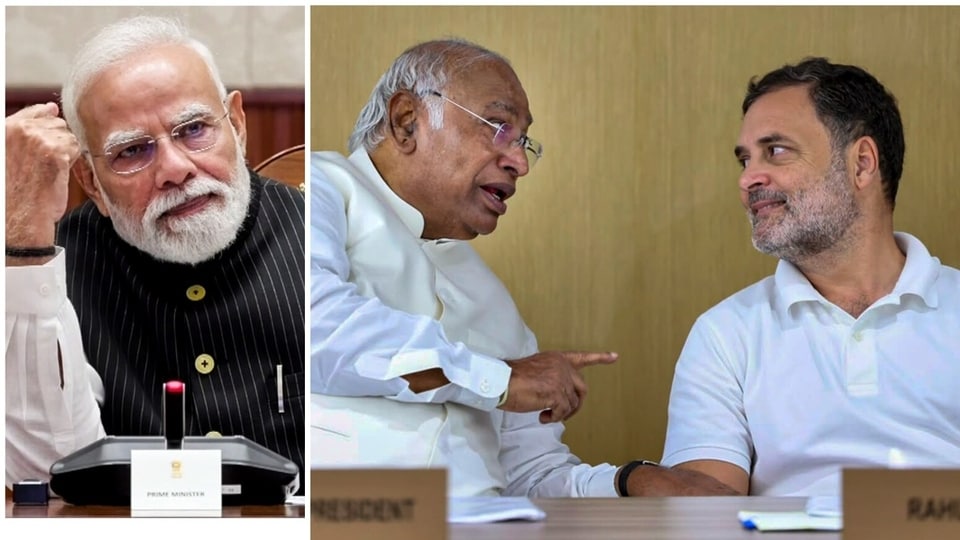
The Population Census 2027 will include caste counting for the first time since Independence. Kharge, Leader of Opposition in the Rajya Sabha, and Rahul Gandhi, his Lok Sabha counterpart, said the government’s decision to use open-ended questions to record caste details could create confusion.
Reliable caste data was essential for framing social justice policies and assessing the socio-economic status of different communities, the leaders said. “Your government has chosen the method of recording caste information in the census using open-ended questions, which is misleading,” the letter read.
ALSO READ | Caste among 40 questions notified for the second phase of the Census 2027
The leaders said the same caste could have different names, sub-castes and spellings in different parts of India. If people from the same caste are recorded under different names, one caste could end up being counted as several different groups.
“This will result in millions of castes in the country, rendering the entire data obtained from the caste census useless,” the letter said.
Kharge and Rahul Gandhi said this could lead to incorrect estimates of the size of different communities. This could also affect decisions on education, jobs, government planning and social justice schemes, they said.
The proposed census would not give an accurate figure for the total OBC population because the questionnaire does not include the term “backward class”, the leaders wrote in the letter.
ALSO READ | SP turns to booth-level caste data ahead of 2027 assembly polls
Kharge, Rahul suggest caste list
The Congress leaders suggested using a fixed list of castes through a drop-down option instead of allowing people to enter caste names freely.
They said such a list could be prepared using existing government lists, including the Socially and Educationally Backward Classes list and information from the Anthropological Survey of India.
They cited the caste surveys conducted in Telangana and Bihar, saying both used caste lists. Copies of the caste lists from the Telangana Caste Survey-2024 and Bihar Caste Survey-2022 were attached to the letter.
“We do not accept this method of conducting a caste census,” Kharge and Rahul Gandhi said.
They asked the government to cancel the current questionnaire and prepare a new one after consulting political parties, experts and the public.
They said the new method should ensure that the number of people belonging to each caste and community is recorded correctly.
ALSO READ | How will the 2027 Census count caste? Number Theory
Caste census in India
One of the most important parts of this Census is the caste enumeration, which will take place for the first time in independent India. Caste was counted during the British period but this practice was later stopped.
The Census has continued to separately count Scheduled Castes (SCs) and Scheduled Tribes (STs). The population of other communities, including Other Backward Classes (OBCs), was not separately counted.
The demand for a caste census has mainly come from OBC groups and political leaders. So, how will the 2027 Census count caste apart from SCs and STs? Here is what we know so far.
The challenge of counting OBC sub-castes
A key question is whether the government has a complete list of all OBC sub-castes. There is no single nationwide list. There are 2,479 entries in the Central OBC list, while states have their own lists. The total number is therefore much higher.
For example, Tamil Nadu has 182 OBC entries on the Central list but 252 entries on its state list. The Mandal Commission identified 3,743 communities as OBCs.
Why detailed data matters
Government surveys have already given broad estimates of India's caste composition. The NFHS 2019-21 estimated the population share of SCs, STs, OBCs and others at 22%, 9%, 42% and 27%.
The PLFS 2025 gave similar figures: 20%, 9%, 46% and 24%. The Bihar caste survey released in 2023 also broadly matched these estimates.
(With inputs from HT's Roshan Kishore, Abhishek Jha and Nishant Ranjan)


