
 E-Paper



Rahul Gandhi turns to Congress workers for inputs on key issues
Under pressure for the Congress to support Delhi chief minister Arvind Kejriwal’s sit-in protest, Rahul Gandhi turned to party workers for their take on the matter.


As Delhi chief minister Arvind Kejriwal was on his nine-day sit-in protest at lieutenant governor Anil Baijal’s residence, and other regional leaders began expressing solidarity with him, Congress leaders came under increasing pressure — especially on social media — to extend their support as well.
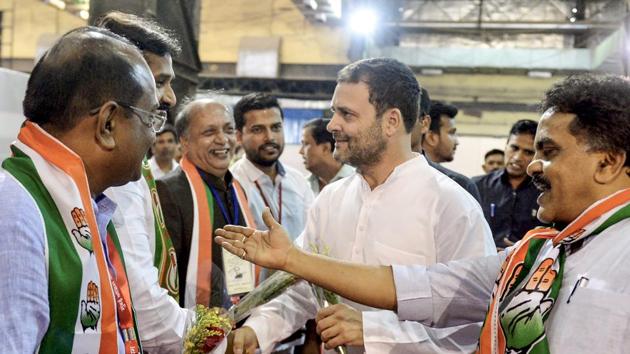
Party president Rahul Gandhi then decided he would not only rely on the inputs of party leaders, but turn to workers directly. He instructed the party’s data analytics department chief, Praveen Chakravarty, to use the Shakti database, a platform with data on party workers at the booth and block level, supplemented with their electoral, demographic, social and economic information.
Within eight hours, the party had — through automated calls — reached out to 40,000 workers, said a party functionary familiar with the development.
“We asked them what the party should do and gave them options. More than 20,000 responded. Among them, a majority said ‘stay away.’ I cannot share the exact breakdown, but the feedback was a major element in the party president’s decision.”
The Congress kept its distance from Kejriwal’s sit-in, which was aimed at getting the L-G to intervene to get civil servants back to.attending meetings with Delhi ministers; the officials had been avoiding attending meetings since an alleged assault on chief secretary Anshu Prakash in February by AAP legislators.
A second Congress functionary confirmed that such a survey had indeed taken place and said it was not just the decision, but the mechanics of decision making, which was important.
“Gandhi has always spoken of bridging the gap between the party and its workers: For the first time, the party immediately reached out to workers on such a scale to gauge their response on a pressing issue. These are the workers who have to go and sell any decision in every house,” he said. The idea was not just to rely on leaders, who may have their own alignments and vested interests, but go beyond them, the first functionary said.
As Gandhi consolidates his control over the party, a major element of his decision-making process in terms of internal party functioning seems to be reliance on data and direct feedback from workers, as one among the many inputs, said both functionaries.
The first functionary offered another example. “Take Karnataka. Senior leaders were given charge of districts. When the party finally decided on ministers, we looked at how the party had done in those districts. Gandhi understood that vote share and seat share could be different. He went by vote share to introduce a degree of accountability and institutionalise a rewards system. This kind of data was always there, it was never used.” He emphasised that this was not the only criteria, but it was one element in appointments. The Congress has faced major dissidence on the state on ministerial appointments.
The second functionary gave a third example - of direct interface with party workers through Shakti.
“Gandhi was going to Chhattisgarh in May. Before addressing a rally in Durg, he decided he wanted to hear from women workers of the Mahila Congress what were the big local issues in that region. We reached out to them through messages. They sent responses. The president weaved it into his speech, and even called one of them out to the stage.”
Looking ahead, this second functionary said that the method of direct interface with workers, through technology, will also be used as an instrument in determining selection of candidates.
“It is the same principle. Workers have to go and campaign for the candidate. If there are 8,000 workers in a constituency, and 6,000 don’t want a particular candidate, how can he win? We now have a mechanism and willingness to use a more scientific system to pick a candidate, rather than decide only in a vacuum and views of a few.”
When asked about the rationale of such methods, Chakravarty said, “Conceived by the party president, Shakti aims to bolster the party at the grassroots through direct engagement with workers. Electorally, it will serve to improve the party’s vote to seat conversation.”
The Congress has noted that BJP’s ability to convert even limited vote-shares to massive majorities, and recognised it needs to do the same. Detailed booth-level data of workers is expected to contribute to the objective. “It is also an important decision-making tool for the party allowing it to receive feedback from workers in a democratic, objective and transparent manner.”
Experts, however, are sceptical about the efficacy of such instruments beyond a point.
‘There is a distinction between taking decisions based on what appears to be popular opinion within the party, gauged through data, and taking decisions which are in the optimal interests of the party and the organisation in the medium and long term,” says Neelanjan Sircar, a senior fellow at the Centre for Policy Research, who has extensively used quantitative data in political analysis.
“So in Delhi’s case, Congress leadership may have got a better sense of the mood of the workers through this mechanism. But the key question is: will this strengthen the Congress in Delhi in six months? This method will not help answer that.”


