
 E-Paper



RBI keeps status quo on rate, ups inflation target
Analysts see MPC’s communication as “modestly hawkish” and believe that RBI’s future course on monetary policy is likely to take a data dependent course.

 Prefer HTon Google


The Reserve Bank of India kept the policy rate unchanged at 6.5%, but increased the cash banks need to keep with it by around ₹1 lakh crore as it moved to remove excess liquidity from the system, indicating that inflation was still a concern, especially in the short-term.
While those with home loans can take cheer from the fact that their mortgages will not become more expensive, and from the central bank’s instruction to commercial banks to make the process of fixing the rate for floating rate home loans more transparent, they will likely have to wait till around early 2024 (if that) for a rate cut.
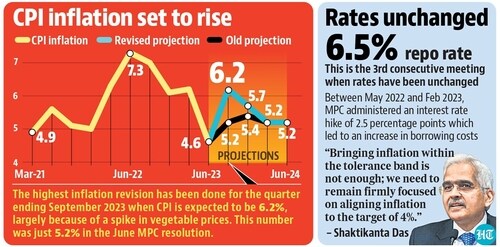
Growth, especially in India, is not a concern, RBI Governor Shaktikanta Das indicated in his statement, and the central bank’s monetary policy committee has kept its growth projection for 2023-24 unchanged at 6.5%, although it has increased its inflation projection from 5.1% to 5.4%. Indeed, with headline inflation numbers set to see a spike due to a sharp rise in vegetable prices, the central bank’s Monetary Policy Committee has sent out a message that it will step in (with rate hikes) if food price tailwinds to overall inflation last beyond the next couple of months.
“We do look through idiosyncratic shocks, but if such idiosyncrasies show signs of persistence, we have to act”, Das said in his statement after the conclusion of the three-day MPC meeting on August 10.
Analysts see MPC’s communication as “modestly hawkish” and believe that RBI’s future course on monetary policy is likely to take a data dependent course. To be sure, most of them agree that the upward revision of inflation projections has pretty much taken rate cuts in the current calendar year out of question.
The highest inflation revision as been done for the quarter ending September 2023 when CPI is expected to be 6.2%, largely because of a spike in vegetable prices. This number was just 5.2% in the June MPC resolution. To be sure, MPC has also flagged risks of rise in prices of cereals and pulses and the resultant pressure on inflation expectations. “It is important to be vigilant about these shocks with a readiness to act appropriately so as to ensure that their effects on the general level of prices do not persist”, the monetary policy committee’s resolution says.
But the overall tone of the MPC resolution as well the Governor’s statement is pretty bullish on the state of the economy despite possible headwinds from the domestic economy. “Healthy balance sheets of banks and corporates, supply chain normalisation, business optimism and robust government capital expenditure are favourable for a renewal of the capex cycle which is showing signs of getting broad-based. Headwinds from weak global demand, volatility in global financial markets, geopolitical tensions and geoeconomic fragmentation, however, pose risks to the outlook”, the MPC resolution said.
Governor Das’s statement is even more bullish on the economy’s growth prospects. “India is uniquely placed to benefit from the ongoing transformational shifts in global economy in the wake of geopolitical realignments and technological innovations. A large economy marching ahead with vast domestic demand, untapped resources and demographic advantages, India can become the new growth engine for the world”, he said.
This is the third consecutive MPC meeting when policy rates have been left unchanged at 6.5%. Between May 2022 and February 2023, MPC administered a cumulative interest rate hike of 2.5 percentage points which led to a significant increase in borrowing costs, especially mortgage payments for creditor firms and households. The latest MPC resolution notes that the rate hike in this cycle is still “working its way into the economy”.
RBI has announced a temporary hike in the Cash Reserve Ratio to absorb surplus liquidity, which is aimed at taking care of the excess liquidity due to withdrawal of ₹2000 currency notes. “It has been decided that with effect from the fortnight beginning August 12, 2023, scheduled banks shall maintain an incremental cash reserve ratio (I-CRR) of 10 per cent on the increase in their net demand and time liabilities (NDTL) between May 19, 2023 and July 28, 2023. This measure is intended to absorb the surplus liquidity generated by various factors referred to earlier including the return of ₹2000 notes to the banking system. This is purely a temporary measure for managing the liquidity overhang”, Governor Das said in his statement.
Analysts see MPC’s actions as an exercise in managing sentiments at a time when monetary policy tools might not be very useful in controlling the latest surge in inflation.
“The central bank is seeking to anchor inflation expectations through its rate actions and communications…We read the MPC decision and statement as a modestly hawkish hold and thus do not expect any further rate moves for the rest of the fiscal year, but any more supply shocks could raise the risks of an incrementally hawkish MPC, especially in the next two meetings”, Rahul Bajoria Head of EM Asia (ex-China) Economics Research, Barclays, said in a note.
 ABOUT THE AUTHORRoshan Kishore
Roshan Kishore is the Data and Political Economy Editor at Hindustan Times. He heads the newsroom's data journalism team, which produces Number Theory, a daily data-driven feature for the print edition and the HT app. Number Theory uses data analysis and story-telling based on it to add value to the newsroom’s daily coverage by putting stories in a larger context on a range of issues, including politics, macroeconomy, markets, global affairs and climate. Under his leadership HT’s data journalism work has established itself as a niche product in Indian journalism and pushed the boundaries of marrying academic rigour with news sense and speed. Along with writing and editing data stories, he has also been writing a weekly political economy column called Terms of Trade for HT Premium. A trained economist with an MPhil degree from Jawaharlal Nehru University, Kishore has also been a visiting fellow at the Centre for Advanced Studies of India (CASI) at the University of Pennsylvania. Along with his journalistic work, his writings have also appeared in journals such as the Economic and Political Weekly and working papers for CASI and UNESCAP.Read More


