
 E-Paper



Covid-19: Religious places in Maharashtra reopen after seven months
Touching of idols, statues and holy books is not allowed and those over the age of 65 and below 10, those with comorbidities or pregnant women have been advised to stay at home


Religious places in Maharashtra re- opened on Monday, after remaining closed for seven months to check the spread of Covid-19 pandemic. The state government’s decision to re-open all the religious places was welcomed not only by the priests but also by the devotees.
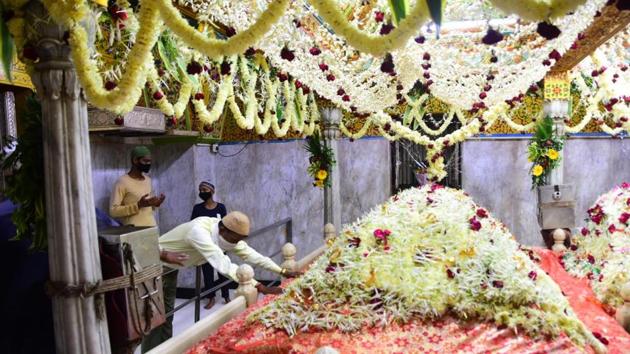
This comes after the Maharashtra government, on Saturday, issued standard operating procedure (SOP) with safety measures. As per the SOPs, offerings to the deity(or prasad), group singing, large gatherings and congregation at religious places was still prohibited. Entrances of religious places have to have thermal screening and sanitiser dispensers.
The state government has also specified that individuals must maintain six feet distance with each other, wash hands frequently using soap or sanitiser,wear masks compulsorily and follow respiratory etiquette.
Also read | No lockdown in Delhi even as Covid-19 cases go up, says Delhi health minister Satyendar Jain
The state has called for staggered entry of visitors in places of worship, which must be decided based on the size of the structure, ventilation etc. by the trust/board running the place and the local authorities. Footwear must preferably be kept inside devotees’ own vehicles or in a separate slot for each person or family. Touching of idols, statues and holy books is not allowed and those over the age of 65 and below 10, those with comorbidities or pregnant women have been advised to stay at home.
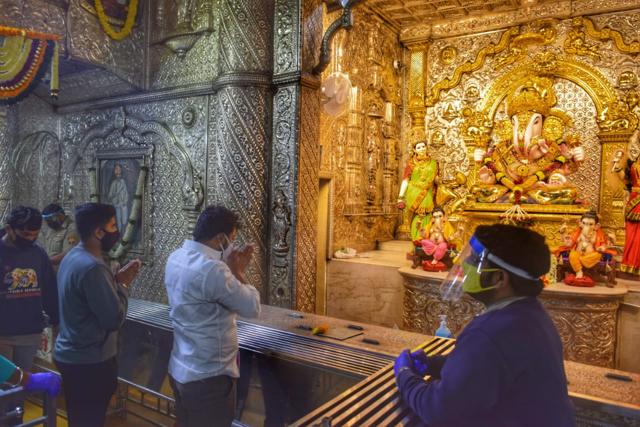
Adesh Bandekar, chairman, Shri Siddhivinayak temple trust, said, “With an aim to provide darshan to 1,000 devotees a day, the temple has laid down measures to be followed by each devotee. We have come up with a mobile application through which devotees can book a slot for their visit. Only when they get a QR code on their mobile phones will they be allowed to enter the temple.”
The temple saw 500 devotees till 12pm and all its 1,000 slots were booked not only for Monday but also for Tuesday.
Haji Ali Dargah had seen over 700 devotees till Monday noon. “It had been months since devotees offered their prayers to Haji Ali. Complying with all guidelines of the state, we expect the numbers to increase. We are allowing 15 people to enter the Dargah at a time,” said Mufti Mansoor Ziyaee, advisor and trust member, Haji Ali Dargah.
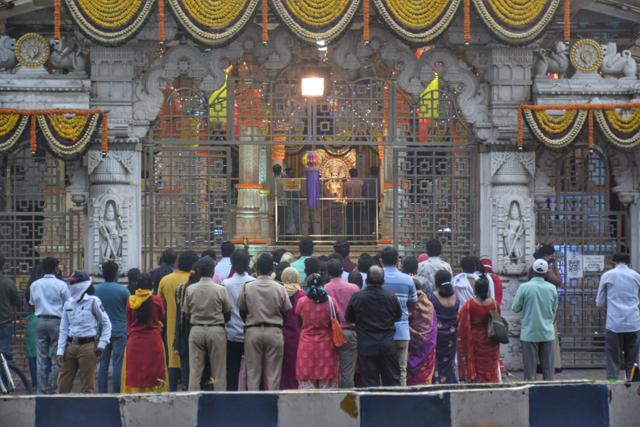
At a Dadar gurudwara, 125 devotees had visited from 8am till Monday noon. “One person has been stationed at the entry to ensure social distancing and to check whether each person is wearing a mask...Langar has been postponed till next Sunday,” said Manmohan Singh Ratti, general secretary, Sri Guru Singh Sabha Bombay, Gurudwara, Dadar.
Mahim Dargah trustee Suhail Y Khandwani said management officials had made all arrangements for the early morning namaz since 12am. “This 363-year-old dargah, which became the first religious shrine in India to get an International Organisation for Standardisation (ISO) certification in 2007, has its own SOP during this pandemic to ensure safety of devotees and the dargah. In addition, all government procedures are being followed,” said Khandwani.
Shirdi Sai baba sansthan they too were following protocols and have restricted the daily count of devotees to 6,000. Following the state’s SOP, no devotee is allowed to wait and offer garlands and prasad.
Fr Nobert D’souza from Holy Cross church in Kurla said, “We have opened the church for two hours in the morning and three hours in the evening. Monday morning saw around 100 devotees. Since our church is big and spacious, we are allowing 15 people at a time but with the help of a team we are ensuring that no one touches idols and lights candles.”
Fr. Nigel Barrett, spokesman of the Archdiocese of Bombay, too said that they were allowing devotees only for five hours at least till Wednesday and they were not allowing community-based prayer. “We have made available only one entry and exit point in the church to ensure safety protocols are followed. A review meeting will take place on Wednesday to understand how our directives have been taken,” he said.
At the International Society for Krishna Consciousness (ISKCON) temple, Juhu, approximately 1,200 devotees offered their prayers through the day on Monday. However, representatives explained they had a strict protocol in place both at the Juhu and Girgaum temples. “We have a separate entry and exit gate so people do not cross each other or mix. Only asymptomatic devotees are allowed to enter and we are checking them using temperature guns at the entry. We have markings on the floor which people are supposed to follow. It is a flowing crowd, and at no point is the queue allowed to stop inside the temple premises or during darshan,” said Parijata Devidasi, communications coordinator, ISCKON Juhu.
Jehangir Patel, editor of the Parsi community magazine Parsiana said, “Our community is small and hence barring a few fire temples at places like Dadar and Tardeo that may have around 40 devotees in a day, we hardly see people going to the fire temples even during pre-Covid days. Hence, carrying out safety protocols and obeying the state governments rules would not be an issue for us.”
Kersi Randeria, a trustee of the Bombay Parsi Panchayet (BPP) said, “We are happy with the state’s decision to open up religious places. While the number of Covid-19 cases and deaths are dropping in Mumbai, there is always a fear of a spike following the festive season, and the dangers that opening up more places may pose. There are 50 fire temples in Mumbai with three under the BPP trust while remaining are run by other trusts. We, as, a community are careful in following the law. Stringent measures in terms of social distancing, proper sanitisation, people have been asked to bring their own prayer books and not touch the ones within the temples, and limited hours for prayers. Overall, we are ensuring the safety of citizens but also reminding them that the pandemic is not over yet.”
(With inputs from Faisal Malik)


