
 E-Paper



‘Rishi Kumar Shukla inexperienced in corruption cases’: Mallikarjun Kharge on new CBI chief appointment
Justifying the need for a dissent note, Kharge wrote, “One cannot stand by and accept the dilution of norms when an appointment to such a critical post is being made.”

 Prefer HTon Google


Mallikarjun Kharge, leader of the largest Opposition party in Lok Sabha, sent a dissent note to Prime Minister Narendra Modi on Saturday that said seniority can’t be the only criteria in selecting the CBI chief and that “experience in investigation of anti-corruption” must also be considered.
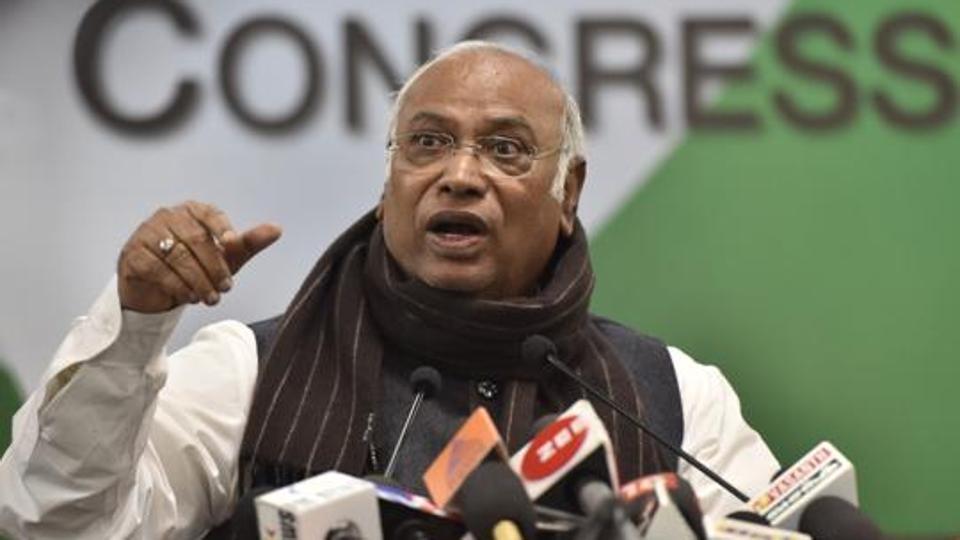
Kharge said Rishi Kumar Shukla, who has been named the new CBI chief, had zero experience in anti-corruption cases.
In the dissent note, HT learns, Kharge suggested that three Indian Police Service officers — S Javed Ahmad, Rajiv Rai Bhatnagar and Sudeep Lakhtakia — were the only candidates who fulfilled the criteria in order of merit. The Congress leader argued that “seniority, integrity and experience in anti-graft cases should be given equal weightage in this matter to get the best suited officer.”
Justifying the need for a dissent note, Kharge wrote, “One cannot stand by and accept the dilution of norms when an appointment to such a critical post is being made.”
Ahmed, a 1984-batch Uttar Pradesh cadre officer, has 303 months experience in anti-corruption cases. Bhatnagar, a 1983-batch UP cadre officer, has 170 months of similar experience and Lakhtakia, a 1984-batch Telangana cadre officer 155 months.
The selection panel, comprising Prime Minister Modi, Chief Justice of India Ranjan Gogoi and Kharge, met on Friday to select CBI chief. Kharge’s dissent note suggests that the new chief was not a unanimous choice but was selected on the basis of majority.
The letter also suggests that, as per the panel’s recommendation, Bhatnagar should be top choice, followed by Shukla, Lakhtakia, Ahmad and AP Maheshwari (a 1984-batch officer of UP cadre).
Also read | New CBI chief appointed: Rishi Kumar Shukla’s Journey from MP top cop to central probe agency’s helm
Kharge cited the Supreme Court’s order in the Vineet Narain judgment that said, “the (selection) committee shall appoint an IPS officer on the basis of seniority, integrity and experience in the field of anti-corruption.” He also cited the Delhi Special Police Establishment (DSPE) Act that said the CBI chief should be selected “on the basis of seniority, integrity and experience in anti-corruption cases.”
According to senior functionaries, the government had drawn up a list of 16 names on the basis of three criteria — seniority, annual confidential report (ACR) with minimum 95 marks, and 100 months of experience in investigation. Kharge objected to the third criteria, but the committee rejected his contention by 2:1 majority and said it would go ahead with the selection. Kharge then decided to send a dissent note in which he emphasised that it was important to restore the image and the integrity of the CBI as a premier institution fighting corruption.


