
 E-Paper



Riyaz Naikoo setback upsets Syed Salahuddin, says the spark will spread in region
Syed Salahuddin, who also heads the alliance of pro-Pakistan terrorist groups, called the United Jihad council, warned India that the Kashmir issue is a spark that could set off a fire that envelopes the entire region.

 Prefer HTon Google


A day after security forces eliminated terror group Hizbul Mujahideen’s Kashmir chief Riyaz Naikoo in a joint operation, the terror group’s Pakistan-based boss Syed Salahuddin said the sacrifice would help them achieve the mission that they had set out to achieve.
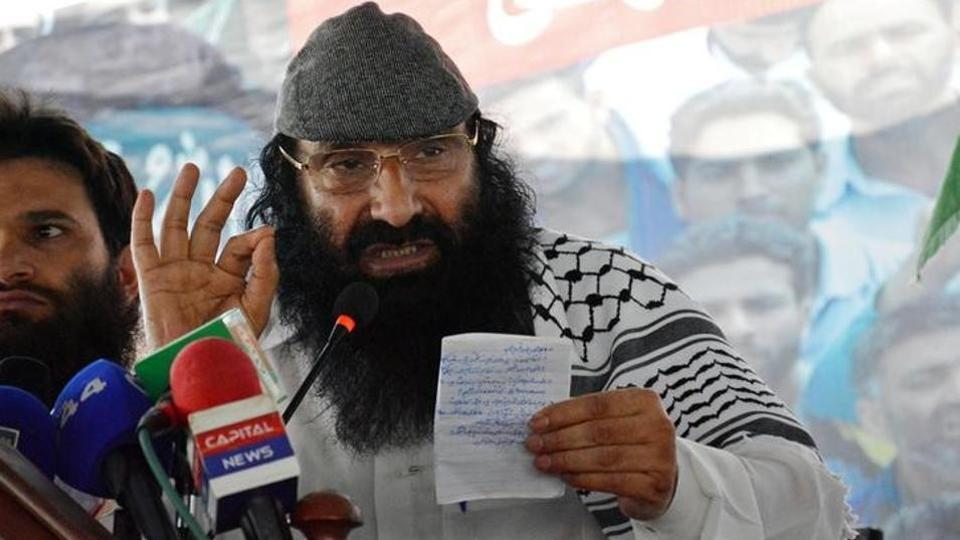
Salahuddin, who also heads the alliance of pro-Pakistan terrorist groups, called the United Jihad council, warned India that the Kashmir issue is a spark that could set off a fire that envelopes the entire region.
Also read: Top Hizbul terrorist Riyaz Naikoo was hiding in south Kashmir bunker; killed in overnight op
The message, according to a statement issued by the terror group said, was delivered at a meeting to condole the death of 32-year-old Riyaz Naikoo and his associate Adil Ahmed who were killed in Wednesday’s operation carried out by Jammu and Kashmir police and troopers from the 21 Rashtriya Rifles.
Syed Salahuddin
Salahuddin was designated as a global terrorist by the United States in 2017. According to the US, Salahuddin had committed or poses a “significant risk of committing acts of terrorim”.
But that classification hasn’t made a difference to the Hizbul Mujahideen boss who has the support of Pakistan’s deep state and has been participating in public events for years. The Pakistan government had then declared that it will not act against Salahuddin since the United Nations Security Council hadn’t classified him as a terrorist.
Islamabad hasn’t acted against those designated by the UNSC either. There are about 130 individuals who have been sanctioned by the UNSC. On them, Pakistan says it can’t find most of the individuals sanctioned by the UNSC due to inadequate or inaccurate information about them in UNSC dossiers.
Riyaz Naikoo’s luck ran out at 7th hideout
Syed Salahuddin’s statement described Riyaz Naikoo’s status in the Hizbul Mujahideen hierarchy as its chief commander. His elimination is a huge setback to the terror group and will lead to its weakening in south Kashmir, where the Hizbul has traditionally been active, a senior police officer said.
This part of Kashmir is also where Riyaz Naikoo had an extensive network.
He had many hideouts in this area, Inspector General of Police Vijay Kumar said on Thursday. Kumar said they had already busted six of his hideouts. The one where he was found dead after the firefight with security forces was his seventh. Because there was a possibility that this house could be linked to others in the vicinity via underground tunnels, the security forces even brought earth-digging equipment, including four JCB machines, to block any such effort to slip out.
Kumar said it was natural that the terror group would be impacted by his elimination. “Riyaz Naikoo was the most experienced… When the next one is named, we will go after him…. We already know who it is going to be,” the Kashmir region’s top police officer said.
Syed Salahuddin’s statement on Thursday did not name anyone. He hadn’t formally designated Riyaz Naikoo either who was seen to be the de facto chief of the Hizbul in Kashmir.


