E-Paper



Rough deal: Panna’s biggest diamond auction means nothing for its miners
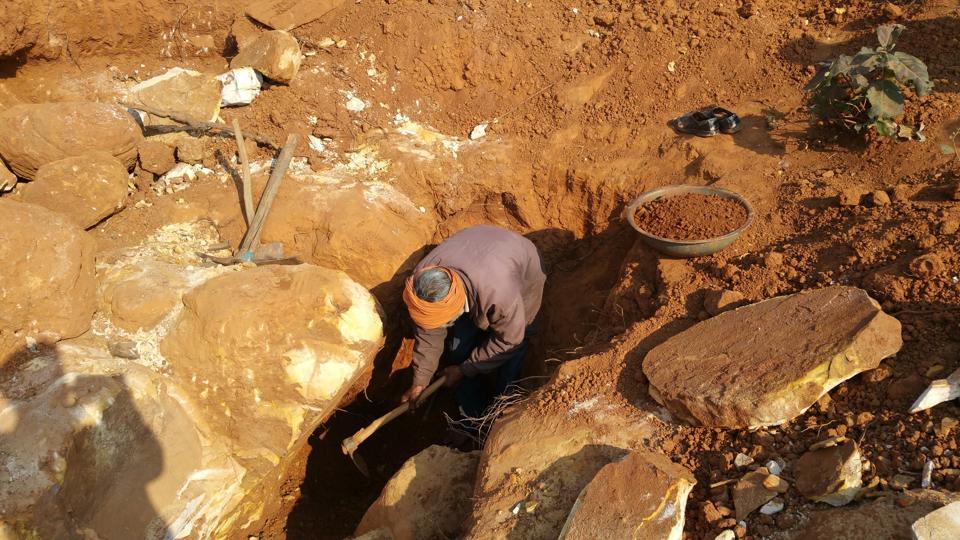
For nearly 6,000 labourers who dig, sift and wash gravel through the year in the region’s diamond mines -- India’s biggest diamond mining zone that auctions the precious stone for around Rs 50 lakh a piece -- the connect ends with finding diamonds in the rough.


Gond tribal Jaggu ‘Adivasi’ is not losing his sleep over a 2 carat diamond he found in the gravel of Panna in November last year. It is out of his hands and will be among the diamonds that would go for lakhs of rupees at a government auction in the Panna collectorate on January 30. Jaggu, who seems to be in his 30s but looks much older, has been paid his wages. It is unlikely he will ever know how much the 2 carat (1 carat= 0.2 gram) diamond went for.
The January 30 auction is the biggest in the history of Panna’s shallow diamond mines and bids would be made for nearly 594 rough diamonds weighing around 476 carats. “Normally diamonds worth Rs 40 lakh to Rs 60 lakh are sold at each auction (four such auctions are held in a year). Though we don’t reveal the price of individual diamonds, collectively we are hoping to get Rs 1 crore in the auction on January 30,” said Ratnesh Dixit, the diamond officer of Panna.
Traders from Mumbai, Surat, Hyderabad and other cities are expected to place bids for the rough diamonds from this zone in Madhya Pradesh’s Bundelkhand region. They would hope to make a killing off the rough diamonds after they are cut, polished.
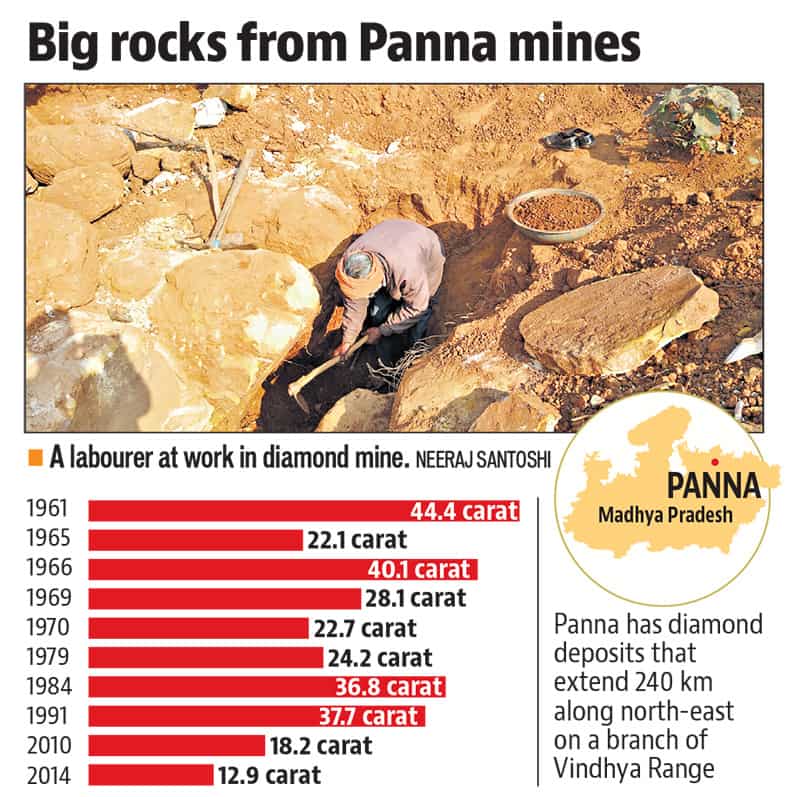
For Jaggu and nearly 6,000 labourers like him who dig, sift and wash gravel through the year in the region’s diamond mines, the wages range between Rs 150 to Rs 200 for a day’s work. This is India’s biggest diamond mining zone and the source of fine stones for the industry. For Jaggu and fellow dihadi (wage) earners, the connect ends with finding diamonds in the rough.
“We get nothing,” said Jagggu, who found the 2 carat diamond after two hours of cleaning dried gravel. “Sab sahab ki kismet. Wo paisa lagate hain aur humein dihadi dete hain. Panna ke jo heere aapke bade sehron mein chamakte hain, unme hamara khoon aur pasina bhi hota hai (It’s all the mine owner’s luck. He invests money and pays us wages. The Panna diamonds that glitter in your big cities have out blood and sweat).”
Most of the labourers are from the local Gond tribe. They know the landscape and are acknowledged as experts in finding diamonds.
Panna’s mining zone runs parallel to the Ken river for nearly 80 km and is 10 km wide and has close to 952 mining leases for shallow diamond mines.
Narendra Jain, one of the many diamond hunters operating in the area, recently found around 30 diamonds which will figure in the auction. “I invests heavy sums and face the prospect of losses because finding a high-value diamond is more by chance than just hard work,” he said. “In our area, the diamond mines are deep and labour cost high. Last year, I lost Rs 6 lakh as I didn’t find any good diamonds. I am hoping this auction will fetch me Rs 10-15 lakh and I can make some profit.”
There have been instances of labourers trying to steal diamonds by swallowing or concealing them in the body, but few are as lucky as actorDjimon Hounsou’s character in the Academy award-winning movie Blood Diamond who managed to take a diamond out of a mine in Africa.
“The mine owners have retrieved diamonds from excreta of labourers and even from wounds inflicted by some to hide the precious stones,” said an official at the Panna diamond office. “Every worker is under constant watch of strongmen appointed by mine owners to prevent leakages.”
For a handful few who have managed to sneak out rough diamonds, there isn’t much money to be made selling them on the sly.
“I found a three carat diamond and the buyer gave me Rs 10,000. We don’t know the exact value of diamonds. I took whatever he gave me,” said Dhaniram (name changed) at Dalhan Chowki in Panna.
Another labourer Hari (name changed) said he found a 6 carat diamond in Hurra Chowki area a few years ago and sold it for Rs 10,000. “We sell them quickly. I have a family to feed and I can’t keep a diamond with me for long. It has no use for me.”
According to locals, it often does not end well for tribals who manage to sneak out diamonds in Panna, as many spend the cash, which they can’t even count properly, on alcohol.
Diamond hunting in the craggy terrain of Panna is a mixed bag. Not all are that lucky, but no one gives up.
NK Hans, superintending geologist at the directorate of geology and mining, Madhya Pradesh, said Panna has right conditions for diamond formation as it is located in one of the oldest and coolest regions of the continental crust. The diamonds are formed at a very high temperature and pressure nearly 140kmto 190 km below the earth’s surface.
“In Panna, the diamond-bearing rocks were carried to the surface by volcanic eruptions hundreds of years ago. Once they surface, they erode out and get distributed over a large area. The weathered diamond bearing rocks are then found either lying near the surface, or in the sands or in the river beds or the gravel layer,” he said.