
 E-Paper



RSS begins three-day annual meet in Raipur to discuss social issues
RSS chief Mohan Bhagwat, general secretary (sarkaryavah) Dattatreya Hosabale and BJP president J P Nadda were present in the meeting that started in Jainam Manas Bhavan.


The top brass of the Rashtriya Swayamsevak Sangh, the ideological parent of the Bharatiya Janata Party, began its three-day annual national coordination meet (Akhil Bharatiya Samanvay Baithak) on Saturday in Chhattisgarh’s capital to discuss various social issues, including religious conversions and expanding the reach of the Hindutva organisation and its affiliates.
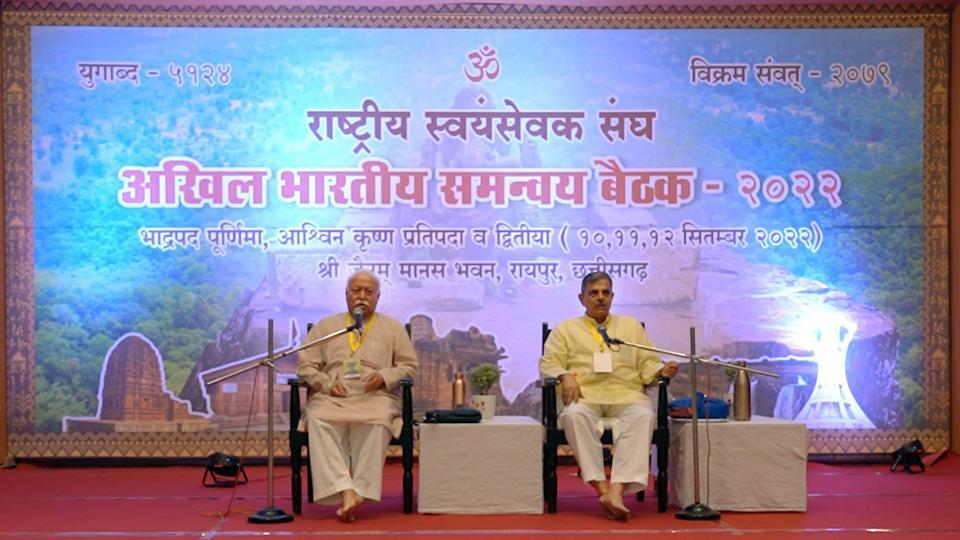
RSS chief Mohan Bhagwat, general secretary (sarkaryavah) Dattatreya Hosabale and BJP president J P Nadda were present in the meeting that started in Jainam Manas Bhavan.
Around 240 office bearers of 36 outfits inspired by or linked to the RSS, including the BJP, the Vishva Hindu Parishad, the Vanvasi Kalyan Ashram and the Akhil Bharatiya Vidyarthi Parishad, are taking part in the closed-door coordination meeting.
“Apart from many other issues, the core issue of Samanvay Baithak will be religious conversion and expansion of the organization and its wings,” a RSS functionary said, seeking anonymity.
All 36 organisations are working for social causes and nationalism, and they will share their experiences and discuss their work and achievements in the past one year, said Sunil Ambekar, the chief national spokesman of the RSS.
The RSS is looking at significantly expanding its shakha (branches) network by 2025 to mark its centenary year.
“We have more than 60,000 shakhas and the aim is to open more than 1 lakh shakhas by 2025,” the functionary said. “Some of the states like Chhattisgarh, Rajasthan , Jharkhand and others have non-BJP governments and the strategy to help BJP come in power by 2025 is also an agenda.”
It is for the first time that the national coordination meeting of RSS-linked organisations is being held in Chhattisgarh.
The RSS has strategically planned this meeting in Raipur because the organization wants to boost its wings for the upcoming state elections, Chhattisgarh BJP leaders said, wishing to remain unnamed. In 2018, the Congress got two-thirds majority in the state assembly, ending a 15-year rule of the saffron outfit.
For the BJP, the 2023 assembly elections are important, and the party is focusing on its second line of leadership in the state. they said.
Since Congress in the past 3.5 years has managed to raise the issue of sub-nationalism in the state , the main opposition BJP is eying on religious conversion as the core agenda in upcoming state elections.
“In Chhattisgarh, conversion is the biggest issue, which is to be discussed in the meeting,” a BJP leader said. “Secondly, since the assembly election is in 2023, the organization wants to push its wings and office bearers to hit the ground.”
-kW0H-U20214218012MgB-250x250%40HT-Web.jpg)


