
 E-Paper



SC hears plea to apply 2014 verdict on single directive with retrospective effect
On Tuesday, a five-judge bench headed by justice Sanjay Kishan Kaul demarcated the broad contours of arguments to be made by CBI, and other lawyers appearing in the matter


The Supreme Court, which struck down a provision that required the government’s prior sanction to proceed in corruption cases against officers of the rank of joint secretary and above, set out on Tuesday to examine whether its judgment could be applied retrospectively.
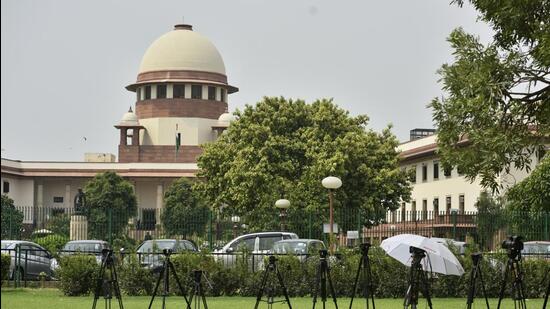
In 2014, a five-judge bench struck down Section 6-A of the Delhi Special Police Establishment (DSPE) Act that shielded officers of the rank of joint secretary against investigation by the Central Bureau of Investigation without sanction under the Prevention of Corruption Act. This bench ruled that the amendment was “invalid and violative of Article 14 of the Constitution” but did not specify whether the decision applied retrospectively or not.
As the decision was by a five-judge bench, this issue had to be resolved by a composition of five judges.
In March 2016, the court referring this question to a constitution bench said, “The provisions of Section 6A(1) of DSPE Act do indicate that for officers of the level of joint secretary and above a kind of immunity has been provided for. Whether there can be a deprivation of such immunity by a retrospective operation of a judgment of the Court, in the context of Article 20 of the Constitution of India, is the moot question that arises for determination in the present case.”
On Tuesday, a five-judge bench headed by justice Sanjay Kishan Kaul demarcated the broad contours of arguments to be made by CBI, and other lawyers appearing in the matter. “The principle in law has to apply as declared by the court. But the court can deal with a situation by saying it will apply prospectively.”
Senior advocate Arvind Datar who appeared for an accused opposing retrospective operation of the judgment, said, “This court while declaring a law invalid or unconstitutional should also specify the consequence of the judgment. Any judgment doing away with the protection should be prospective.”
Since the judgment of the court in 2014, another development took place in 2018 when the Parliament brought an amendment to the Prevention of Corruption Act, re-introducing the blanket protection of prior sanction before investigation and prosecution of any public servant, extending it even to retired bureaucrats and other ranks. This provision contained in Section 17A of PC Act created a situation where the protective cover, removed by the top court, was revived.
Noting the development, the bench, also comprising justices Sanjiv Khanna, AS Oka, Vikram Nath and JK Maheshwari said, “Since a protective regime is declared ultra vires by this court on grounds of discrimination being violative of Article 14, the legislature brought it back, extending protection even to retired persons. That protection is available prospectively. “
The judges further remarked, “At some stage between Subramanian Swamy judgment and the new law (Section 17A) there was a period of hiatus. We have to deal with the complication arising during such time. How should the court read into what happened during the hiatus? We understand the problem. Let us see what via media can be worked out.”
The court also noted that making the judgment retrospective will have its share of problems. “There will be an egregious situation where a person prosecuted earlier will be prosecuted again.” Referring to Article 20 protection under the Constitution which protects a citizen from being prosecuted or punished twice for the same offence, the bench said, “Article 20 is a specific protection against criminalization of past acts.”
Solicitor General Tushar Mehta who made brief arguments on Tuesday will continue to make submissions on Wednesday.


