
 E-Paper



SC to hear plea on Prez Rule in Bengal over Waqf violence
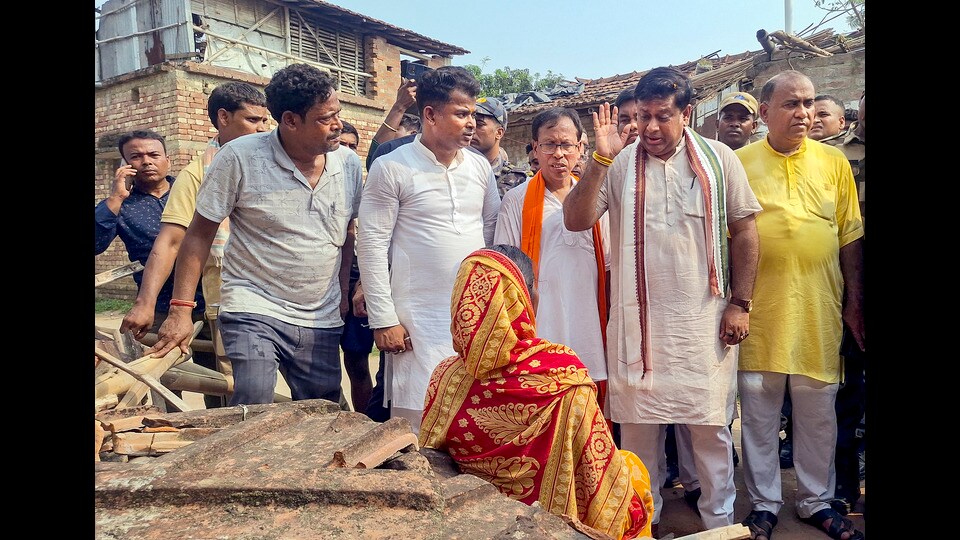
The violence triggered a political battle with the Bharatiya Janata Party targeting the Mamata Banerjee government for permitting violence triggered by protests against the Waqf Amendment Act 2025.

 Prefer HTon Google


The Supreme Court on Monday agreed to hear an application seeking imposition of President’s Rule in West Bengal in the context of recent violence in the state over the Waqf Amendment Bill, even as it spoke for the first time on the criticism of judicial overreach in recent judgments.
A bench headed by justice Bhushan R Gavai was hearing a fresh application filed by West Bengal-based social worker Devdutta Maji and advocate Mani Munjal who sought President’s Rule after clashes in Murshidabad since April 13 left three dead and 18 policemen injured.
Responding to lawyer Vishnu Shankar Jain’s request for considering imposition of President’s Rule, the bench, also comprising justice AG Masih, said, “You want us to issue a writ of mandamus to impose President’s Rule. As it is, we are being blamed for encroaching upon the legislative and executive functions.” The petition will be heard on Tuesday.
In a parallel proceeding, a separate bench of the top court -- comprising justices Surya Kant and N Kotiswar Singh -- heard two petitions demanding an independent probe into the Murshidabad violence case. The court permitted the two petitioners – advocates Vishal Tiwari and Shashank Shekhar Jha -- to withdraw their petitions, as the court found the pleadings to be based on media reports, lacking the decency and standards expected in a matter to be filed before the top court, and for not naming the government officials as parties against whom allegations of inaction is alleged.
The violence triggered a political battle with the Bharatiya Janata Party targeting the Mamata Banerjee government for permitting violence triggered by protests against the Waqf Amendment Act 2025. Following the incident, as NH-2 remained blocked, situation in Murshidabad and some neighbouring districts became tense as shops were looted and police came under attack. The Calcutta high court on April 13 ordered central forces to be deployed in violence-affected areas. The police later swung into action and claimed to have arrested 118 people in connection with the arson and violence.
The application on President’s Rule filed was mentioned by advocate Vishnu Shankar Jain, to be heard along with a pending petition filed by Ranjana Agnihotri and others who asked for President’s Rule in the context of post-poll violence in West Bengal in 2021.
The bench allowed the application to be listed after Jain said, “In the 2021 matter, court has already issued notice and the same is under consideration. Through this application we have brought recent incidents of violence. All we seek is a report under Article 355 of the Constitution by the Centre from the state.”
Article 355 deals with the Union’s duty to protect states against external aggression and internal disturbance, which is a ground to impose President’s Rule. This provision requires Centre to ensure that states run in accordance with the provisions of the Constitution.
The application by Maji and Munjal pointed out incidents of violence targeting Hindus in the state from 2022 till April 2025, and sought a three-member judicial committee headed by a former Supreme Court judge and two former high court judges to inquire into the incidents, particularly the violence in Murshidabad. The applicants also sought directions to the Centre to deploy central forces in the violence-affected areas and the state government to ensure the life, liberty and dignity of citizens.
In 2022, after violence on the eve of Lakshmi Puja in the Mominpur area of Kolkata, the Calcutta high court had ordered the state government to form a special investigation team (SIT) to probe the incident. However, the application said that SIT made no progress in booking the culprits.
Plea for SIT withdrawn
Another bench of justices Surya Kant and N Kotiswar Singh heard petitions filed by Vishal Tiwari and Shashank Shekhar Jha demanding a special investigation team (SIT) to be set up to probe the failure of the state administration and police to control the violence that took place on April 12. Jha even demanded compensation and rehabilitation for the victims.
But the court differed. “In an Article 32 petition, we look for interesting questions of law. Look at your petition. We should maintain dignity and decorum of this institution while filing any petition,” it said.
Jha cited the matter related to President’s Rule in West Bengal being heard by another bench on Tuesday, and requested his matter to be tagged with the other case. “Never be in a hurry to file such petitions,” the bench said, adding, “If you are alleging failure of administration in the state, the basic rule is that you will first cite what are the responsibilities of authorities and how they failed in performing their duties.”
The court further stated, “They are not party before us. Do you think we can examine their role in such a situation? If you make allegations against someone, are they not to be made party. Help us in being the voice of the voiceless but do it in a proper way.”
The court permitted both petitions to be withdrawn, granting them the liberty to approach the court with a better, comprehensive petition.


