
 E-Paper



SC to review Presidential files on Jallikattu assent in 3 states
“Jallikattu”, also known as “eruthazhuvuthal”, is a bull-taming sport played in Tamil Nadu as part of the Pongal harvest festival.

 Prefer HTon Google


The Supreme Court on Wednesday agreed to examine the basis for providing Presidential assent to the three state laws of Tamil Nadu, Maharashtra and Karnataka allowing the bull-taming sport of Jallikattu and other sports involving animals and asked the Centre to keep the files ready for its perusal.
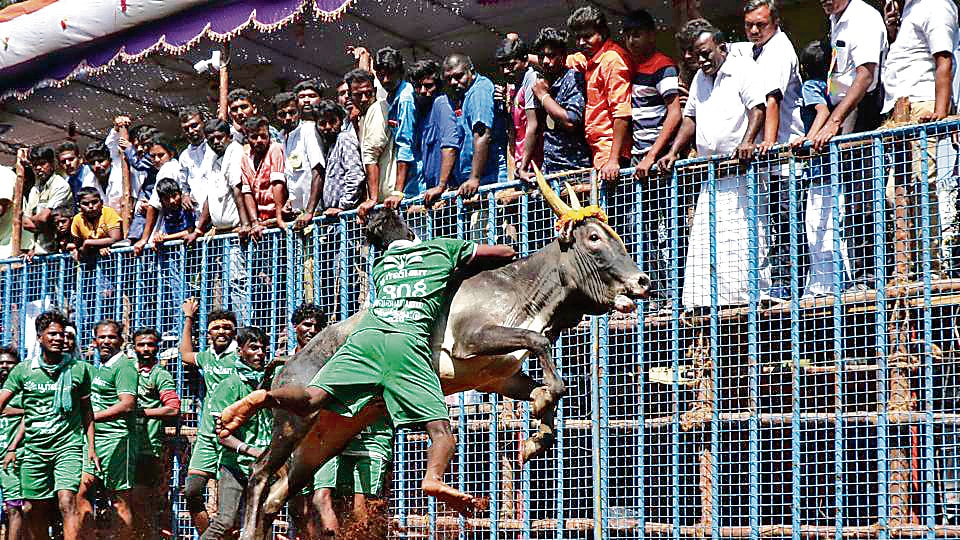
“Jallikattu”, also known as “eruthazhuvuthal”, is a bull-taming sport played in Tamil Nadu as part of the Pongal harvest festival.
With the Centre expected to open arguments in the matter on Thursday, a five-judge bench headed by justice KM Joseph told Solicitor General Tushar Mehta that it would like to examine the files as an argument was raised by the petitioners attacking the law on the sufficiency of material placed before the President.
The bench, also comprising justices Ajay Rastogi, Aniruddha Bose, Hrishikesh Roy and CT Ravikumar said, “An argument has been made (by petitioners challenging the state laws) whether all aspects were presented while seeking Presidential assent. You (Centre) will have the file with you. You should not have any objection in presenting it before us.”
The Court also asked Mehta to examine the files and to keep it ready before the hearing. The petitioners comprising mainly animal lover organizations and individuals had questioned the validity of the three state laws on multiple grounds alleging that it went against the constitutional guarantee of dignity of animals, the legislative intent under the Prevention of Cruelty to Animals (PCA) Act, 1960 and a 2014 judgment of the Supreme Court which held the law allowing the bull-taming sport of Jallikattu popular in Tamil Nadu to be unconstitutional.
On Wednesday, the bench, which usually closes proceedings by 4 pm extended its proceedings by another 90 minutes to complete the arguments made against the three laws. The petitioners, including People for Ethical Treatment of Animals (PETA) had challenged the Tamil Nadu Amendment Act 2017 by which state amendments were introduced to the Central Act of 1960 providing for bulls as “performing animals”.
Similar amendments were introduced by Karnataka and Maharashtra to provide for Kambala (buffalo race) and bullock cart race respectively.
Senior advocates Shyam Divan, V Giri and Anand Grover made legal submissions on behalf of the petitioners pointing out to the cruelty meted to the animals during the sport which was set aside by the top court in 2014 but reintroduced as “old wine in new bottle” with rules providing for safeguards which served as a “smokescreen”. Divan said, “There is a certain element of biological integrity, behaviour and mental elements associated with the bulls that never changes even if rules change. Compelling them to fight in this kind of an event even with all safeguards will still amount to cruelty.”
The bench sought to distinguish the kind of bulls used in Jallikattu to be different from the rest of their breed. “In jungles, bulls fight over cows. These bulls have been domesticated. They are specially reared. They are muscular and can withstand fight. This is part of a custom and tradition handed down for centuries. These bulls are trained for performing. It is not that those who rear them are antagonistic to bulls. They treat them with affection.”
The Court examined the rules put in place by the three state laws which brought radical changes to prevent cruelty to animals. With regard to Jallikattu, the participants were not allowed to pull the tail of the bull or block any of the entry, exit points. “Men can be playful with animals. They can be injured in the process. You can’t call it cruelty unless it touches a certain level. That is why this Court in 2014 stepped in and said that it (treatment to bulls in Jallikattu) was wrong. If the rules are now being violated, that cannot be a ground to set it aside.”
The bench further said that the Court while examining constitutional validity cannot go by ground realities but will test the scheme for what it provides for.
Giri told the Court that culture and heritage cannot be a ground for the state to seek exemption from the Parliamentary law provided by the 1960 Act. His point was furthered by Grover who said that there is doubt over what was presented before the President by the state governments. He said that the principle of dignity attached to animals is what the Court seeks to protect and this was upheld in the 2014 judgment which invoked Article 21 right which has dignity as one of the aspects to life and liberty.
The lawyers arguing against the Maharashtra law distanced from the argument that animals have fundamental rights but projected flaws in the state law for omitting the word “unnecessary pain” which reintroduced the element of cruelty.
On Tuesday, the bench had raised doubts on whether animals could claim fundamental rights when laws enacted by Parliament permit killing of animals or harm to be caused to them in specific situations.
It was in February 2018 the Supreme Court had referred the laws in question for consideration by a five-judge bench. The question that arose was whether the states in their attempt to preserve their culture and tradition of holding such sports could violate the Nagaraj judgment of 2014 and the protection against cruelty guaranteed by the 1960 Act. The Centre and the state governments will present arguments on Thursday.


