
 E-Paper





Follow the latest breaking news, major developments and agenda-setting stories from India and around the world with the newsdesk at Hindustan Times. Operating round the clock, the desk brings together experienced editors, reporters and correspondents to deliver fast, accurate and contextual reporting across subjects that influence public policy, governance, business, society and international affairs. The HT News Desk covers politics, elections, government policies, the economy, business and markets, science and technology, the environment, law and order, infrastructure, education, climate issues and geopolitics, while closely tracking developments across states, institutions and global capitals. The team also leads coverage of major breaking news events, policy announcements, court proceedings, natural disasters, public emergencies and significant international developments. Reports published by the newsdesk are based on information gathered from reporters on the ground, official statements, government agencies, court records, regulatory filings, recognised institutions and other authoritative sources. Stories undergo editorial scrutiny and verification processes to ensure accuracy, fairness and relevance, and are updated as events evolve and additional information becomes available. Whether covering a key political decision in New Delhi, an economic policy shift affecting millions, a landmark court ruling or a major global event, the HT News Desk aims to provide readers with reliable, fact-based journalism that delivers not only the latest developments but also the context and analysis needed to understand their wider implications.
Sikkim standoff: Indian Army ready for long haul in Dokalam, pitches tents, gets more supplies
Indian soldiers deployed in the disputed area have pitched in tents, and a steady line of supplies is being maintained for the soldiers at the site, official sources said.


The Indian Army is ready for a long haul in holding onto its position in Dokalam area near the Bhutan tri-junction, notwithstanding China ratcheting up rhetoric against India demanding pulling back of its troops.
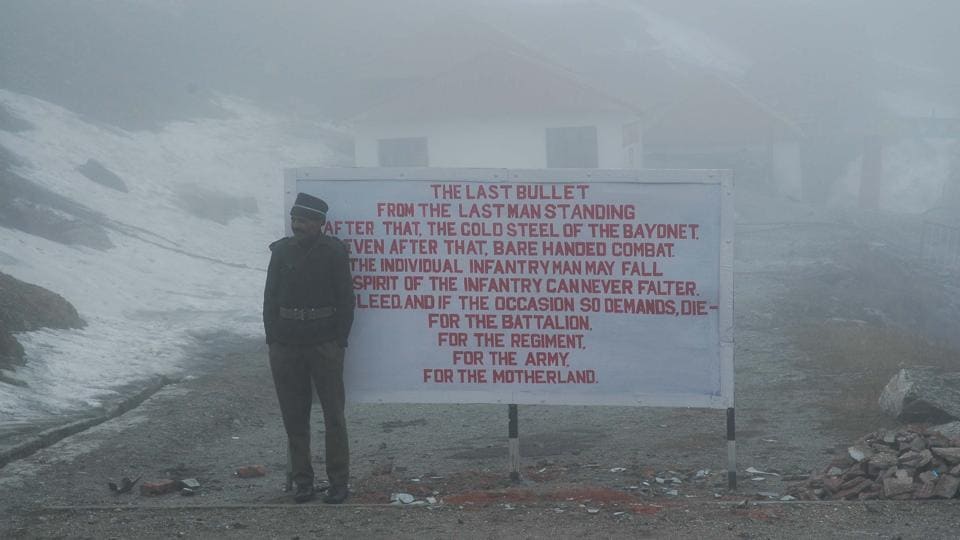
Indian soldiers deployed in the disputed area have pitched in tents, in an indication that they are unlikely to retreat unless there was reciprocity from China’s PLA personnel in ending the face-off at an altitude of around 10,000 feet in the Sikkim section.
A steady line of supplies is being maintained for the soldiers at the site, official sources said, signalling that Indian Army is not going to wilt under any pressure from China.
At the same time, they sounded confident of finding a diplomatic solution to the dispute, citing resolution of border skirmishes in the past through diplomacy.
Though China has been aggressively asserting that it was not ready for any “compromise” and that the “ball is in India’s court”, the view in the security establishment here is that there cannot be any unilateral approach in defusing the tension.
Both the countries had agreed to a mechanism in 2012 to resolve border flare ups through consultations at various levels.
The mechanism has not worked so far in the current case as the standoff near the Bhutan tri-junction, triggered by China’s attempt to build a road in the strategically important area, has dragged on for over three weeks.
New Delhi has already conveyed to China that such an action would represent a significant change of status quo with “serious” security implications for India. The road link could give China a major military advantage over India.
Doka La is the Indian name for the region which Bhutan recognises as Dokalam, while China claims it as part of its Donglang region.
China and Bhutan are engaged in talks over the resolution of the dispute in the area. India argues that since it is a tri-junction involving the three countries, it also has a say in the issue, specially in the backdrop of 2012 agreement between special representatives of the two countries, that have till now held 19 rounds of talks.
Bhutan has no diplomatic ties with China. As a close friend and neighbour, Bhutan enjoys diplomatic and military support from India.
Of the 3,488-km-long India-China border from Jammu and Kashmir to Arunachal Pradesh, a 220-km section falls in Sikkim.


