
Sign in

Step up anti-terror ops in Jammu and Kashmir: NSA Ajit Doval to forces

There is an intelligence alert about plans by the terror group Jaish-e-Mohammed to carry out simultaneous suicide attacks at army and paramiliary bases on Monday, May 11.

Updated on: May 10, 2020, 04:52:00 IST
Hindustan Times, New Delhi | By
Share
Share via
  • facebook
  • twitter
  • linkedin
  • whatsapp
Copy link
  • copy link

National Security Adviser Ajit Doval on Saturday carried out a complete operational review of the security situation in Jammu and Kashmir and told top army commanders and paramilitary forces to tighten the counter-infiltration grid along the Line of Control (LoC) with Pakistan and the counter-insurgency network in the Kashmir valley.
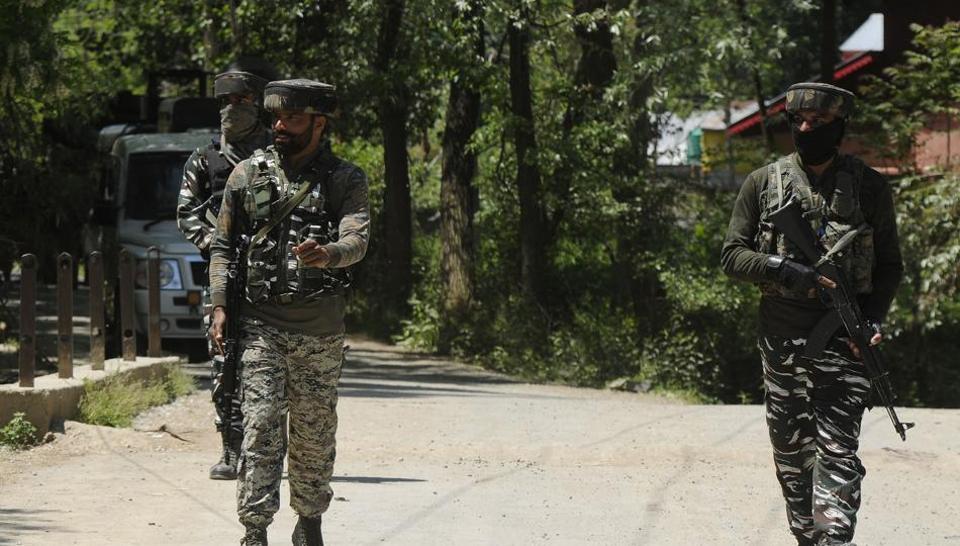
Security forces near the site of a gunfight in which Hizbul Mujahideen commander Riyaz Naikoo along with an associate were killed, in Beighpora area, Pulwama district, Jammu and Kashmir on Wednesday. (Waseem Andrabi/HT Photo)

The high-level meeting was convened against the backdrop of militant activity in north Kashmir’s Handwara, Baramulla and Sopore triangle that cost lives of six soldiers including, a colonel-rank officer. It is also in this region that the security forces eliminated a top Lashkar terrorist, Haider.

Then there is an intelligence alert about plans by the terror group Jaish-e-Mohammed to carry out simultaneous suicide attacks at army and paramiliary bases on Monday, May 11.

Top government officials told HT that the NSA also took note of the increased air activity by the Pakistan Air Force along India’s western border that coincided with Pakistan Prime Minister Imran Khan, and later the foreign office in Islamabad releasing statement that alleged India was looking for a “pretext for a false flag operation targeting Pakistan”.

Officials said there was consensus that the Imran Khan government’s effort to distance itself from the terrorists it supports was a pre-emptive move and indicated a renewed push from Pakistani terror launch pads over the next few weeks.

The meeting noted how Pakistan was funding outfits such as The Resistance Front or the JK Pir Panjal Peace Forum to claim that terrorism in the valley was indigenous and not sponsored by it. An official said, placing the Pakistan Air Force on high alert was also designed to further Imran Khan’s narrative that asks the international community to intervene lest there is a confrontation between the two nuclear-armed neighbours. The NSA also told officials to step up the engagement with terrorists in the Kashmir valley.

The five-hour-long meeting was attended by, among others, Army chief General Manoj Mukund Naravane, Intelligence Bureau director Arvinda Kumar, Research and Analysis Wing chief Samant Kumar Goel, Border Security Force director general SS Deswal and Central Reserve Police Force chief AK Maheshwari.

A senior counter-terror official told HT that the meeting analysed the infiltration routes used by terrorists from Pakistan and suggested tweaks at the ground level that could ensure that the terrorists were detected.

  • Shishir Gupta
    ABOUT THE AUTHOR
    Shishir Gupta

    Shishir Gupta is Executive Editor at Hindustan Times and one of India's top journalists covering national security, strategic affairs, foreign policy and geopolitics. Over the past three decades, he has extensively reported on India's military, diplomatic and security landscape, covering every major conflict and national security challenge, from the 1999 Kargil War and the 2020 East Ladakh standoff to Operation Sindoor in 2025. He has also covered major terror attacks, including the IC-814 hijacking, the 26/11 Mumbai attacks and the 2025 Pahalgam terror strike, along with numerous Pakistan-backed terrorist incidents in the Kashmir Valley and across India. He has reported on national and state elections for more than three decades. A recognised authority on strategic affairs, Gupta has covered India's nuclear programme since the Pokhran-II (Shakti series) tests in May 1998 and has written extensively on global nuclear issues, Indian diplomacy and the country's expanding global outreach. He has also reported widely on international conflicts and terrorism, with a special focus on the Indian subcontinent. Gupta has interviewed Prime Minister Narendra Modi more than four times, including Modi's first interview with the print media after becoming Prime Minister in May 2014. His other interviews include three with the Dalai Lama, as well as conversations with Benjamin Netanyahu, Amit Shah, Yogi Adityanath, S. Jaishankar, Nirmala Sitharaman and Piyush Goyal. He is the author of Indian Mujahideen: The Enemy Within (Hachette, 2011) and Himalayan Face-off: Chinese Assertion and Indian Riposte (Hachette, 2014). He was awarded the Chevening-Wolfson Joint Scholarship at Wolfson College, University of Cambridge, UK, in 1998 and participated in the International Visitor Leadership Program (IVLP) of the US State Department in 2006. He received the Ben Gurion Prize from Israel in 2011 and the K. Subrahmanyam Prize for Strategic Studies in 2015 from the Manohar Parrikar Institute for Defence Studies and Analyses (MP-IDSA). Since 2024, he has hosted Point Blank, Hindustan Times' weekly YouTube show on global geopolitics.Read More

Get the latest India News, breaking headlines and real-time updates from across the country. Stay informed about politics, government policies, crime, weather and major national developments.