
 E-Paper



Supreme Court notice to Centre, EC on plea over pre-poll freebies
“This is no doubt a serious issue. Budget for freebies is going above the regular budget. As the Supreme Court said before, this disturbs the level playing field,” the bench said.


Terming unrealistic poll promises and hand outs a “serious issue” that “disturbs the level-playing field”, the Supreme Court on Tuesday asked for explanations from the Union government and the Election Commission of India (ECI) on steps taken by them since the court’s 2013 judgment to regulate electoral promises and distribution of freebies by political parties using public funds.
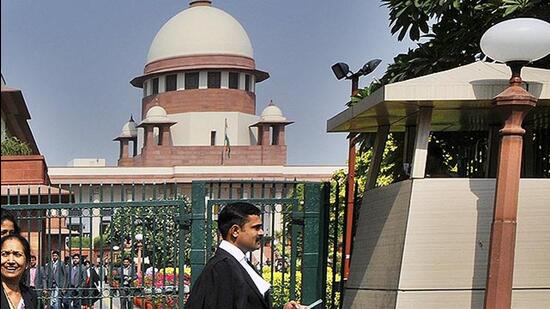
A bench, headed by Chief Justice of India NV Ramana, issued notices to the Centre and ECI on a public interest litigation filed by advocate Ashwini Kumar Upadhyay, who sought a direction for issuance of stringent guidelines to deregister errant political parties and seize their election symbols over offering “irrational freebies” ahead of polls.
“This is no doubt a serious issue. Budget for freebies is going above the regular budget. As the Supreme Court said before, this disturbs the level playing field,” observed the bench, which included justices AS Bopanna and Hima Kohli. Admitting Upadhyay’s petition, the court sought replies from the Centre and ECI within four weeks.
During the proceedings, senior counsel Vikas Singh, representing Upadhyay, contended that parties, even in debt-ridden states, were promising or distributing freebies to garner votes, creating an uneven playing field before the elections. Singh added that ECI had framed certain guidelines as per the court’s direction in 2013 judgment but that these were “toothless” .
“There are states such as Punjab where every individual has an average debt of more than ₹3 lakh with state owing more than ₹ 2.8 lakh crore in debt. Even there the political parties are promising freebies. Ultimately, who is suffering? Citizens are suffering. And every party is doing this,” argued Singh.
At this, the bench asked Singh to read out from the Supreme Court’s judgment in S Subramaniam Balaji vs Government of Tamil Nadu & Ors in July, 2013, in which the issue of election manifesto and freebies were dealt with.
After Singh read out a couple of relevant paragraphs from the 2013 judgment, the bench intervened to state that the court had then underscored the need to have a separate legislation “for governing the political parties in our democratic society” but it appeared that this has not been passed to date.
Striking a cautious note, the bench asked Singh: “Now, when there is no legislation, how do we manage it? Assuming we issue a notice and the EC will reply, but explain how we are going to control all this? You answer this as a question of law.”
“Within the limited scope, we directed the Election Commission to frame guidelines. But subsequently, they conducted only one meeting after our directions. They sought views from political parties and thereafter we do not know what happened,” added the bench.
Singh responded that Upadhyay’s petition is seeking curbs on freebies for future and therefore, the central government and ECI should be called upon to furnish explanations on the steps taken by them in the spirit of the 2013 judgment.
Accepting Singh’s submissions, the bench proceeded to issue notices to the Centre and ECI: “We want to have a legal debate on how to control this...for the time being, we will see what the Union government and the Election Commission have to say.”
In the 2013 judgment, the top court had said that distribution of freebies of any kind, undoubtedly, influences all people. “It shakes the root of free and fair elections to a large degree. The Election Commission through its counsel also conveyed the same feeling both in the affidavit and in the argument that the promise of such freebies at government cost disturbs the level playing field and vitiates the electoral process and thereby expressed willingness to implement any directions or decision of this Court in this regard,” that judgement said.
The court held in the 2013 judgement that promises in the election manifesto cannot be construed as “corrupt practice“ under the Representation of People Act or under any other prevailing law and hence, distribution of freebies can’t be stopped when the ruling party uses public funds for this purpose through passage of Appropriation Acts in state assembly.
At the same time, the court noted that there is no enactment that directly governs the contents of the election manifesto, and directed ECI to frame guidelines for the same in consultation with all the recognised political parties.
Upadhyay relied upon the 2013 judgment to complain that the promise or distribution of freebies from public funds before election unduly influences the voters, shakes the roots of free and fair elections, disturbs level playing field and vitiates the purity of election process.
The plea pointed out that ECI’s guidelines said that while there could be no objection to the promise of welfare measures in election manifestos, political parties should avoid making promises which are likely to vitiate the purity of the election process or exert undue influence on the voters in exercising their franchise.
“Arbitrary promises of irrational freebies violated the ECI’s mandate for free and fair elections, and distributing private goods-services, which were not for public purposes, from public funds clearly violated the Constitution,” added Upadhyay’s petition.
The fulcrum of democracy is the electoral process, said the petition, adding that if the integrity of electoral process is compromised then the notion of representation becomes vacuous.


