
 E-Paper



The long road to the runway
Even as the aviation sector soars, it is a test of patience for travellers reaching the airport due to unreliable buses, disjointed metro links, and costly cabs

 Prefer HTon Google


On a muggy July morning in Bengaluru, Anamika Mehra, a 32-year-old marketing executive, sat helplessly in a cab crawling through traffic on her way to Kempegowda International Airport. The dashboard clock showed 8:15am—only 45 minutes before her Delhi flight’s gates closed. What should have been a one-hour journey from Indiranagar had already taken over two hours. By the time Mehra reached the terminal, her flight had departed. “I had to pay a fortune for a new ticket,” she says. “With no Metro link to the airport and buses slowed by traffic, I spent ₹1,500 on a cab and still missed my flight.”
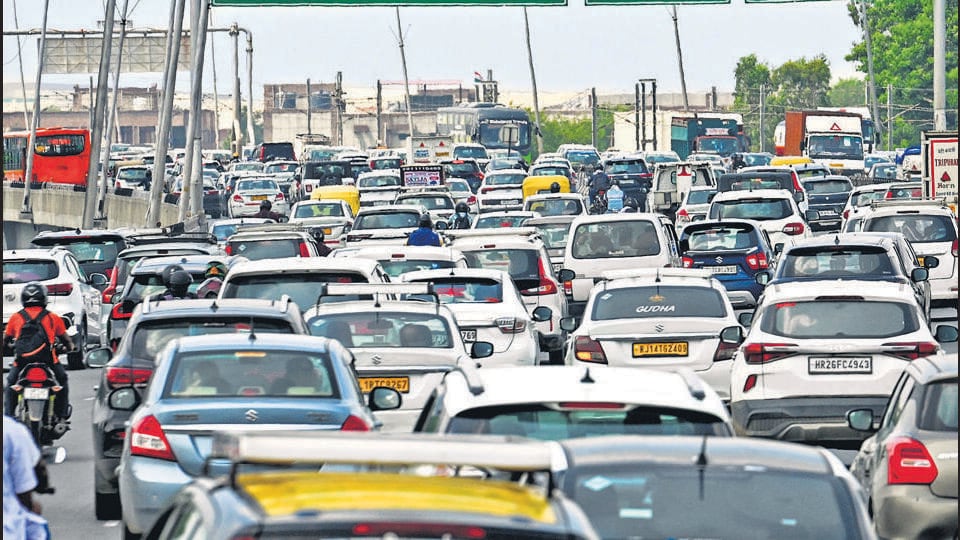
Mehra’s ordeal is far from rare. For most Indian travellers, reaching the airport is a test of patience due to unreliable buses, disjointed Metro links, and costly cabs. To avoid missing flights, many leave hours in advance, choking access roads and overcrowding terminals.
Ironically, this disconnect between cities and their airports continues even as India’s aviation sector soars. The number of airports has nearly doubled—from 74 in 2014 to 162 in 2025—with 50 more slated to open by 2030. New hubs like Jewar (Noida) and Navi Mumbai are opening this year, while domestic passenger traffic reached 174 million in 2024 and is projected to surpass 400 million by 2030.
“This is the paradox. We’re building world-class airports but forcing people to fight their way to reach them. It’s more than an inconvenience—it clogs terminals with early arrivals, worsens road congestion and causes missed flights,” says Suresh Babu, a Mumbai-based architect and urbanist.
“I’ve missed flights myself due to traffic, paying the price both financially and professionally. A study on daily missed flights because of this chaos would be revealing.”
Such a long journey
Globally, airport connectivity has long been an integral part of urban planning. In the 1920s, passengers reached London’s Croydon, and New York’s LaGuardia (opened in 1939) by horse-drawn carriages and early taxis like the Ford Model T and Morris Oxford. By the 1950s, London’s Routemaster buses carried passengers between the newly opened Heathrow and the city. Rail soon followed. The Piccadilly Line reached Heathrow in 1977, the Heathrow Express in 1998, and the Elizabeth Line in 2022.
Paris’s Orly Airport , opened in 1932, first depended on Renault taxis and Citroën buses, while Charles de Gaulle, opened in the 1970s, got RER rail service two years later and TGV connections in the mid-1990s. New York’s JFK, which began operations in the late 1940s, added the AirTrain in 2003—a delayed but important upgrade. From the start, these cities treated airports as transport hubs, seamlessly linked to their cores.
India’s story was different. Early airfields—Kolkata’s Dum Dum (1924), Mumbai’s Juhu (1928), and Delhi’s Palam (1930s)—relied on horse-drawn tongas and cycle rickshaws to move passengers and luggage. Colonial planners prioritised roads over urban rail, paving the way for car-dependent airport access.
After Independence, Hindustan Ambassador taxis and buses from Ashok Leyland and Tata became the standard, but they were slow, overcrowded, and poorly connected to city networks. Metro did not arrive until the 2000s, deepening this car dependence. Even as aviation surged after the 1990s liberalisation, airport connectivity failed to keep pace.

Patchy progress
Last week, Kolkata got its Metro connection to the airport with the inauguration of the Noapara–Jai Hind Bimanbandar Yellow Line, joining Delhi, Chennai and Mumbai in offering a Metro link. In Mumbai, the CSMIA–T2 Station on Metro Line 3 became operational in October 2024 and was linked to Terminal 2 via an overbridge last month. Mumbai’s airport station has seen low uptake, largely because of poor terminal integration. The long walk from the CSMIA–T2 station, even with the overbridge, frustrates travellers with luggage. Chennai’s Metro faces similar criticism, with passengers complaining of the station’s distance from the terminal.

Delhi fares better than other Indian cities in airport connectivity, with two Metro lines and shuttle bus services. The city has had Metro access for over a decade now—via the Airport Express Line to Terminal 3 since 2011 and the Magenta Line to Terminal 1 since 2018—and is seeing a steady rise in ridership. Footfalls at the T1 Metro station rose from 9,315 in all of 2023 to 12,747 in the first seven months of this year, while T3—considered India’s best-integrated terminal station—inched up from 27,441 last year to 27,737 in the same period. At this pace, footfalls at airport metro stations in the Capital are likely to almost double by the end of the year.
Bengaluru and Hyderabad still lack direct Metro links and depend on buses—BMTC’s Vayu Vajra in Bengaluru and TSRTC’s Pushpak in Hyderabad. But heavy traffic

means most travellers still prefer private cars and cabs. At Hyderabad’s Rajiv Gandhi International Airport alone, about 40,000 cars use the access road every day, while TSRTC operates only 40 airport buses, covering around 400 trips daily
Overall, airport connectivity in India remains patchy.
Experts call this the legacy of poor planning. “Integration of Metro or rail links should be planned at the beginning for any airport. It cannot be an afterthought, as it is at most Indian airports today,” says Shreya Gadepalli, a Chennai-based urban mobility expert.
Jagan Shah, urban expert and former director, the National Institute of Urban Affairs (NIUA), agrees. “Planning is the biggest challenge in our country. When airports are planned, real estate interests take over early—land use is decided and development prioritized without reserving adequate space for integrated transport infrastructure beyond roads. By the time the need for Metro or rail connections is recognized, entrenched growth patterns make it difficult to implement them effectively,” he says, adding, “To fix this, India needs a unified approach from the start—clear spatial, economic, and transport planning to ensure airports are seamlessly connected to the cities they serve.
Lessons from abroad
Globally, airport access is considered a core element of urban mobility. Singapore’s Changi Airport is seamlessly integrated into its Metro network, with trains every few minutes. Hong Kong’s Airport Express links the airport to Central in just 24 minutes and even offers in-town check-in. Cities like London and Paris provide multiple rail and Metro options that are often faster and more frequent than road transport.
“There is a fundamental flaw in how we plan infrastructure: piecemeal and in isolation,” says architect and urbanist Dikshu Kukreja. “Airports are treated as standalone mega-projects, disconnected from the cities they serve. Add to this compartmentalisation between municipal bodies, transport authorities, and airport operators, and what you get is lack of a cohesive vision. We build destinations rather than integrated nodes.”
He adds, “Airports are more than transit points—they shape the first and last impression of a city. When you land in Zurich or Seoul, getting to the city by rail, road, or even bicycle feels seamless—a part of the urban experience. Indian cities must recognise that the airport is not at the periphery of identity—they are a highly visible expression of it.”
Shreya Gadepalli notes that most Indian airports still prioritise private vehicles and taxis over public options. “Take Mumbai’s Terminal 2: the first zones you encounter after stepping out are for private cars and taxis, followed by private car parking, then auto-rickshaws. Buses and the Metro are pushed to the farthest point, with the Metro accessible only via a poorly maintained ramp that requires quite a long walk. In Hong Kong, you simply take an escalator down to the Airport Express.”
She adds, “Airports have plenty of signage for cabs and parking, but rarely for Metro or buses. Public transit, especially buses, should get first and easiest access.”
Buses vs trains: Can Regional Rapid Transit help?
Experts say the Regional Rapid Transit System (RRTS) could be a game-changer for airport access. The planned Delhi–Alwar and Delhi–Panipat lines will connect to IGI Airport via Sarai Kale Khan, with similar plans for the upcoming Jewar Airport. Bengaluru has also proposed a high-speed link to Mysuru that would serve both Kempegowda Airport and city commuters. But progress remains slow.
“RRTS can provide a faster, more efficient alternative to metros and buses by connecting airports with both major cities and nearby towns. The proposed Bengaluru–Mysuru corridor, for instance, should have a direct airport link,” says Goonmeet Singh Chauhan, a Delhi-based architect and urban designer.
Transport expert OP Agarwal, however, disagrees. “With a few exceptions like Bengaluru and Panjim, most Indian airports are not very far from city centres, so we don’t necessarily need fast rail connectivity like Paris’ RER,” he says.
“A better solution is a fleet of small, high-quality airport buses running every 15 minutes from about 40 key locations across a city like Delhi, with only three to four stops en-route. Air travellers are usually willing to pay a premium for reliability and comfort. Seoul runs such a system effectively,” he says.
He suggests creating dedicated lanes for airport buses a few kilometres ahead of the terminals to bypass bottlenecks. But Chauhan says, “Dedicated airport roads or lanes are neither practical nor democratic.”
Babu says multi-modal connectivity must be built into every new airport’s design, not added later. Existing Metro stations, he adds, should connect more smoothly to terminals with better walkways, travelators, and easy transfers. “Airports are civic gateways—a city’s calling card—and reaching them should be effortless.”


