
 E-Paper



This time is different: $100 oil more painful now than before for India
India faces a different impact because oil is priced in dollars and the exchange rate dynamics are at play.

 Prefer HTon Google


New Delhi: Crude oil prices breaching the $100 per barrel threshold is the equivalent of midflight turbulence to global economy. Business as usual has to be suspended and a prolonged phase can cause serious damage. For a country like India, which is heavily dependent on oil imports, crude crossing $100 per barrel today is not the same as when it breached this threshold earlier. To be sure, this is true for all countries to some extent and nominal crude prices, even in dollar terms, follow a different trajectory compared to real dollars. HT showed this in a chart on March 10.
However, for a country like India, the dynamics are vastly different because of the exchange rate dynamics at play. Crude oil is almost always paid for in dollars, unless the trade is with a country like Iran or Russia which is facing US economic sanctions. This means the actual prices for the Indian economy, in rupee terms, can be drastically different. A long-term analysis of the data shows this clearly.
Crude in March 2026 and March 2022 is not very different in $ terms, but ₹ price is very different
Also read: How will current oil shock impact Indian factories? | Number Theory
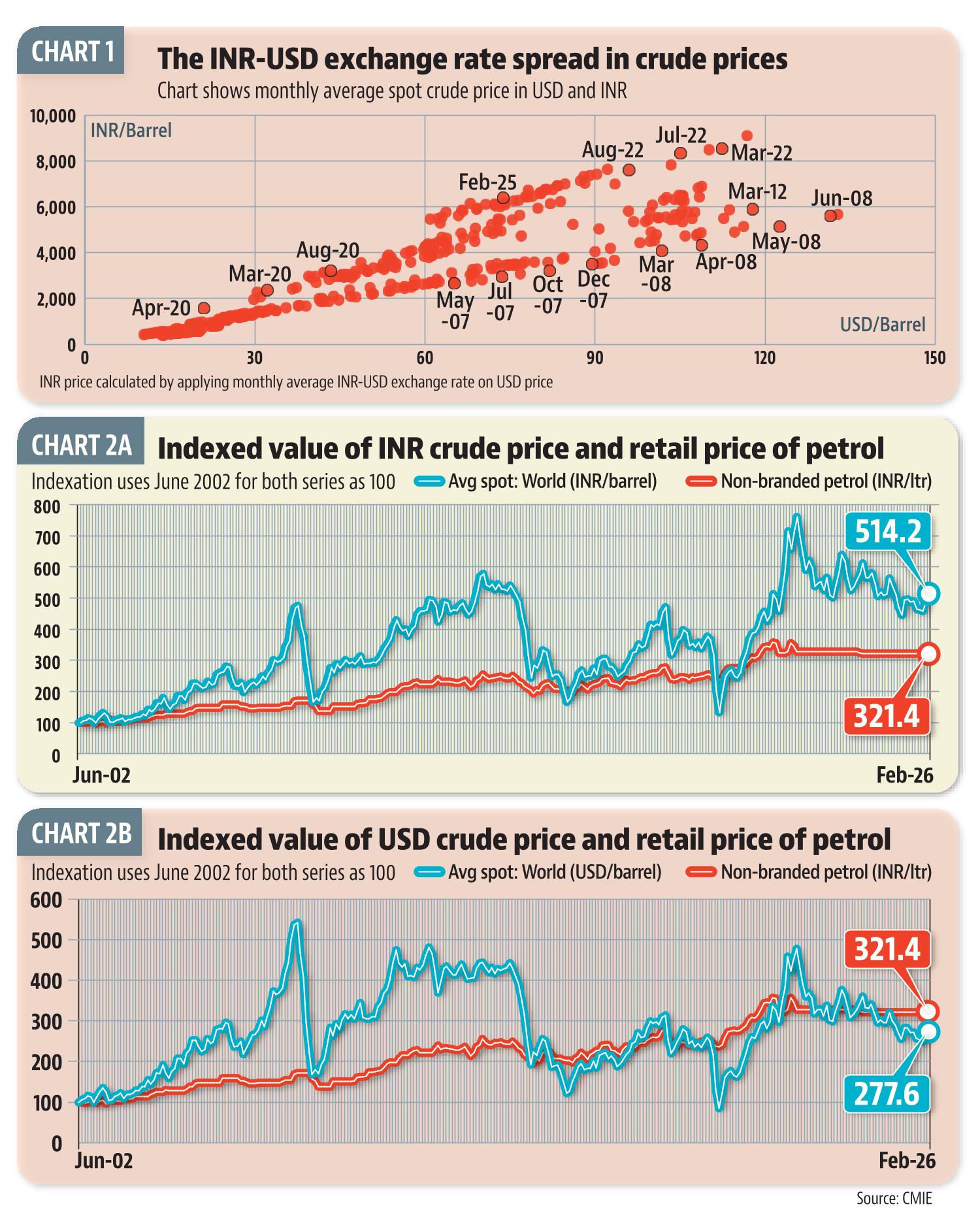
CMIE gives monthly and daily data for the price of crude oil in dollar terms. Brent crude was priced at $117.2 per barrel in March 2022. This is an important milestone because the Russia-Ukraine war started in February 2022. Brent crude’s price was $118.4 per barrel on March 20, 2026. This is a difference of just about 1% from the immediate aftermath of Ukraine war. However, the price in INR in these two periods varies by a much larger amount. This is because of the movement in the INR-USD exchange rate. This number was ₹76.24 per USD in March 2022, leading to a price of ₹8,935.3 per barrel for Brent crude. With the INR-USD exchange rate falling to ₹93.35 per USD on March 20, 2026, the domestic currency price of Brent crude was ₹11,052.64 per barrel; a difference of 23.6%. Such differences can also be seen in historical data. (See Chart 1)
This also means retail transmission of fuel prices looks different when compared with crude prices in $ or ₹ terms
Crude oil prices matter for government finances and refinery margins. For the retail economy what matters are things like the prices of petrol and diesel. How have the two moved in India? The picture looks very different if one compares the retail price of petrol (in Delhi) with crude prices in USD and INR terms. The former shows that retail prices had not come down as much as crude prices until the current war broke out while the latter shows that even though crude prices had been falling, retail prices were still lower in proportional terms as they had not increased. (See Chart 2A, 2B)
Also read: Indian Oil buys first Iranian LPG since 2018 as shortage worsens
A counter-cyclical fuel price policy by the current govt underlines the limits of price deregulation in India
Petrol and diesel prices were officially deregulated in 2010 and 2014.
In 2017, the government allowed a daily revision of prices. However, the situation changed when prices crashed during the Covid-19 pandemic and largely remained lower barring a brief spike during the initial phase of the Ukraine war. Retail prices have mostly been flat since a few months after the Ukraine war started in 2022.
Also read: 60 days of oil stock in place, no shortage: India clarifies amid US-Iran war
The government clearly made a fiscal windfall via this arrangement when prices were lower. It is no wonder that it is now having to take a fiscal hit by cutting excise duties on petrol-diesel when crude prices have increased and the rupee’s depreciation vis-à-vis the dollar is only adding to this pain. One can criticise or praise the government depending on one’s perspective. The larger lesson to be learnt is that fuel prices are too sensitive to be left completely deregulated for an economy like India for reasons of fiscal prudence and political anger over inflation.


