
 E-Paper



New tiger estimation report provides glimpse of hope for human-animal co-existence
The tiger estimation report shows that the flora and fauna in the tiger landscapes of Shivalik Hills and Gangetic Plains, Central India and Eastern Ghats and southern Western Ghats has improved despite people living there, leading to tigers colonising new forest area of about 24,509 square km between 2014 and 2018.


The recently released tiger estimation report, pegging India’s tiger population to 2,967 in 2018 - a 33% increase since 2014 - clearly shows tigers and humans can co-exist as long as the locals are incorporated in conservation schemes and people are convinced that tigers are their friends, not enemies. The report also presents a possible solution to the raging debate over people versus animals in the forests of India in the context of implementation of the watershed Forest Rights Act, 2005.
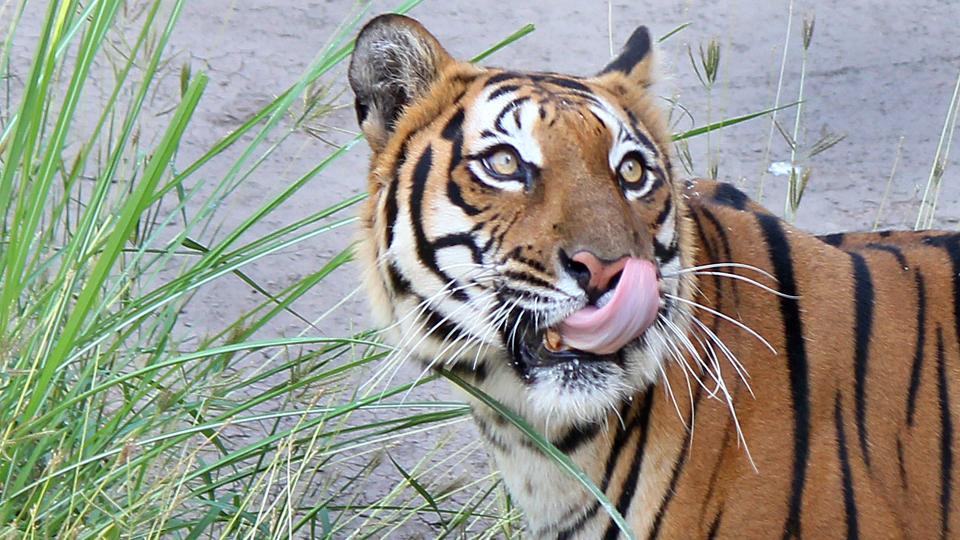
The tiger estimation report shows that the flora and fauna in the tiger landscapes of Shivalik Hills and Gangetic Plains, Central India and Eastern Ghats and southern Western Ghats has improved despite people living there, leading to tigers colonising new forest area of about 24,509 square km between 2014 and 2018.
Even though the tiger occupancy in 2018 was found to be stable in 88,985 square km - a marginal improvement since 2014 (88,558 square km) - the report reveals that tigers have migrated to newer areas clearly implying improvement in the forests and habitats where ecological protection focus is high.
The Wildlife Institute of India (WII), which drafted the report, reached this conclusion on the basis of the Forest Survey of India (FSE) report on health of the Indian forests. The FSI report, when matched with tiger landscapes, showed that the areas in which the tiger population increased the most showed significant improvement in the forest quality.
The forest survey report of 2017 marked an increase in very dense forest cover in Karnataka and Kerala that falls in the southern Western Ghats by 2,854 sq km between 2015 and 2017. That is the period of two forest surveys. Similarly, in Uttarakhand in Shivalik Hills and Gangetic Plains, the dense forest cover improved by 446 sq km and in Central India in Madhya Pradesh, it was up by 277 sq km.
The tiger estimation, done a year after the forest survey, showed that the big cat population in Karnataka had increased from 406 in 2014 to 524 in 2018; in Kerala from 136 to 190; in Uttarakhand from 340 to 442; and in Madhya Pradesh from 308 to 526 in the four years. About 40% of the increase in tiger population came from these four states.
The reality is that a large number of people live in these tiger landscapes. According to National Tiger Conservation Authority (NTCA) data submitted to Parliament in 2018, of the nearly 250 million people who live in forests in India, around 5,00,000 people still live in tiger reserves. Just 145 of 932 villages inside the reserves have been relocated between 2006 and 2018. Most of the people who still live inside the tiger reserves are tribals, the indigenous forest dependent communities considered as saviours of Indian forests.
In Rajasthan’s Sariska tiger home, which lost all its tigers in 2004 due to alleged poaching, around 20 villages are still inside the reserve. The Simlipal tiger reserve has about 60 villages of which half are in the buffer of the habitat. The Sabrimala temple in Kerala is in the Periyar tiger reserve, hampering its ecology. Similarly, people still live in the buffer zone of Kaziranga national park in Assam, which has the second highest density of tigers after Corbett National Park in Uttarakhand. Except a few tiger reserves, such as Ranthambore in Rajasthan and Corbett in Uttarakhand, people still live in most of the 50 notified tiger habitats in the country.
Former environment minister, Jairam Ramesh, had said in 2012 that moving people out of the reserve was an “almost impossible” task, considering the money and politics involved. The NTCA provides ₹10 lakh per family to the state forest departments for “voluntary” relocation of villagers outside the reserves but the departments have found it difficult to convince people to move out. So, if one goes by the NTCA figure of about 55,000 families still living inside the reserves, the government will need ₹5,500 crore to relocate all of them, a difficult task considering that the authority got ₹10 crore for 2019-20.
“We cannot force people to leave tiger reserves. The relocation exercise is totally voluntary,” Anu Nayak, member secretary of the National Tiger Conservation Authority (NTCA), told HT earlier this week.
Although the tigers are found in just 7% of India’s total forest cover of 7,08,273 sq km, there are enough indications from the estimation that both people and tigers can prosper. For instance, in Pilibhit in Uttar Pradesh, the tiger population has increased even in the areas having high human density. So is the case in several other tiger reserves. Nayak said about 30% of the 2,967 tigers in 2018 were found to be outside the reserves, which are not inviolate (free from human interference) and have good human population.
The data can become a basis to resolve the long pending issue of declaring critical tiger habitats under the Forest Rights Act 2005 through philosophy of co-existence. The law empowers the environment ministry to declare core critical areas in tiger reserve where rights of tribals and traditional forest dwellers will not be applicable in consultation with the tribal affairs ministry. Even after 14 years, the two ministries have failed to reach a consensus on how to declare critical tiger habitats.
The best way forward is for the two ministries to sit together and work out a plan for the coexistence of tigers and humans, which had been a reality in India for centuries. Wildlife activists need to accept the fact that removing people out of tiger habitats was neither politically nor economically feasible but their coexistence is a real possibility.


