
 E-Paper



Tiger spotted in Chhattisgarh’s Dantewada; 10 villages alerted: Officials
The recurring presence of tigers has also raised questions about the impact of mining activities in the Bailadila region

 Prefer HTon Google


A tiger was spotted on Saturday on a road in Faraspal area near Masodi village in Chhattisgarh’s Dantewada district, prompting the forest department to alert residents of around 10 villages spread across nearly 20 square kilometres and intensify surveillance in the area, officials said on Tuesday.
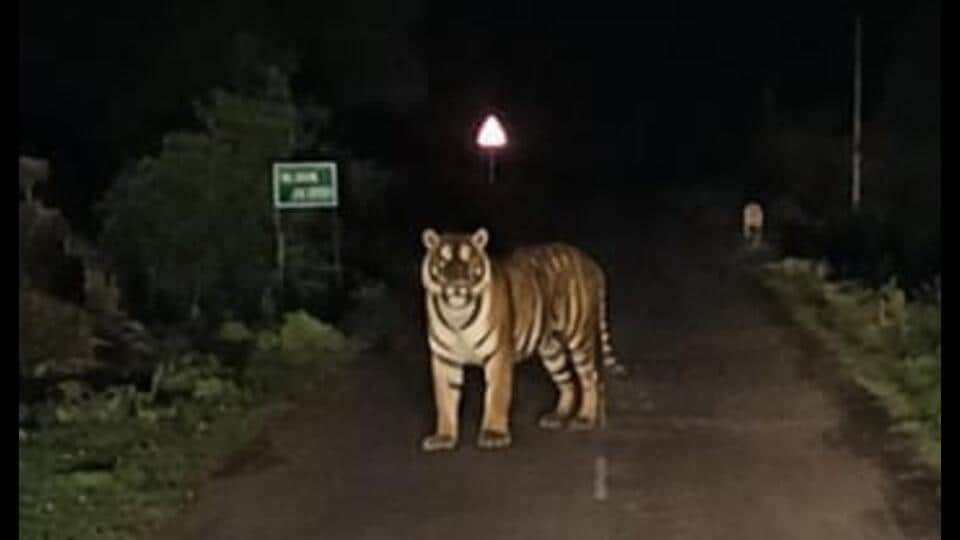
On Saturday, truck driver Santosh Kumar Sethia spotted the tiger and clicked photographs on his mobile phone.
Dantewada DFO Ranganath Ramakrishna said village announcements had been made in the affected area, urging people not to venture into the forests during the early morning and late evening hours.
Four camera traps have been installed in the forest where the tiger was last seen, but no images of the animal have been captured over the past two days, he said.
“There has been no report of the tiger killing cattle or any other animals so far. If it had made a kill, it would have been easier for us to locate it,” Ramakrishna said.
“It is possible that the tiger has moved ahead. However, monitoring its movements has become difficult because of the rain, as pugmarks are quickly washed away,” he added.
The overflowing Dankini river could also push the tiger back towards the area, the DFO said.
Also Read:Andhra intensifies search for elusive royal Bengal tiger ‘Explorer’, livestock attacks
The sighting comes amid a pattern of tiger movement in the Bailadila region.
According to the forest department, tigers have been spotted in the area over the past three to five years. A tiger was sighted in the region in March this year and had killed three cattle.
Forest officials, however, maintain that Dantewada is not a permanent tiger habitat. Ramakrishna said three factors were crucial for a tiger to establish a permanent territory: adequate prey, limited human disturbance and suitable habitat.
“Bailadila does not have sufficient prey density for a tiger to remain permanently in the area,” he said.
He explained that a tiger’s territory can be as small as around one square kilometre where prey density is high, but can expand to nearly 100 square kilometres when prey is scarce.
“Tigers generally avoid humans. Humans are not part of their food chain, so they prefer to stay away from villages and human settlements,” he added.
The recurring presence of tigers has also raised questions about the impact of mining activities in the Bailadila region, particularly as new mining operations have begun close to areas considered suitable for the big cats.
Tigers have been spotted between Pandewar and Bhansi over the past three to five years. Earlier this year, forest officials recovered tiger and leopard skins from the area, and 16 people were arrested in connection with the case.
Mining activity has recently started at Deposit-4 near Bhansi, around four kilometres from Raja Bangla, considered one of the most suitable areas for tigers in the region.
The Deposit-4 mining lease has been granted to NMDC-CMDC Limited (NCL), a joint venture between NMDC Limited and Chhattisgarh Mineral Development Corporation, with NMDC holding a 51% stake and CMDC 49%. The project covers 646.596 hectares.
In the Pandewar hills, Rungta has been granted a lease covering 825 hectares at Deposit-1C.
The developments have raised concerns over whether mining projects could affect tiger habitat and movement corridors.
Ramakrishna said Chandrapur in Maharashtra is an example of tigers continuing to survive despite extensive mining and industrial activity.
“Chandrapur has thermal power plants and large-scale mining activities, yet tigers continue to be present there. Tigers were there before mining began, and they are still there. Their movement has also been recorded around mining areas,” he said.
Dantewada has around 1,100 square kilometres of forest area, while current mining activity covers about 20 square kilometres, he said.
“Given the limited area under mining, it is unlikely to have a major impact on tiger movement. Tigers generally adapt to changing circumstances and alter their routes,” Ramakrishna said.
The DFO said the movement of young tigers from neighbouring landscapes could also explain their presence in Dantewada.
With tiger numbers increasing in Maharashtra’s Tadoba landscape, some young tigers venture out in search of new territories and reach the Indravati Tiger Reserve and the adjoining Bailadila hills, he said.
“Most of these are young tigers, around two to two-and-a-half years old, which leave their natal territories in search of new areas. In some cases, they can travel long distances in search of a mate,” Ramakrishna said.
The tiger, an apex predator, plays an important role in maintaining the balance of the forest ecosystem. However, the lack of adequate prey in Dantewada means that tigers entering the region generally do not stay for long and keep moving in search of food, he said.
Ramakrishna added that the forest department conducts intensive patrolling between February and June every year, when several cases of wildlife hunting are detected. “Because the tiger population here is low, the impact of hunting on tiger numbers remains limited. But hunting reduces the prey available to tigers,” he said.
-kW0H-U20214218012MgB-250x250%40HT-Web.jpg)


