E-Paper



Two weeks after big blowout in Assam, gas well catches fire
As the gas well in Assam caught fire, residents staged a protest close to the site and blamed Oil India Limited (OIL) for failing to control the blowout for two weeks now.


A gas well at Baghjan in Assam’s Tinsukia district caught fire on Tuesday and triggered protests from the residents of the area even as chief minister Sarbananda Sonowal assured them of their safety and said he has spoken to Centre for all possible assistance. The well caught fire as experts were trying to control the blowout, or leakage of gas and condensate, from it since May 27.
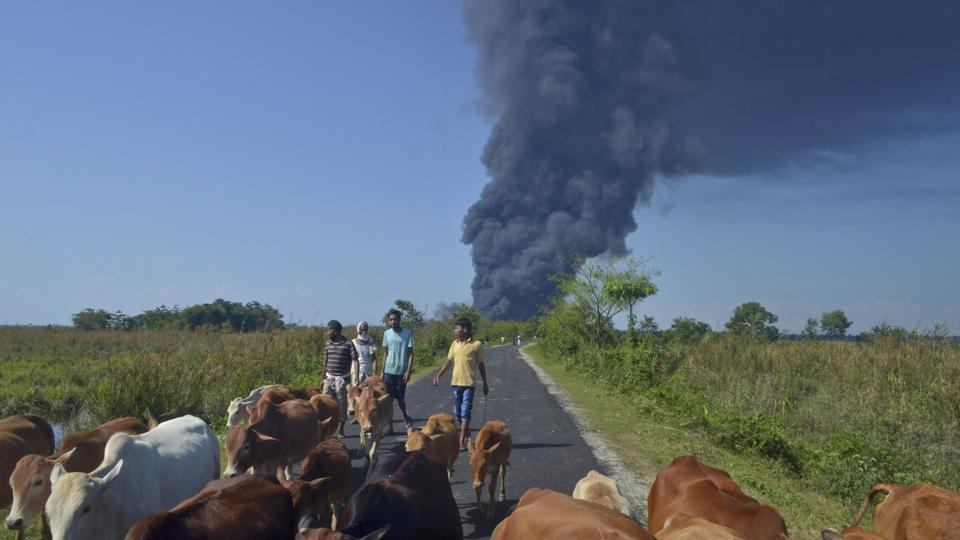
The blowout had prompted the evacuation of nearly 2,000 people living near the well to four relief camps.
Plumes of smoke emanating from the well could be seen kilometers away from the site near the Dibru Saikhowa National Park and the eco-sensitive Maguri Mottapung wetland, which are home to endangered hoolock gibbons and Gangetic dolphins.
The residents staged a protest close to the site and blamed Oil India Limited (OIL) for failing to control the blowout for two weeks. “We have been living in relief camps for two weeks now with the hope that the blowout would be controlled. But the fire has damaged several houses and hopes of any early solution. The night sky is lighted up by the fire and the air is filled with smoke,” said Madhab Moran, a resident of Baghjan.
OIL has asked the state government to control the situation so that experts and officials can reach the site to control the fire and the blowout. Three experts from Singapore firm Alert Disaster Control arrived in Assam to plug the leak on Monday.
“The fire broke out at 1:40 pm. The reason for the outbreak is not ascertained yet. Apart from a fireman of the Oil and Natural Gas Commission, who sustained a minor injury, no one else has been injured,” said OIL’s senior manager (corporate communications) Jayant Bormudoi. “The experts were not present at the site when the fire broke out. They were at meetings at an OIL office in Duliajan. There is no immediate threat to residents of the area, who have already been shifted beyond a radius of 1.5 km from the well.”
An OIL statement said fire tenders have been pressed into service to control the fire. “The current situation would be brought under control by the experts,” it said.
The statement said several options for plugging the blowout were discussed and it was decided to use the capping stack guide rail system, which will involve a large prefabricated device to seal off the well.
Sonowal said instructions have been issued to district officials to ensure the safety of the residents. “Police, military, paramilitary forces, and NDRF [National Disaster Response Force] are present at the spot,” he said. “I have apprised Union petroleum minister Dharmendra Pradhan about the incident and asked him to take steps to contain the fire and the blowout. The Indian Air Force can also play a role in controlling the fire and I have asked defence minister Rajnath Singh about it.”
Sonowal asked residents of the area and Tinsukia town, 9 km away, to not panic and assured all help from the government.
The blowout on May 27 was reported while work was underway to produce gas from a new oil and gas bearing reservoir at a depth of 3729 metres. A blowout means an uncontrolled release of crude oil or gas from a well when pressure control systems fail.
HT on June 3 reported the blowout was causing extensive damage to biodiversity and wildlife in the region.
“Release of particulate matter and the fire will affect Dibru Saikhowa National Park. But the damage to Maguri Mottapung wetland will be immense. If this continues for another four weeks, humans will also not remain unaffected by the pollution. Despite a history of over 100 years of oil and gas exploration in the area, it is surprising we do not have the experts and equipment to deal with such an emergency,” said environmentalist Raj Phukan, who is a member of the International Union for Conservation of Nature.