E-Paper



Uniform Civil Code: Will it work for India? Arguments in favour and against
The UCC is a proposal to “formulate and implement personal laws of the citizens which will be applicable to every Indian irrespective caste, religion and sexual orientation.”

 Prefer HTon Google


After a controversial private member's Bill seeking a panel on Uniform Civil Code (UCC) was introduced in Rajya Sabha on Friday, the Upper House swirled into chaos following the Opposition's protest. Much political buzz has been around establishing a UCC in India as the ruling Bharatiya Janata Party keeps pushing its “necessary” implementation while the Opposition has repeatedly criticised the bill, alleging its implementation would damage the secular fabric of our country.
What is Uniform Civil Code?
Article 44, part 4 of the Indian constitution reads “The State shall endeavour to secure for the citizens a uniform civil code throughout the territory of India”. The UCC is a proposal to “formulate and implement personal laws of the citizens which will be applicable to every Indian irrespective caste, religion and sexual orientation.” Under it, all personal matters such as marriage, divorce, adoption, inheritance, and succession will be dealt with uniformly for all persons.
Also Read | Uniform Civil Code being studied for implementation in Haryana: Anil Vij
Arguments in favour
The Centre believes the personal laws based on religion are an “affront to the nation’s unity” but adds that the UCC will ensure the integration of India by bringing different communities on a common platform. However, it has maintained that only elected representatives and the legislature will decide whether the country should have a UCC, rather than involving a court in it.
Several BJP-ruled states have announced setting up committees to implement the UCC. Karnataka chief minister Bommai had said UCC can make people’s “welfare possible and bring equality”. Uttarakhand CM, announcing the committee on the same said it was being done “to provide uniformity (in law) to all religious communities and to preserve the culture of Devbhoomi”.
Also Read | 'Walking with Swara Bhasker...': Narottam Mishra asks Congress to clarify stand on Uniform Civil Code
In November last year, the Allahabad High Court also termed UCC as a “necessity” and said it was “mandatorily required today”, as per the news portal LiveLaw. The court was hearing a batch of petitions moved by interfaith couples seeking protection, on which the court noted the importance of a “single-family code” to protect interfaith couples from being “hounded as criminals”.
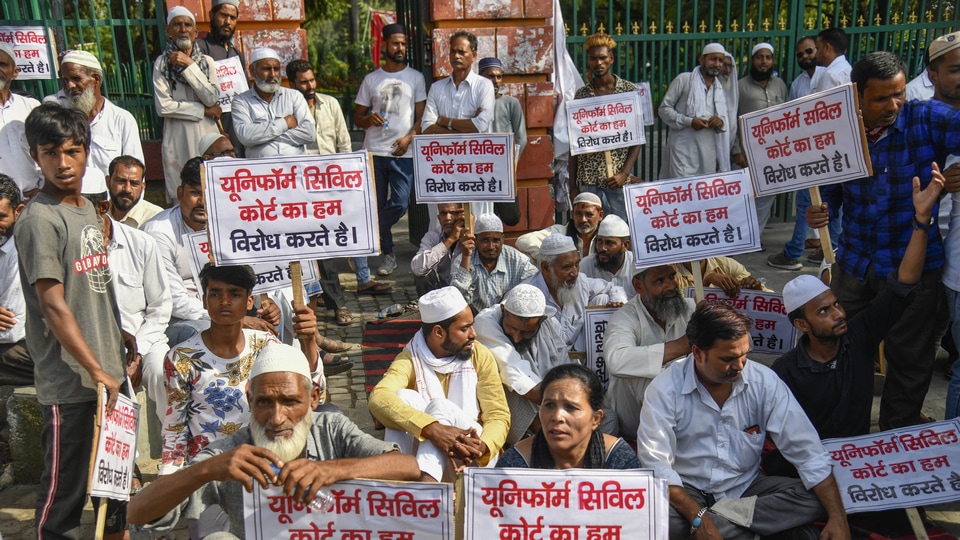
Why the protest?
Critics term the code as “anti-minority”. The Opposition parties believe a law like UCC goes against the “values of unity in diversity” prevalent in India. Congress leader and advocate Salman Khurshid had said on the code that it is yet to be determined whether it “affects human rights or not”. Certain social groups are of the view that a potential UCC could affect their customs and religious practices.
In 2018, the law commission examined the code and deemed it “unnecessary” and “undesirable”. Stating that the issue of UCC is vast and that “its potential repercussions are untested in India,” the panel headed by retired Supreme Court judge BS Chauhan said the existence of difference does not imply discrimination but is indicative of a robust democracy”. The panel in its report said there was rather a need to “deal with laws that discriminate between men and women”.
(With bureau inputs)