
 E-Paper



Budget 2025: What's cheaper and what's costlier
Budget 2025: This is the second full budget of the Modi 3.0 government, which returned to power at the Centre in the 2024 Lok Sabha elections.

 Prefer HTon Google


Budget 2025 cheaper and costlier list: Finance minister Nirmala Sitharaman presented her eighth consecutive Union Budget for the fiscal year 2025-2026. Here are the items that have become cheaper and costlier for consumers.
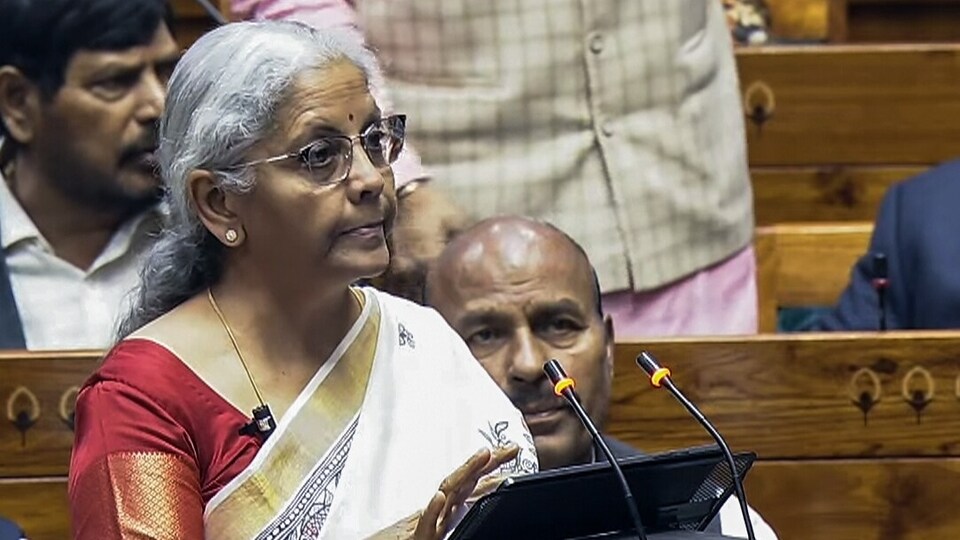
This is the second full budget of the Modi 3.0 government, which returned to power at the Centre in the 2024 Lok Sabha elections. This year's budget focuses on 10 broad areas, starting with agriculture, manufacturing, employment, MSMEs, uplifting rural areas, innovation.
"This budget aims to work on transformative reforms," Sitharaman said in her budget speech.
Follow Budget 2025 Live Updates
What's cheaper, what's costlier: At a glance
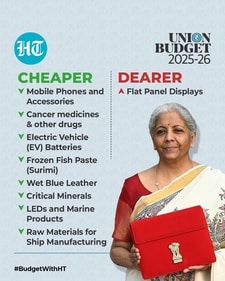
Items that got cheaper
- As many as 36 drugs for cancer, rare diseases will also be exempted from Basic Customs Duty.
- Government proposed to exempt Basic Custom Duty on 37 more medicines.
- Basic Customs Duty to be reduced to 5 per cent from 30 per cent on fish pasteurii.
- Basic Customs Duty on fish hydrolysate for manufacture of aquatic feed reduced from 15 per cent to 5 per cent.
- Other chemical compounds containing pyrimidine ring or piperazine ring's Basic Customs Duty reduced from 10 per cent to 7.5 per cent.
- Basic Customs Duty on synthetic flavouring essences and mixtures of odoriferous substances of a kind used in food or drink industries reduced to 20 per cent from 100 per cent.
- Centre proposes to fully exempt cobalt product, LED, zinc, lithium-ion battery scrap and 12 critical minerals from Basic Customs Duty.
- Basic Customs Duty on Platinum findings have also been reduced from 25 per cent to 6.4 per cent.
- Basic Customs Duty exempted on raw materials for manufacturing ships for another 10 years.
ALSO READ | Budget 2025: Modi govt's big income tax relief to middle class| Key takeaways
- The Centre also announced scheme to further promote handicraft exports.
- The government will fully exempt wet blue leather from Basic Customs Duty.
- Raw materials used for manufacture of wired headset, microphone and receiver, USB cable, etc., will be exempted from Basic Customs Duty.
- The duty on ethernet switches carrier-grade has been reduced from 20 per cent to 10 per cent.
- Motorcycles with an engine capacity not exceeding 1600 CC will have now Basic Customs Duty of 40 per cent instead of the current 50 per cent.
- Bikes with engine capacity of 1600 CC and above will have reduced Basic Customs Duty of 30 per cent from 50 per cent.
- Export duty on crust leather (hides and skins) reduced from 20 per cent to zero per cent.
Items that got costlier
- Basic Customs Duty on knitted fabrics covered under specified tariff items will increase from 10/20 per cent to 20 or ₹115 per kg, whichever is higher.
- The government proposed to increase Basic Customs Duty on interactive flat panel display to 20 per cent from 10 per cent. This, the finance minister said, is aimed at rectifying the inverted duty structure.
Additionally, the finance minister proposed a time limit for provisional assessment fixed at two years.
Union Budget 2024
During last year's Union Budget, the finance minister had announced measures resulting in the reduction of mobile phone, gold, silver, and copper prices.
Three cancer treatment medicines were also exempted from the Basic Customs Duty.
The central government, in 2024, had proposed rise in customs duty on non-biodegradable plastics to 25 percent. Basic customs duty on specified telecom equipment also increased from 10 per cent to 15 per cent.


