
 E-Paper



Vaccines to data: India made push on issues key to developing countries
At the summit held in Rome during October 30-31, the grouping of the world’s 20 largest economies was focused on data free flow with trust and cross-border data flows


India made a strong push on key issues that are important to developing countries, including data, vaccines and climate change, while shaping the outcomes of the G20 Summit.
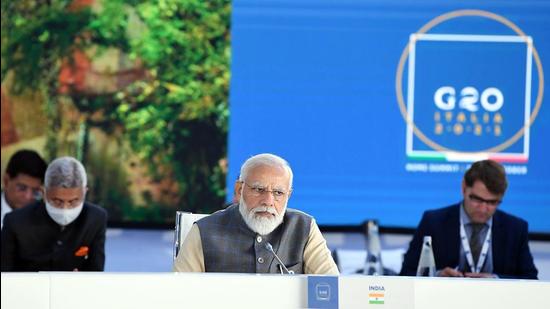
At the summit held in Rome during October 30-31, the grouping of the world’s 20 largest economies was focused on data free flow with trust and cross-border data flows. India brought the issue of data for development into the Rome Declaration, issued at the end of the summit, as an important point for developing countries, people familiar with the matter said on condition of anonymity.
“We acknowledge the importance of data free flow with trust and cross-border data flows. We reaffirm the role of data for development. We will continue to work on addressing challenges such as those related to privacy, data protection, security and intellectual property rights, in accordance with the relevant applicable legal frameworks,” the Rome Declaration said.
It added that the G20 states will push for common understanding and work to identify “commonalities, complementarities and elements of convergence between existing regulatory approaches and instruments” to enable the flow of data with trust to foster future interoperability.
In the field of climate action, India pushed for the inclusion of “critical enablers”, such as sustainable and responsible consumption and production and provision of finance and technology for climate action, into the Rome Declaration. These critical enablers are seen as key to achieving the climate goals, first decided under the Paris Accord, by developing countries that need more finance and green technologies, the people cited above said.
Prime Minister Narendra Modi also made a personal push by highlighting the need for sustainable lifestyles, which found resonance in the Rome Declaration.
On the issue of phasing out coal as part of efforts to cut greenhouse gas emissions, India’s suggestion of not financing unabated coal-powered plants, rather than phasing out coal completely, was accepted, the people said.
Unabated coal power generation refers to the use of coal that is not mitigated with technologies to reduce CO2 emissions, such as “carbon capture utilisation and storage”.
In the field of Covid-19 vaccines and post-pandemic recovery, India highlighted the need to optimise the processes and procedures of the World Health Organization (WHO) for vaccine approval and emergency use authorisation, and this was endorsed by the G20 leaders.
“This will strengthen WHO so that it can recognise vaccines faster,” one of the people cited above said.
India’s call to work on a common framework for accepting vaccine certificates for the reopening of international travel was also included in the Rome Declaration.
The declaration noted that post-pandemic recovery “remains highly divergent across and within countries, and exposed to downside risks, in particular the possible spread of new variants of Covid-19 and uneven vaccination paces”.
G20 leaders also agreed on India’s push for declaring Covid-19 immunisation as a global public good.
Modi’s suggestion of a global minimum 15% corporation tax rate, originally made at the 2014 G20 Summit, found acceptance from the grouping’s leaders.


