
 E-Paper



Varanasi court gives nod for ASI survey of Gyanvapi mosque
The area under seal is where Hindus insist a Shivling has been found, while Muslims claim it is part of a fountain

 Prefer HTon Google


The Varanasi district court on Friday ordered an extensive survey of the Gyanvapi Masjid by the Archaeological Survey of India (ASI) to ascertain whether the mosque was built over a pre-existing Hindu temple, holding that the scientific investigation is “necessary” for the “true facts” to come out.
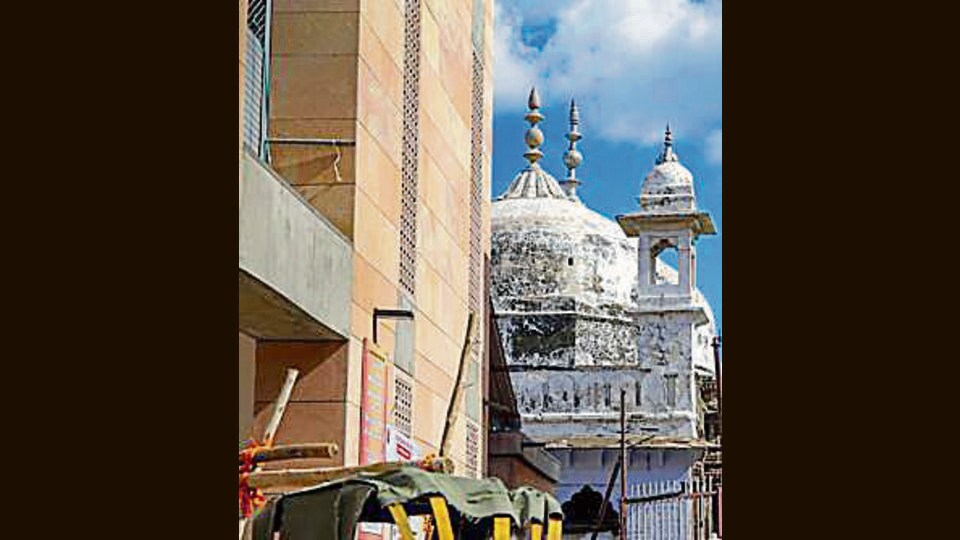
Allowing an application by four Hindu women plaintiffs, district judge Ajaya Krishna Vishvesha directed ASI to conduct a comprehensive survey, using dating, excavation and ground penetrating radar (GPR) techniques, of the plot where the mosque stands, next to the Kashi Vishwanath Temple.
Also Read | How Gyanvapi battle may set template for places of worship cases
The court, however, ordered excluding the section which has remained sealed since the Supreme Court order in May 2022. The area under seal is where Hindus insist a Shivling has been found, while Muslims claim it is part of a fountain.
“The director of ASI is directed to conduct a detailed scientific investigation by using GPR Survey, excavation, dating method and other modern techniques of the present structure (mosque) to find out as to whether same has been constructed over a pre-existing structure of a Hindu temple,” stated the court order, seeking a report from ASI up to August 4 when the matter will be taken up next.
Dating is a method of calculating the age of very old objects while a GPR survey is a method of gathering data about what’s below the ground using ground-penetrating radar technology that sends electromagnetic energy signals into the subsurface.
The order directed ASI to carry out GPR survey under the three domes of the mosque (where the plaintiffs claim there are remains of the pinnacle of a temple) and beneath the western wall (where the Hindu shrine of Shringar Gauri exists).
Also Read | Shringar Gauri-Gyanvapi case: Bhadri ex-royal meets plaintiff, assures support to legal battle
“The director of ASI is also directed to conduct GPR survey beneath the ground of all the cellars and conduct excavation, if required. The director of ASI is also directed to conduct dating exercise of the pillars and plinth of the building to find out the age and the nature of construction,” it added.
Permitting ASI to carry out scientific investigation of all the artefacts found in the mosque to find out their age and nature, the court further directed ASI to study all objects of historical and religious importance existing in different parts of the building and also beneath the structure which may be found during excavation.
“The director of ASI is also directed to conduct GPR survey, excavation wherever required, dating exercise and other scientific methods for determining the age and nature of construction existing at the site in question,” said the court, adding that ASI must ensure that there should be no damage to the structure standing on the disputed land and that it remains intact and unharmed.
One of the lawyers for the mosque management committee, Raees Ahmad Ansari said that they will challenge the order in a higher court.
The court order came on two applications moved by four of the five Hindu plaintiffs who filed a suit in August 2021, demanding the right of unhindered worship at the Maa Shringar Gauri Sthal, located inside the complex that houses idols of Hindu gods. Rekha Pathak, Manju Vyas, Sita Sahu, and Lakshmi Devi filed the application for the survey. Their pleas were argued by advocates Hari Shankar Jain, Vishnu Jain, Sudhir Tripathi and Subhash Nandan Chaturvedi.
The mosque management committee, in its reply, refuted that the mosque was built over a temple, maintaining the structure at the spot was always a mosque. Represented through advocates Ansari and Ekhlaq Ahmad, the management committee opposed the survey, saying such an exercise cannot be ordered to collect evidence. It was also argued that a survey by an advocate commissioner was previously conducted in April 2022 and until the validity of that survey is not decided, no new survey can be ordered.
But the district judge shot down the mosque management committee’s objections, noting the spot inspection conducted in April 2022 is entirely different from a scientific survey by ASI, which has all the modern techniques and wherewithal to ascertain the age and nature of construction at the disputed site.
“In my view, if ASI will be directed to hold survey and scientific investigation at the property in question and submit report then it will help in just and proper disposal of the case and true facts will come before this court. I am also of the view that objections, filed by defendant no.4 (mosque management committee) are unfounded and without any substance,” held the court.
The mosque management committee had earlier sought to get the case thrown out under Order VII Rule 11 of the Civil Procedure Code (CPC), arguing the suit by the Hindu plaintiffs was barred by the 1991 Places of Worship Act. The Act locks the position or “religious identity” of any place of worship as it existed on August 15, 1947.
But in last September, the Varanasi district judge dismissed the committee’s application. This judgment was upheld by the Allahabad high court in May, and the committee’s appeal is now pending before the Supreme Court.
On Friday, the Varanasi court pointed out that the Supreme Court did not stay the proceedings before it even as the Allahabad high court order for a scientific survey to determine the age of a structure inside Varanasi’s Gyanvapi mosque complex that Hindus insist is a Shivling, and Muslims say is part of a fountain, was stayed. Therefore, the judge held, the Supreme Court orders on protecting a specific section inside the mosque complex or staying the scientific survey of a structure had no bearing on the application being decided by him.
“Scientific investigation by ASI seems to be necessary in this case so that true facts relating to this case can come before the court and this court can arrive at a just and reasonable conclusion,” the order held.
Advocate Rajesh Mishra, state government’s special counsel for the Gyanvapi case, said: “The Varanasi district court allowed the application for survey in the Gyanvapi Complex’s barricaded area, excluding its barricaded area, by ASI.”
The district judge is currently trying eight suits claiming the existence of idols of Hindu deities inside the Gyanvapi mosque located next to the Kashi Vishwanath Temple. While the first one to be filed by the five HIndu women asked for a right to worship Hindu deities inside the mosque complex, six others have pressed for a claim over title of the land where the Gyanvapi Masjid stands.


